

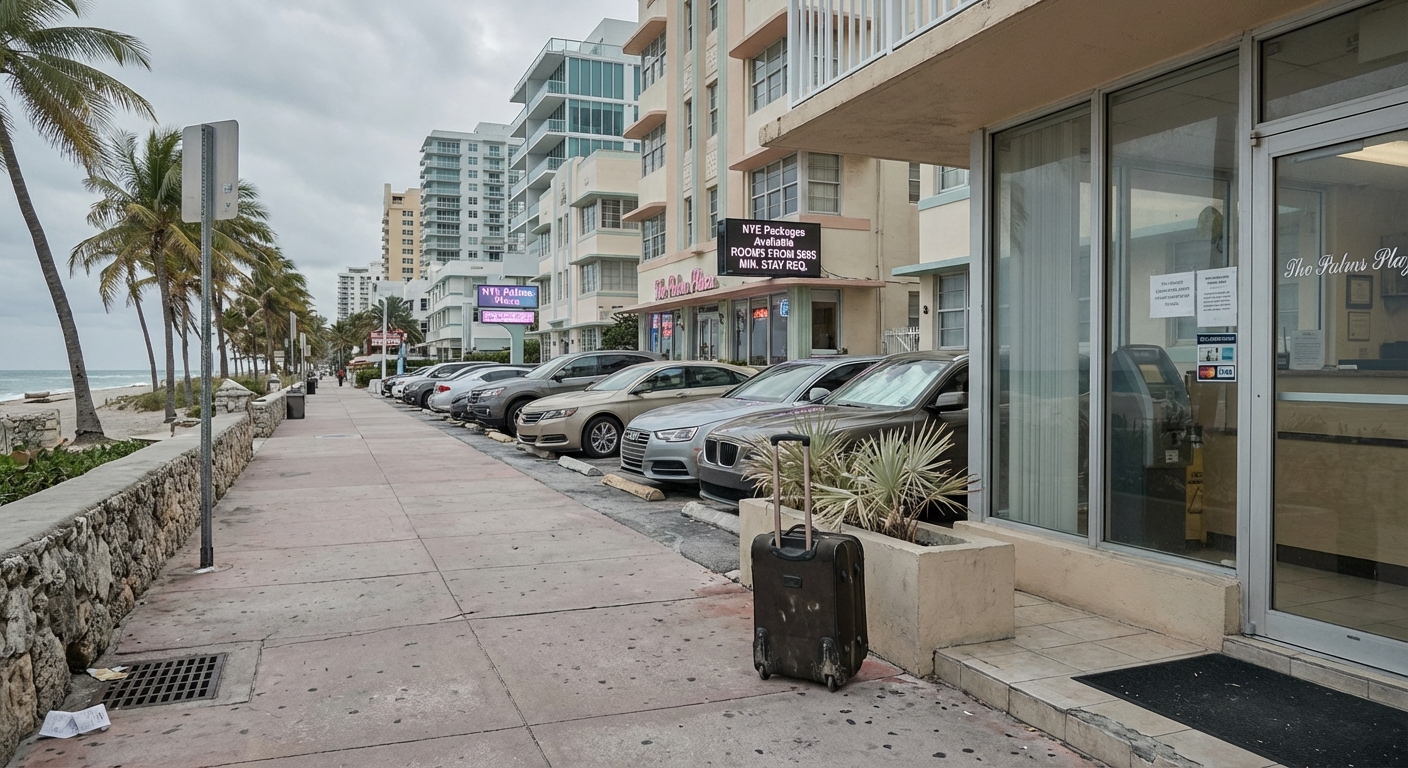
The moment feels familiar enough. You picture arriving in Miami Beach for a year-end escape, rolling your suitcase past palm trees and neon, convinced you know what a splurge looks like.
Then the bill appears, and even travelers used to big-city prices find themselves rereading the numbers, unsure if a mistake has been made or if this is simply what the destination now costs.
In conversations among travelers, Miami Beach is increasingly described less as a sunny getaway and more as a kind of financial stress test. People do the math on a basic room and realize they are spending what used to cover a long-haul trip, or a week somewhere else entirely.
The shock is not that the city is expensive, but that the gap between “high season” and “New Year’s Eve in Miami Beach” has stretched into something that feels like a different economic universe.
This is not a one-off surprise tied to a single year. Over time, the city has developed a pattern: whenever the calendar approaches the turn of the year, nightly rates in parts of Miami Beach peel away from the rest of the market, climbing into a tier that outpaces many of the world’s capital cities.
Against a backdrop of rising costs almost everywhere, Miami Beach still manages to stand out as the place that tests the limits of what a night in a standard hotel room can command.
What feels unstable to travelers is not just the size of the bill, but the lack of clear reference points. A visitor might be comfortable paying elevated prices in places known for festival crowds or landmark countdowns, and may assume those destinations set the high-water mark. Instead, they discover that a strip of sand-facing towers in South Florida has quietly taken the lead, with price patterns that no longer line up neatly with conventional ideas of supply and demand.
Part of the confusion comes from how quickly the ground seems to shift once those year-end dates are involved. Someone comparing trips across cities can see a relatively modest increase in one destination, a steep but understandable jump in another, and then a near-vertical climb in Miami Beach.
On paper, these are all urban beach or big-city celebrations. In practice, one of them behaves like an entirely different product category.
Local tourism voices tend to frame this as the natural outcome of strong demand converging on a small, highly desirable strip of coastline. In their telling, limited inventory, intense global attention and a concentration of high-spending visitors all combine to push rates upward. The language is usually about vibrancy and premium experiences, about a city that has “earned” its price point through atmosphere and allure.
What travelers encounter at the booking screen often feels more blunt. Instead of a sliding scale from budget to luxury, Miami Beach at this time of year can present itself as a series of steep cliffs.
The so-called entry-level option is already deep into luxury territory by global standards, while genuinely high-end properties occupy a realm that starts to resemble private villa pricing elsewhere. The spectrum narrows until there is very little left that resembles a middle ground.
Other destinations see their own sharp increases, but many keep some tether to their usual baseline. Participants in large urban celebrations often pay more, but can still recognize the same city they visited at other times, only marked up. In Miami Beach, travelers describe feeling as if the entire destination temporarily rebrands itself for a single night, with prices that shrug off any resemblance to normal.
This has broader consequences for how people talk about the city. Miami Beach has long been associated with glamour and indulgence, but its position in the year-end price hierarchy turns it into a benchmark of excess in travel conversations. It becomes the example people reach for when trying to explain how far festive pricing can go, even to friends who are used to paying a premium for iconic celebrations elsewhere.
The pattern also reshapes who feels that Miami Beach is “for them” during this period. Some travelers who once treated it as a reachable splurge now quietly redirect their searches to other coastal cities or inland hubs where year-end rates still feel connected to reality.
At the same time, certain visitors appear drawn in precisely because of the eye-watering numbers, reading them as a signal that this is where the biggest party must be taking place.
What gets lost amid the focus on beachfront towers is how uneven the experience can be from the traveler’s perspective. Someone who booked far in advance and absorbed the cost might arrive relaxed and ready to justify the expense as part of the occasion.
Another guest, forced into a last-minute reservation or misled by outdated expectations, may spend their stay calculating every hour against the room rate, wondering what, exactly, they have paid for beyond an address and a date on the calendar.
Even within the same city, moving a short distance off the most coveted blocks can mean entering a different pricing world. Yet in the language travelers share with one another, those nuances are often flattened into a single idea: Miami Beach equals extreme year-end rates. That reputation then loops back into the market, reinforcing the notion that the destination can keep asking for more and still find people willing to pay.
For travelers, the significance of Miami Beach’s position is less about bragging rights on a global list and more about what it reveals about the direction of celebratory travel.
When one coastal city can regularly outprice entire capitals at the exact moment people feel most pressure to make memories, it highlights how emotional occasions are becoming fertile ground for aggressive pricing.
There is no clear threshold at which this stops. As long as some segment of visitors absorbs the cost, the pattern continues, leaving others feeling pushed out or caught unaware. Miami Beach’s role in this story is as a kind of bright, neon marker of where the edge currently lies, even if that edge keeps moving.
In the end, what lingers for many travelers is a sense that the simple act of ringing in a new year has quietly shifted from a shared global ritual into a tiered experience, sharply stratified by destination and budget.
Miami Beach sits near the top of that staircase, not just as a party backdrop but as a symbol of how far festive pricing can stretch. For anyone planning where to be when the countdown comes, that reality has become part of the calculation, whether they choose the city or decide its moment has become too costly to join.