

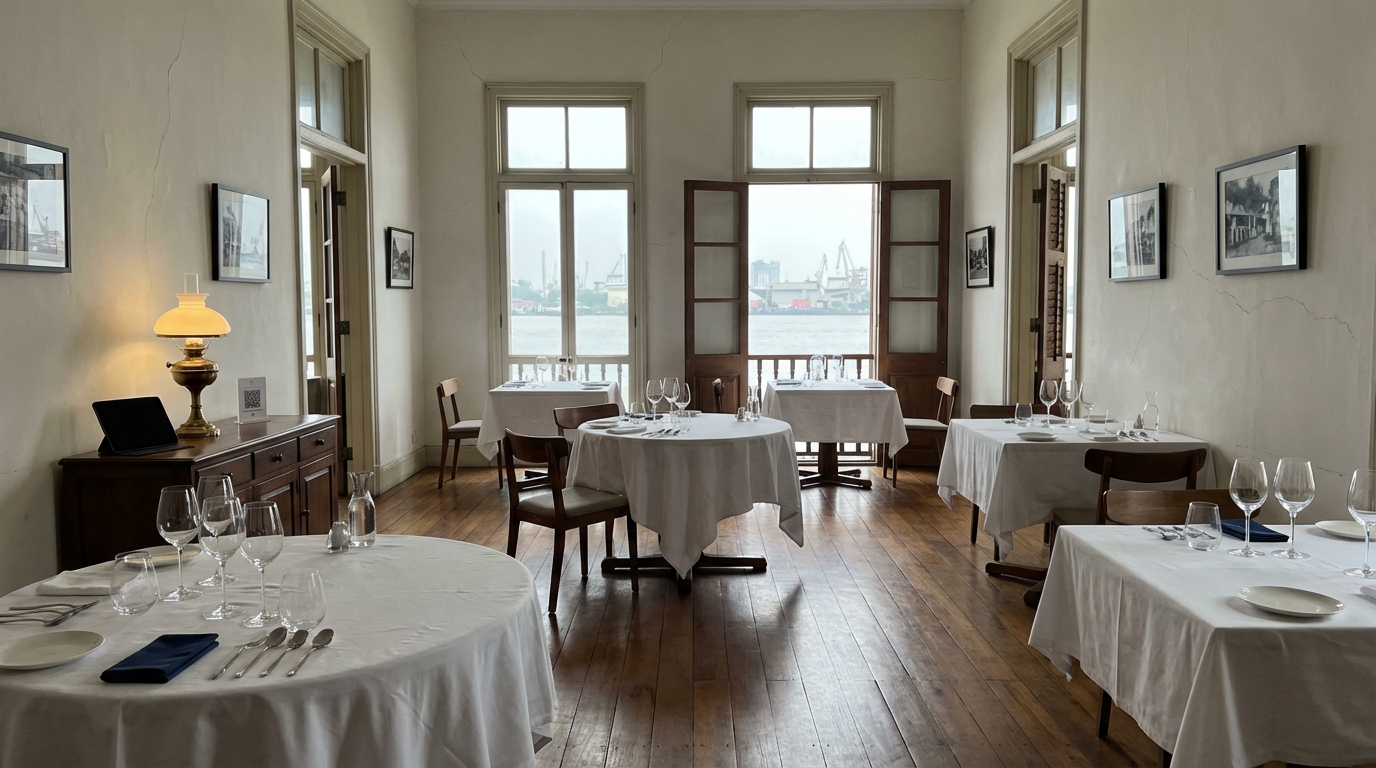
The first surprise arrives not on the plate, but in the expectations travelers carry with them. A reservation that sounds like dinner in a resort restaurant quietly reveals itself as something closer to a staged performance, with the dining room cast as a historical set and the guests nudged into the role of audience.
What once felt like a simple choice between local specialties and international comfort food now comes wrapped in narrative, symbolism and a curated sense of the past.
Across many destinations, travelers who think they are booking a meal find themselves entering a script. Hosts greet them with backstories, menus read like miniature novels and the architecture around the table is framed as a character in its own right.
It is no longer enough for a space to be beautiful; it must be storied, themed and emotionally legible, even to people stepping in from the street for the first time.
In riverside corners of northern cities, one teak mansion captures this shift especially clearly. Once a working address in the machinery of empire, it now functions as both dining room and stage, its polished floors and shaded verandahs repurposed into a setting where travelers are invited to glide through a version of the past that feels tidy and consumable.
The building’s original purpose lingers in the background, but today it is the idea of the house, not its former occupants, that is plated and served.
What feels unstable is the growing distance between the story travelers are promised and the experience they actually navigate. Promotional language leans heavily on notions of elegance, convergence and dialogue between cultures, yet the reality on the ground often involves QR codes, tasting notes and choreographed pacing that owe more to contemporary global gastronomy than to any particular local tradition.
Guests may arrive expecting a simple exploration of regional flavors and instead encounter a carefully engineered journey managed course by course.
Many travelers are caught off guard because the marketing vocabulary has barely changed while the experiences themselves have become much more scripted. Words like heritage, colonial and consular are deployed as atmospheric shorthand, signaling sophistication without asking visitors to grapple with the power imbalances that once animated these spaces.
A teak-lined dining room is introduced as a neutral canvas for refinement, rather than a place where authority and diplomacy once intertwined with the surrounding city in complicated ways.
Operators tend to frame this shift as a celebration of shared history. Official descriptions often position the dining room as a meeting point where imported rituals and regional customs harmonize, a kind of culinary bridge between worlds.
The chef’s table is said to translate cultural convergence into seven deliberate courses, with each dish cast as a chapter in a story about understanding and exchange.
The language is gentle, curated and reassuring. It emphasizes craftsmanship, imagination and respect for local ingredients, presenting the menu as a tribute rather than a reinterpretation.
Colonial-era details become aesthetic touchpoints: a certain type of timber, a particular style of furniture, the outline of old verandahs. They are invoked as visual proof that this is an authentic encounter with the past, even when the sequence of dishes feels squarely rooted in contemporary fine dining trends.
On the guest’s side of the table, the experience can feel more ambiguous. Some travelers find themselves savoring the choreography without ever quite understanding what story they are meant to take away.
The dishes may reference trade routes, diplomatic dinners or cross-cultural soirées, but the commentary tends to stay broad, smoothing the rough edges of history into a comforting narrative of mutual appreciation.
Others notice the quiet tension between the setting and the city outside. A river-facing verandah that once looked out on a working port of customs and commerce is now an escape from that daily reality.
The menu’s journey through “cultural convergence” unfolds in a controlled, high-cost environment, even as the living forms of that convergence continue in markets, family kitchens and small eateries just beyond the resort’s gates.
This is where confusion seeps in. Travelers are often told they are engaging with local heritage, yet many of the moves feel familiar from tasting menus half a world away: the progression from amuse-bouche to dessert, the theatrical plating, the chef’s brief appearances tableside to narrate inspiration. Local elements frequently appear as accents rather than anchors, folded into a framework largely shaped elsewhere.
At the same time, there is a genuine effort to respond to shifting expectations. Many visitors now arrive seeking more than comfort; they want to feel they are in conversation with the place they are visiting.
The chef’s table format offers an appealing structure for this, creating a sense of intimacy and intention. Each course can nod toward a particular ingredient, community or memory, even if those nods are carefully pre-scripted and repeated night after night.
The instability lies in what this does to the meaning of “place” in travel dining. As more heritage buildings are transformed into high-concept restaurants, the line blurs between sites of memory and sites of consumption.
Travelers find themselves paying for proximity to a version of history that has been edited down to its most photogenic elements, and it can be difficult to tell where reverence ends and set dressing begins.
In northern river cities, the former consulate-turned-dining-room has become one among many examples of this pattern. The structure that once embodied a specific geopolitical relationship now functions as a versatile backdrop for tasting menus, afternoon rituals and private events. Its walls carry the weight of one story, while its current use tells another, and visitors move between them without always realizing the dissonance.
None of this makes the experience less compelling on a sensory level. The flavors can be intricate, the pacing finely judged, the service attentive without being stiff. For many guests, the simple pleasure of good food in a beautiful room is enough, and the historical framing reads as a gentle extra, something to notice and then set aside in favor of the next course.
Yet for travelers who are paying attention to how travel is changing, this kind of dining room has become a quiet barometer. It shows how the industry is learning to package complexity into something digestible and atmospheric, how architecture is recruited into storytelling, and how references to convergence can gloss over who had power to shape that convergence in the first place.
The meal ends, the plates are cleared, but the questions about what exactly was consumed, and whose version of the past was being served, linger long after the final course.