

The moment a tray of identical chicken breasts appears at a conference, you can almost feel the mood in the room flatten. Guests still eat, but the energy drops, phones come out, and conversations drift away from what is on the plate.
In more and more venues, that old pattern is colliding with a new expectation that food at an event should feel as tailored as the invitations that brought people there.
Attendees walk into ballrooms, rooftops, back lawns, and expo halls now expecting some kind of choice that feels personal. They have seen “build-your-own” setups in fast-casual chains, custom drink options in coffee apps, and playlists designed around their listening history.
When they arrive at an event, the absence of this kind of customization quietly registers as a missed opportunity, even when no one says it aloud.
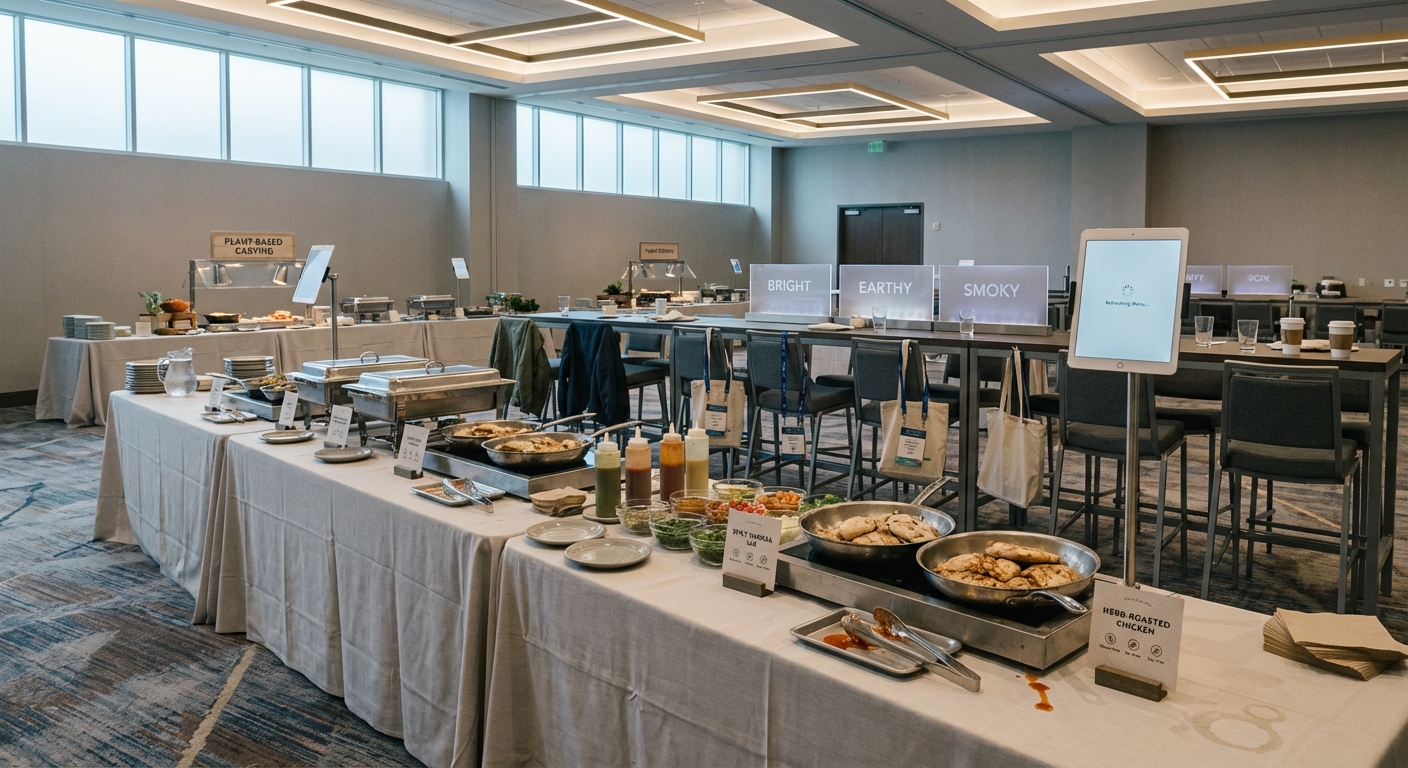
Across many types of gatherings, the meal has stopped being a background necessity and has begun functioning as a sort of interactive set piece. Instead of a single plated dish arriving in unison, guests are routed past small “labs” where a chef finishes a dish to their preferences or a bartender tweaks the sourness, spice, or sweetness of a drink on the spot. It feels less like receiving dinner and more like participating in it.
This shift can catch travelers off guard because so much of event dining used to be about predictability. Buffets signaled abundance, plated meals signaled formality, and the stress mostly lived behind the scenes in kitchens and back corridors.
Now the friction often moves into the room itself, where guests linger in front of unfamiliar ingredients, scan small signs describing flavor profiles, and try to decode what a dish will actually taste like before they commit.
Hosts and operators tend to describe this evolution in polished terms. They talk about immersion, storytelling, and journeys, and they frame food as one more channel for creating a memorable moment.
The language is smooth and aspirational: flavor “flights,” tasting “paths,” experiential “stations.” It projects the sense that everything has been thoughtfully orchestrated and that guests are walking through a carefully composed culinary narrative.
What travelers actually encounter is more complicated. At a crowded event, a “customization bar” can feel like a bottleneck in disguise, a place where people queue with small plates while juggling a drink, a badge, and a conversation.
The promise of personalized flavor sometimes collides with the reality of limited prep space and small teams. If one station becomes the unofficial favorite, a supposedly fluid system hardens into a line that snakes through the room.
The new vocabulary around flavor can also create a subtle form of pressure. Menus increasingly lean on descriptors like smoky, bright, earthy, or floral, and on mashups of regional references that sound adventurous but reveal little about intensity.
Some guests discover that they have accidentally ordered something far hotter, sweeter, or funkier than they expected. Others self-censor, defaulting to the safest option rather than risk an unpleasant surprise in the middle of a networking conversation.
Behind the scenes, many organizers are working with more data about preferences than ever before. Pre-event forms now ask far beyond basic dietary needs, probing for favorite cuisines, spice tolerance, and even preferred textures.
These questions are usually presented as a path to better hospitality, but they also raise expectations. When guests have disclosed so much, they notice when what appears on the plate still feels generic.
At the same time, the push for hyper-personalized flavor is colliding with stricter attention to allergens and dietary patterns. Labels multiply across stations, small symbols appear beside dish names, and staff are trained to recite ingredient lists and cross-contact caveats.
For some attendees this brings relief, but it can also fragment the shared experience. One person joins a plant-based carving station, another finds the gluten-light corner, someone else is routed to a nut-free dessert table. The room looks full, yet people are scattered into parallel culinary tracks.
Technology adds another layer of instability. In some venues, screens and codes replace printed menus, promising live updates and dynamic pairings. Guests point their phones at signs to see individualized recommendations or to call up a deeper explanation of flavor components.
When these systems work, they can quietly smooth decisions. When they stutter or stall, hungry people are left staring at progress bars while the line behind them grows restless.
All of this changes what it feels like to attend an event in an unfamiliar place. The meal is no longer something that simply arrives in front of you; it has become a sequence of small choices, micro-negotiations, and sometimes minor risks.
Guests learn to navigate “stations” as social environments, deciding whether to make room for conversation with the chef, whether to copy the person ahead of them, or whether to skip a particularly mysterious counter altogether.
Hosts often frame this complexity as empowerment, and in some ways it is. People who once had to quietly remove ingredients from a plate can now request a dish built to avoid them.
Those who care deeply about origin stories or sustainability find more chances to engage staff about sourcing. Yet the same system can leave others feeling exposed, especially when their requests stand out against a backdrop of more carefree orders.
Over time, these patterns are reshaping expectations about what makes an event “memorable.” It is no longer enough for food to be generous or well prepared; it is increasingly judged on how well it reflects the perceived individuality of the people in the room.
The success of a menu is measured not only in empty plates but in the number of conversations it sparks, the photos it inspires, and the sense that guests have authored part of the experience themselves.
For travelers moving between cities, venues, and formats, this means that the culinary side of an event has become harder to predict. Two gatherings with similar budgets and headcounts can feel radically different depending on how they handle choice, flavor language, and interaction.
The result is a curious tension: food is more central to the story of an event than it has been in a long time, yet the actual experience of eating it feels less settled, more variable, and more dependent on the tiny decisions and hesitations of each person who steps up to a station.
That uncertainty is unlikely to resolve soon. As long as events keep reaching for experiences that feel personal and unforgettable, the pressure on food to carry that ambition will remain.
Travelers will continue walking into rooms where the menu is not a fixed script but a set of options that only becomes real in the moment. The gap between the smooth language used to sell that vision and the messy reality of navigating it is where the modern event meal now quietly lives.