

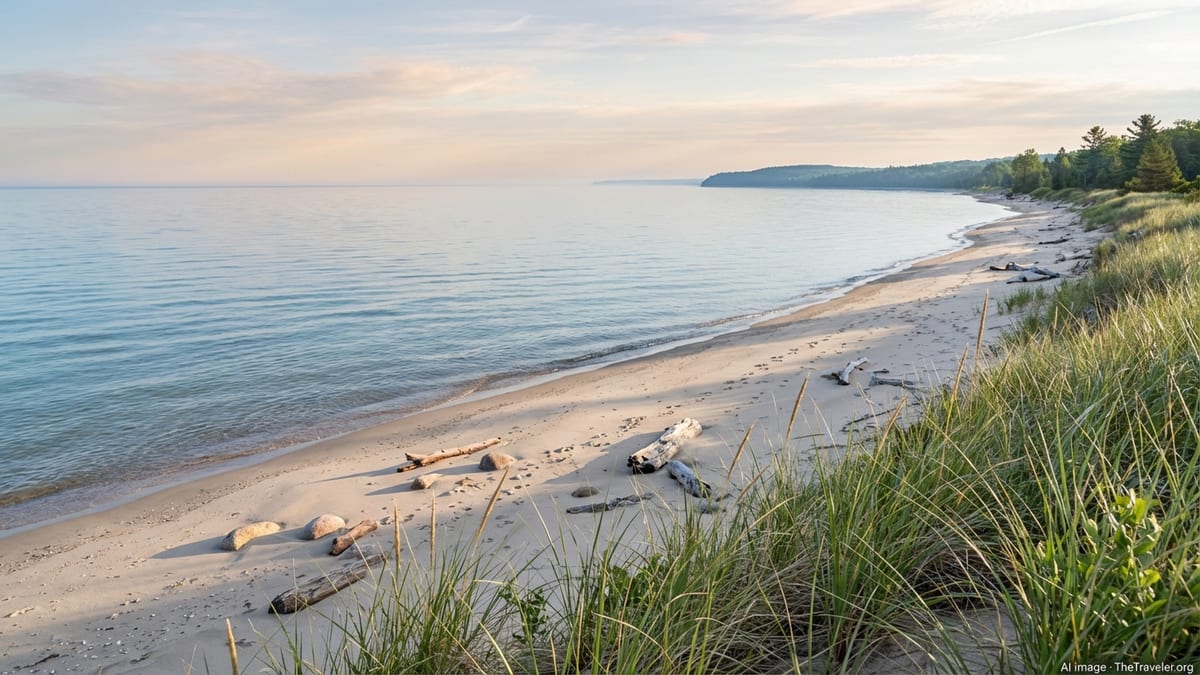
Lake Huron looks gentle from a distance. Its long sand beaches, quiet coves, and cottage towns feel inviting, even tame, compared with ocean coasts. Yet travelers who arrive with that first impression often discover a very different lake: colder, wilder, and far more complex than they expected. Misjudging its size, weather, safety, and character can turn an otherwise memorable trip into a stressful or even dangerous experience. Understanding what Lake Huron is really like is the key to planning a visit that is both rewarding and safe.
Underestimating the Size and Wildness of Lake Huron
Many first-time visitors think of Lake Huron as a large inland lake, something you can drive around in a leisurely day or treat like a long, friendly beach. In reality, Lake Huron is one of the largest freshwater lakes on the planet, with more than 3,800 miles of shoreline when its islands are included. Standing on the open coast in Michigan or Ontario, the far shore is usually invisible. Weather rolls in the way it does on an ocean, and distances between destinations are far greater than they look on a map. Travelers who plan tightly packed itineraries, expecting short hops between beach towns and islands, often find themselves spending far more time driving than exploring.
This vastness has another consequence: remoteness. Outside of a few more developed hubs, long stretches of the Lake Huron coast are sparsely populated. Once you leave places like Alpena, Bay City, Goderich, or Sarnia, you quickly encounter small communities, long forested shorelines, and narrow roads with limited services. Gas stations, restaurants, and accommodation can be widely spaced, especially along Michigan’s “thumb” and parts of Ontario’s Bruce Peninsula and North Channel. Visitors who arrive without advance bookings or a refueling plan sometimes discover that “just finding something when we get there” is not realistic along parts of this lake.
The lake’s wild character is especially clear offshore. The Thunder Bay National Marine Sanctuary off Alpena, for example, protects dozens of shipwrecks, many lying in cold, clear water that attracts divers and snorkelers. Those wrecks are a reminder that mariners have long grappled with strong winds, sudden squalls, and tricky navigation here. The same forces that once sank ships still shape the experience of modern paddlers and boaters. Treating Huron like a calm resort bay rather than a true inland sea is one of the most common and potentially serious visitor mistakes.
Misreading Weather, Seasons, and Water Temperatures
Travelers often time their visit to Lake Huron by air temperature alone, assuming that a warm day means warm water and gentle conditions. On this lake, that assumption can be misleading. Even in July and August, surface water can remain surprisingly cold, especially after strong winds cause upwelling that pulls deeper, chillier water to the surface. It is not unusual for a string of hot days to be followed by a sharp drop in nearshore water temperature, which can catch swimmers and paddlers off guard. Cold shock and rapid fatigue are real risks for anyone who ventures out too far without a wetsuit or flotation device.
Seasonal timing is another point of confusion. Many visitors assume that “summer” in the traditional sense runs from late May through early September, and that any date in that bracket promises beach weather. In practice, Lake Huron’s reliable swimming season is shorter and highly variable year to year. Early June and late September can be beautiful for hiking and sightseeing yet still too cool for comfortable swimming, especially along more exposed shorelines. Spring also lags behind inland areas; buds, blooms, and cottage-country life can arrive later here, making May feel more like early April in places just a short drive away.
Wind and waves are also widely misunderstood. Calm, glassy mornings can give way to whitecaps and breakers by the afternoon as winds shift across the open lake. Travelers unused to large lakes may read the lack of tides as a sign of predictability, when in fact wind setup and pressure changes can quickly build or flatten surf. Short-period, choppy waves on the Great Lakes feel very different from the rolling swell of an ocean, and they can be more disorienting for small boats and novice paddlers. Checking marine and beach forecasts, and being ready to adjust plans, is far more important on Lake Huron than casual visitors often realize.
Overlooking Currents, Drop-offs, and Great Lakes Swim Safety
Perhaps the most serious misconception is that Lake Huron is inherently safer than the ocean simply because it is freshwater without tides or sharks. In reality, Huron can be dangerous for swimmers who do not understand Great Lakes currents and underwater topography. Rip currents, longshore currents, and outlet currents can form where waves break over sandbars and around structures such as piers and river mouths. These flows can carry even strong swimmers quickly away from shore into deeper water, and they are often invisible to the untrained eye. Local officials around Lake Huron issue seasonal warnings after drownings and rescues, particularly near river outlets and along exposed beaches when waves are high.
Underwater drop-offs are another overlooked hazard. In some areas, the bottom shelves gradually, but elsewhere it can plunge from knee-deep to overhead with one or two steps. Visitors accustomed to gently sloping resort beaches in tropical destinations can be startled by these sudden changes. People walking in waist-deep water, sometimes with children in tow, may suddenly find themselves unable to touch bottom, especially near the mouths of rivers where fast-moving water scours deeper channels. Confident waders who step just a little farther out “for a photo” can be pulled into faster, more turbulent currents without warning.
Safety infrastructure is also different from what many travelers expect. Lifeguard coverage is limited along much of Lake Huron’s shoreline; many beautiful beaches have no professional supervision, no clear flag system, and no rescue equipment beyond basic life rings or a posted emergency phone number. Visitors who assume that every popular swimming spot will feel like a managed resort beach often overestimate the margin for error. A safer mindset is to treat Huron like a backcountry environment: know your swimming ability, avoid inflatables on windy days, stay clear of piers and breakwalls, and keep a close eye on children even in shallow water.
Confusing Beach Towns With a Single “Lake Huron Experience”
Another frequent mistake is assuming there is one typical Lake Huron vibe or that any lakeside town will provide an interchangeable experience. The reality is that Lake Huron’s coastlines are remarkably varied. The long, sandy beaches of Ontario’s southeastern shore feel very different from the rocky, pine-framed bays of the North Channel or the dune-backed stretches of Michigan’s eastern shore. A traveler seeking lively promenades and sunset crowds will have a different ideal base than someone looking for quiet campsites and empty horizons. Planning without appreciating these regional contrasts can leave visitors feeling like they chose the “wrong” part of the lake for their interests.
Larger communities and resort areas tend to offer more amenities, events, and family-friendly infrastructure. Towns on Ontario’s Bruce and Huron shores, for example, are known for long beaches, summer festivals, and cottage culture, while Michigan communities such as Alpena or Port Huron combine waterfront recreation with maritime museums, lighthouses, and easy day-trip options. By contrast, stretches of the “thumb” in Michigan and the North Channel in Ontario skew much quieter, catering more to boaters, anglers, campers, and those comfortable with minimal services. Visitors who arrive expecting boardwalk nightlife, only to find a sleepy harbor village with one general store, may feel unprepared for the slower pace.
Within each region, individual beaches can vary sharply in character even over short distances. One bay may be shallow and sandy, ideal for children, while the next point over has a cobble bottom, steeper drop-off, and stronger waves. Travelers often rely on a single photo or a passing social media recommendation without realizing how localized those impressions are. A better strategy is to choose a primary base that matches your style, then build in time to explore neighboring parks and beaches. That way, you experience a range of Lake Huron settings instead of assuming that one stretch of shoreline speaks for the entire lake.
Assuming Amenities, Access, and Cell Coverage Are Guaranteed
Modern travelers are used to finding coffee shops, quick-service restaurants, high-speed data, and rideshare cars almost anywhere they go. On Lake Huron, many discover that these conveniences are not a given. Gas stations can be many miles apart, especially on scenic backroads that hug the shoreline. Restaurants may have limited hours outside peak summer, and roadside shops may close early even on long, sunny evenings. In shoulder seasons, some marinas, campgrounds, and attractions operate with reduced staff or open only on weekends. Visitors who rely on last-minute bookings or spontaneous dining choices may encounter closed signs and long gaps between options.
Access to the lake itself can also be more structured than people expect. Certain stretches of shore are privately owned, with access limited to designated public beaches, parks, or right-of-way points. Boat launches can be busy on summer weekends, sometimes with lineups and parking limits. Elsewhere, access is physically challenging: rocky shorelines, steep stairs down bluffs, or narrow sand paths through dunes. Travelers who assume they can simply “pull off and hop in the water” may be surprised to find that many of the best spots require short hikes, permit fees, or planning around park capacity limits.
Cell coverage is another underappreciated factor. While major towns and highways along Lake Huron typically have reliable service, gaps appear quickly in more rural areas, on islands, and along certain stretches of coastline. Paddlers, cyclists, and road-trippers who pursue the quieter corners of the lake sometimes discover that map apps, restaurant searches, and messaging simply do not work reliably. For safety and convenience, it is wise to download offline maps, save confirmation details, carry paper directions for key segments, and let someone know your general route and timing if you are headed into less-developed sections of the shoreline.
Misjudging Ecological Sensitivity and Local Stewardship
Lake Huron’s beaches and surrounding forests might look robust and untouched, but in many places they are ecologically fragile. Visitors sometimes interpret wide stretches of sand or rock as resilient playgrounds, when in fact the dunes, wetlands, and nearshore habitat are under pressure from erosion, higher or fluctuating water levels, and heavy use. Walking over dune grass, carving paths down bluffs, or trampling beach vegetation can accelerate erosion that local communities are already struggling to manage. Firewood brought from outside regions can introduce invasive insects that threaten shoreline forests. Even seemingly small actions, like leaving litter or drifting too close to nesting birds, can have outsized impacts in sensitive areas.
Water quality is another area where misconceptions arise. The clarity of Lake Huron’s water often leads travelers to assume it is uniformly pristine and safe to drink or swim in anywhere at any time. In reality, conditions can vary by location and season. Local advisories may be issued after storms, runoff events, or infrastructure issues, especially near river mouths or urban beaches. While many stretches of shoreline remain remarkably clear and clean, others occasionally contend with algal blooms, bacteria spikes, or floating debris. Checking local beach reports and park notices before entering the water is a smarter approach than relying on appearances alone.
Local stewardship efforts are more organized than many visitors realize. Volunteers and community groups help maintain trails, monitor wildlife habitat, conduct shoreline cleanups, and support small parks that operate on modest budgets. Travelers who treat Lake Huron purely as a backdrop for personal recreation can miss the chance to contribute positively. Respecting posted rules, staying on designated paths, packing out all trash, and participating in local initiatives when possible all help ensure that the lake’s quieter, wilder corners remain intact for future trips. Thinking of oneself as a temporary caretaker rather than a consumer is a subtle but important shift in mindset.
Overlooking Indigenous Histories and Deeper Cultural Context
Another thing travelers often get wrong about Lake Huron is assuming that its story begins with lighthouses, shipwrecks, and European settlement. In truth, the lake and its shores have been central to Indigenous communities for countless generations. First Nations and Native American nations along Huron’s coasts have long used its waters for travel, trade, fishing, ceremony, and storytelling. Many of the place names around the lake, as well as traditional knowledge about winds, currents, and safe travel routes, originate from these deeper histories. Visitors who focus only on later maritime or cottage-country narratives miss a fundamental dimension of what Huron represents.
In recent years, more cultural centers, museums, and community-led tours around the Great Lakes have begun highlighting Indigenous perspectives. These may include exhibits on traditional fishing techniques, treaty histories, or the spiritual significance of specific landscapes and islands. Some powwows and cultural events near Lake Huron welcome respectful visitors, offering opportunities to learn through experience rather than just displays. However, many travelers never look beyond the standard tourist brochures and therefore are unaware of these options or of the protocols that come with attending Indigenous events and spaces.
Engaging with this deeper context requires intention. It means seeking out local information about whose lands you are visiting, listening to guidance on appropriate behavior at sacred or culturally important sites, and understanding that not all places are suitable for casual recreation or photography. It also means recognizing that modern communities around Lake Huron continue to grapple with issues related to land, water, and environmental change. For travelers, adding this layer of awareness can transform a beautiful shoreline from a scenic backdrop into a place with living stories and responsibilities.
The Takeaway
Lake Huron rewards those who arrive prepared to meet it on its own terms. It is not a single beach town, a predictable summer resort, or a tame version of the ocean. It is a vast, changeable freshwater sea with remote stretches, lively hubs, complex currents, and layered histories. Travelers who misjudge its size, underestimate its weather, or assume guaranteed amenities often find themselves scrambling to adapt. Those who respect its power, plan for variability, and approach local communities and ecosystems with care tend to leave with richer, more memorable experiences.
Practical preparation goes a long way: build slack into your driving days, check marine and beach forecasts, pack extra layers even in midsummer, and treat swimming as a serious outdoor activity rather than a casual hotel-pool dip. Take time to learn about the particular stretch of shoreline you are visiting instead of assuming that one photo or recommendation speaks for the entire lake. Seek out local knowledge, from park rangers and marina staff to long-time residents and cultural centers, and be ready to adjust your plans if conditions or advisories change.
Above all, remember that Lake Huron is not just scenery but an evolving place with communities, ecosystems, and histories that extend far beyond any single trip. Visiting with humility, curiosity, and a willingness to learn reshapes common traveler missteps into opportunities for deeper connection. When treated with that mix of respect and preparation, Lake Huron feels less like a misread destination and more like the remarkable freshwater world it has always been.
FAQ
Q1. Is Lake Huron generally safe for swimming?
Lake Huron can be safe for swimming in designated areas during calm conditions, but currents, sudden drop-offs, and cold water mean you should treat it like a powerful open-water environment and follow local advisories closely.
Q2. When is the best time of year to visit Lake Huron for beach weather?
The warmest and most reliable beach conditions usually fall between late June and late August, although exact timing varies by year and location; late spring and early fall can still be beautiful for hiking and sightseeing even if the water is chilly.
Q3. Do I need special safety gear to kayak or paddleboard on Lake Huron?
At minimum you should wear a properly fitted life jacket, carry a whistle or signaling device, and check wind and wave forecasts; on cooler days or longer outings, additional gear such as a wetsuit, dry bag, and spare layers is strongly recommended.
Q4. Are there lifeguards on most Lake Huron beaches?
A few popular beaches have lifeguards in peak season, but many do not, so you should never assume supervision will be present and always plan as if you are responsible for your own safety and that of your group.
Q5. How cold is the water in summer?
Surface temperatures can feel pleasantly swimmable during warm stretches, but wind-driven upwelling can drop the water from comfortable to very cold in a short time, so conditions may change significantly over just a few days.
Q6. Can I drink water directly from Lake Huron while camping or boating?
It is not advisable to drink directly from the lake; even where the water looks clear, you should filter, boil, or otherwise treat it to reduce the risk of illness.
Q7. How much driving time should I plan between major towns on Lake Huron?
Driving times vary widely, but it is wise to allow more time than map estimates suggest, especially on smaller shoreline roads, and to assume you may go an hour or more between services in quieter areas.
Q8. Are there areas of Lake Huron that are especially good for families with young children?
Gentle, shallow beaches with sandy bottoms and nearby amenities are typically best for families; look for well-known family beaches with gradual entry, restrooms, and clearly marked swimming zones rather than isolated or steeply sloping shorelines.
Q9. What should I know about respecting the environment around Lake Huron?
Stay on marked paths, avoid trampling dune grass and beach vegetation, pack out all trash, respect wildlife and nesting areas, and follow any local guidelines aimed at protecting dunes, wetlands, and shoreline forests.
Q10. How can I learn more about the Indigenous history of the Lake Huron region during my visit?
Seek out local cultural centers, museums, and community events that share Indigenous perspectives, and look for interpretive materials that acknowledge traditional territories and explain the long-standing relationship between Indigenous nations and the lake.