

Experiencing France is not only about checking off museums and monuments. It is also about slipping into a particular way of living that values time at the table, measured workdays, public space, and civility in everyday encounters. For travelers, understanding the French lifestyle can turn a good trip into a genuinely enriching one, helping you interpret social cues, avoid faux pas, and appreciate why things work the way they do.
The Rhythm of Daily Life in France
French daily life moves to a rhythm that may feel slower and more structured than in many Anglo American cultures. Shops in smaller towns often close at midday, offices may empty out for lunch, and dinner begins later than many visitors expect. This is not inefficiency so much as a different prioritizing of time, with clear boundaries between work, meals, and rest. Travelers who adjust their expectations to this cadence tend to find France more welcoming and less frustrating.
Morning routines are typically simple and functional. A quick coffee and a piece of bread or pastry are common, often eaten at home, at a kitchen counter, or standing at the bar of a local café. By late morning, streets and markets become livelier, especially on designated market days when locals shop for fresh produce and specialty foods. The mood is social but not rushed, with people taking time to talk to vendors and acquaintances.
Lunch historically has been the main meal of the day and still shapes opening hours. In many areas, especially outside the largest cities, the lunch window runs roughly from noon to mid afternoon. Offices, post offices, and smaller boutiques may close to allow staff to eat properly. For travelers this can come as a surprise, but planning activities around this schedule can make the day feel more relaxed and in tune with local habits.
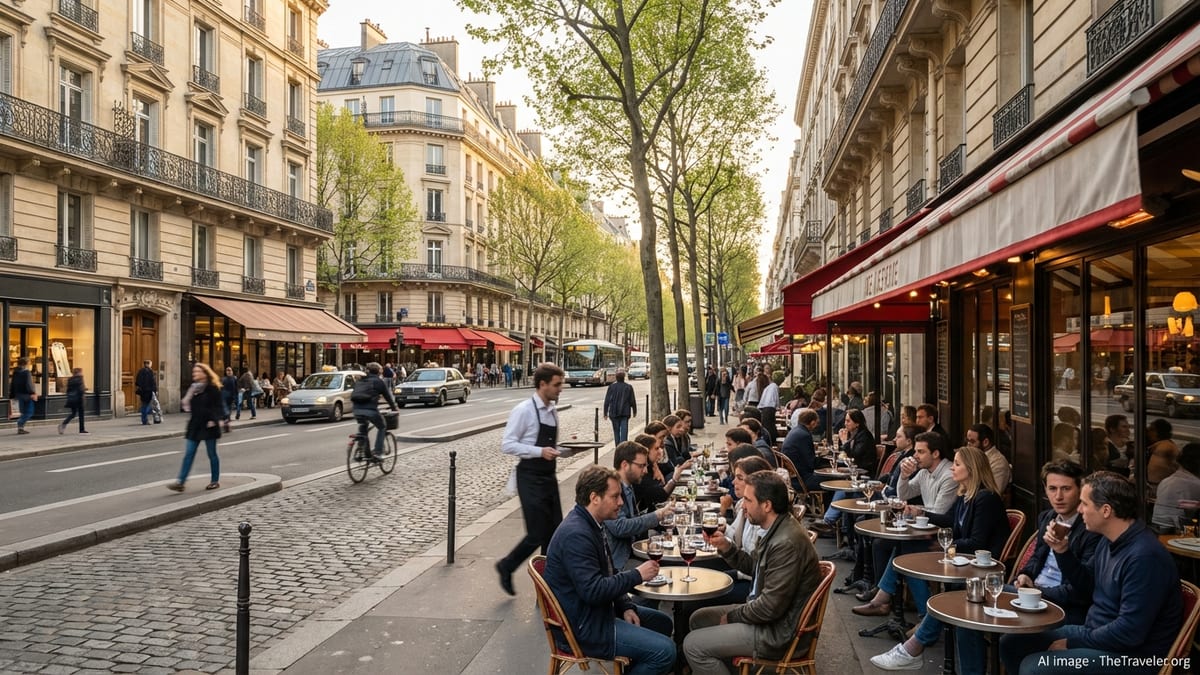
Evenings usually stretch out. After work or sightseeing, people may stop for a drink on a café terrace, meet friends, or return home before a late dinner that often starts around 8 p.m. In the summer, public squares and riversides fill with people of all ages enjoying the longer light. Rather than a constant quest for efficiency, there is a visible enjoyment of simply being out, talking, and watching the world go by.
Work, Leisure, and the Value of Time Off
For many visitors, one of the most striking features of French lifestyle is the importance placed on time off. France is known for generous vacation allowances and a legally enshrined limit on the standard workweek. While individual experiences vary widely, the general cultural expectation is that work should not overwhelm life, and that holidays, weekends, and evenings are meant to be truly restorative.
This attitude is evident in the near ritual of taking several weeks of summer vacation, often in July or August. Cities, including Paris, can feel noticeably quieter as residents decamp to the coast or countryside. For travelers, this can mean some smaller businesses are closed or operating with limited staff, but it also provides a glimpse of how highly the French value getting away, spending time with family, and disconnecting from everyday stress.
At the same time, France is a modern, high income country, and in larger cities work life can feel intense. Long commutes, competitive professional environments, and high expectations in certain fields coexist with strong labor protections and a robust culture of unionization. Strikes and demonstrations, particularly over pensions, salaries, or working conditions, are part of political life and can disrupt transportation or services, especially in Paris and other major hubs.
For travelers, the key is to remain flexible and informed. It is wise to check local news for planned strikes that could affect trains, metros, or flights and to allow extra time when moving between cities or to airports. Understanding that such disruptions are part of a deeply rooted social model, where collective protest is seen as a legitimate tool, can make them feel less like random chaos and more like an expression of civic engagement.
Café Culture, Eating Habits, and Dining Etiquette
Food is central to French life, not only as nourishment but as culture. Meals are meant to be savored rather than rushed, and this shapes everything from opening hours to how long you are left in peace at the table. Sitting for an entire afternoon on a café terrace with a single drink is generally acceptable, especially outside the busiest times, and waiters will not hurry you with the bill.
The daily food rhythm often follows a pattern. Breakfast is light, lunch is considered important, and dinner can stretch into a multi course event, particularly on weekends or when socializing. Many restaurants offer a fixed price lunch menu that represents excellent value and typically runs only at specific hours. Outside those hours, kitchens may close completely, so a late afternoon hunger is better satisfied at a bakery or café than at a traditional restaurant.
Dining etiquette places emphasis on courtesy and moderation. Greeting staff with a clear “Bonjour” or “Bonsoir” when you enter and a “Merci, au revoir” when you leave is essential and sets a respectful tone. It is polite to keep hands visible on the table rather than in your lap, not to start eating until everyone has been served, and to speak at a moderate volume so as not to disturb neighboring tables. Splitting dishes is less common than in some countries, but ordering a single shared starter is usually fine if handled discreetly and politely.
Tipping practices differ noticeably from those in North America. Service is included in restaurant and café prices, and staff are paid wages that are not expected to be supplemented by large gratuities. Leaving nothing is socially acceptable, though rounding up the bill or leaving a small pourboire to acknowledge friendly or attentive service is appreciated. For a simple coffee or glass of wine, a few coins are enough. For a more elaborate meal, a modest extra amount is considered a nice gesture rather than a requirement.
Politeness, Personal Space, and Everyday Etiquette
French politeness revolves around formal greetings, clear boundaries, and a certain reserve with strangers. Visitors who adapt to this framework tend to find that people become much warmer and more helpful. The single most important habit is to greet people properly. When entering a shop, approaching a hotel desk, or addressing a stranger to ask for information, always begin with “Bonjour Madame” or “Bonjour Monsieur” before making your request.
Using the formal “vous” rather than the informal “tu” is standard with adults you do not know well, including staff, drivers, and older people. Switching to “tu” is usually a sign of closeness or equal footing and is best offered by the French person rather than assumed by the visitor. Similarly, titles matter in certain settings. In more traditional environments, addressing doctors, professors or senior professionals with their title followed by their name is appreciated.
Personal space expectations can be somewhat closer than in some cultures while still retaining a sense of privacy. On public transport or in queues, people stand fairly near one another, but conversations tend to be more contained. Loudness, particularly on metros or in restaurants, can be seen as intrusive. On the other hand, taking time for small courtesies such as holding doors, saying “pardon” when passing, or offering your seat to an older person or someone pregnant is widely practiced.
Among friends and family, social rituals like la bise, the light cheek kiss greeting, remain common, although handshakes or verbal greetings alone are more typical with new acquaintances or in professional contexts. Travelers are not expected to initiate la bise, and a simple handshake accompanied by a smile and “Bonjour” is entirely acceptable. Overall, a combination of respectful formality and understated warmth characterizes most everyday interactions.
Public Space, Urban Life, and the Art of Flânerie
One of the pleasures of the French lifestyle is the way people inhabit public space. Parks, riverbanks, village squares, and café terraces all serve as extended living rooms where social life unfolds in public yet relaxed ways. The concept of the flâneur, the observant urban stroller, captures this orientation toward walking without a strict agenda, simply enjoying the city as a series of encounters and impressions.
Cities like Paris, Lyon, Bordeaux, and Nice are built at a pedestrian scale, with dense streets, accessible public transport, and plenty of places to sit and watch the world. Even smaller towns often have a central square anchored by a church or town hall, surrounded by cafés and shops. Market days turn these spaces into lively theaters where producers, residents, and visitors mingle among displays of cheeses, charcuterie, flowers, and seasonal fruit.
Respect for shared space also means certain unwritten rules. Littering is frowned upon, and while urban cleanliness can vary, there is growing sensitivity to environmental issues such as recycling and reducing waste. Picnicking in parks is popular, but people normally leave the area tidy. On public transport, it is courteous to avoid blocking doors, to keep bags off seats when the carriage fills, and to let passengers off before boarding.
At the same time, urban life in France is not without tension. Demonstrations and protests periodically occupy central squares and major boulevards, sometimes accompanied by a heavy police presence or localized disruption. For visitors, the safest approach is to observe from a distance, avoid joining large crowds, and be prepared for temporary closures of certain streets, stations, or attractions when political events unfold.
Religion, Secularism, and Social Topics
Understanding the French approach to religion and public life can help visitors navigate sensitive topics. France is a secular republic, and the principle of laïcité plays a major role in its political culture. In practice, this means a strong separation between religious institutions and the state and an expectation that public services, especially schools and administration, remain neutral in matters of faith.
Religion in everyday life tends to be more private than in some societies. While France has historically Catholic roots and significant Muslim, Protestant, Jewish, and other communities, religious observance is often discreet. It is perfectly acceptable to discuss religion with people you know well, but it is less common as a casual topic with strangers. Displays of religious symbols in certain public institutions, particularly state schools, have been the subject of intense national debate, which visitors may encounter in media coverage.
More broadly, French public conversation can be forthright. Politics, philosophy, and social issues are frequent topics at dinner tables and in cafés. Debate is often viewed as intellectually stimulating rather than confrontational. For travelers, joining such discussions can be rewarding, but it is wise to listen first, avoid assumptions, and recognize that views can be sharply divided on issues such as immigration, national identity, and European integration.
Despite the intensity of public debate, social interactions tend to observe a clear line between private and public realms. Asking about a person’s professional life, cultural interests, or travel is perfectly normal. Questions about income, personal wealth, or very intimate matters can be seen as intrusive unless a close relationship has been established over time.
Strikes, Protests, and Staying Practical as a Visitor
Strikes and demonstrations are recurring features of French civic life. Over the past several years, large movements over pension reforms, labor laws, and policing have generated national debate and disrupted daily routines. Transport strikes can slow or halt train, metro, and air traffic, and major protests periodically draw crowds into central areas of cities such as Paris, Marseille, and Lyon.
For travelers, this does not mean France is unsafe, but it does require attention to logistics. When rumors of a strike emerge, transport authorities typically announce reduced timetables or cancellations in advance. It is sensible to check schedules on the day of travel, allow extra time for reaching airports and train stations, and keep flexible backup options, such as earlier trains or alternative routes, when possible. Most demonstrations are peaceful, but some can lead to clashes between small groups and police, particularly at night. Avoiding front line areas and following the directions of local authorities are straightforward precautions.
Despite periodic unrest, tourism remains a pillar of the French economy, and essential services are usually maintained. Museums and major attractions often stay open during protests, albeit occasionally with shortened hours or special security checks. Hotels are accustomed to helping guests interpret news updates and plan around disruptions, and many French people are sympathetic to travelers caught in the middle of events that have little to do with them.
Adopting a calm, adaptable attitude goes a long way. If a planned train is canceled, taking the opportunity to explore a neighborhood you might otherwise have skipped or spending an extra afternoon at a museum can transform an inconvenience into an unexpected discovery. Understanding that such turbulence is partly the flip side of a society highly invested in social protections can also put the experience into perspective.
The Takeaway
To appreciate the French lifestyle as a traveler is to look beyond postcard images and embrace the underlying values that shape everyday life. Time at the table, clear boundaries between work and rest, formal but sincere politeness, and a robust culture of public debate all contribute to a distinctive social atmosphere. This can take adjustment, especially if you arrive with expectations formed by faster paced or more informal cultures.
Yet those who adapt quickly discover smaller, more personal pleasures. Knowing how to greet a shopkeeper, when to linger at a café, or why a city seems unusually quiet during vacation season can turn confusion into connection. Rather than treating French habits as obstacles, seeing them as invitations to slow down, observe, and participate allows you to step, at least briefly, into another way of thinking about time, community, and enjoyment.
Ultimately, what travelers should know about French lifestyle is that it works best when experienced with curiosity and respect. By matching the local tempo, accepting the occasional disruption, and engaging with people on their own cultural terms, you gain more than just good photographs. You leave with a deeper sense of how a modern society balances tradition and change, individual freedom and collective life, and pleasure and responsibility.
FAQ
Q1. Do I really need to say “Bonjour” everywhere in France?
Yes. Beginning interactions with a clear “Bonjour Madame” or “Bonjour Monsieur” is one of the most important social rules in France and sets a respectful tone.
Q2. What is the usual time for dinner in France?
In many parts of France, especially in cities, dinner typically starts around 8 p.m., and restaurants may not be busy until later in the evening.
Q3. Is tipping mandatory in French restaurants and cafés?
No. Service is included in the prices, so tipping is not mandatory. Leaving a small additional amount for good service is appreciated but not required.
Q4. Why do shops and offices sometimes close at lunchtime?
In smaller towns and some neighborhoods, businesses close at midday so staff can have a proper lunch break, reflecting the importance of meals and rest in daily life.
Q5. How should I behave during a strike or protest as a traveler?
Stay informed, allow extra travel time, follow the advice of local authorities, and avoid the heart of large demonstrations, especially if they become tense.
Q6. Is it acceptable to stay for hours at a café with just one drink?
Generally yes, especially outside peak meal times. Cafés are social spaces, and lingering over a coffee or glass of wine is widely accepted.
Q7. Do French people speak English, or should I try to use French?
Many people in larger cities have some English, but using basic French phrases such as greetings and “s’il vous plaît” shows respect and is highly appreciated.
Q8. How formal is French work culture compared with other countries?
Work culture varies by sector, but in many offices it is relatively formal, with importance placed on titles, punctuality for meetings, and clear separation between work and private life.
Q9. Are public displays of affection or loud behavior frowned upon?
Moderate displays of affection are common, but very loud behavior, especially in restaurants or on public transport, can be considered inconsiderate.
Q10. Is France safe to visit given recent protests and social tensions?
France remains a major tourist destination and is generally safe. Travelers should stay aware of local news, avoid unrest hotspots, and exercise normal city precautions.