

Before I visited Alabama, I carried the same vague images many outsiders do: warm accents, comfort food and a complicated civil rights legacy. What I found when I finally drove its highways and walked its streets was far more layered. From Birmingham’s historic sidewalks to the quiet intensity of Selma and the easy charm of the Gulf Coast, Alabama became my crash course in what Southern culture really looks and feels like in the 21st century.
First Impressions: Hospitality With Edges and Depth
My Alabama education began in a Birmingham coffee shop, where the barista greeted me like an old friend and asked where I was “visiting from,” as if travel were an expected part of everyone’s life. Within minutes, the stranger behind me in line had chimed in with suggestions for barbecue, live music and day trips. The warmth felt effortless, but also deeply practiced, as if hospitality were not just politeness but a regional craft refined over generations.
As I moved through the state, that first impression kept repeating. People held doors, offered directions before I asked and recommended favorite “meat and three” diners with the same pride other places reserve for fine dining. Yet the longer I stayed, the more I realized that this friendliness existed alongside candid conversations about race, politics and the heavy history that shaped modern Alabama. Hospitality here was not shallow; it lived right next to hard truths.
I noticed that strangers were often quick to ask where I was from and what had brought me to Alabama. Those simple questions opened the door to wider exchanges about how visitors see the South versus how locals see themselves. Over and over, I heard a quiet determination to be known for more than stereotypes, without erasing the realities that made those stereotypes so enduring. That tension between welcome and self-definition became one of the state’s defining lessons.
Birmingham: Learning History Where It Happened
Birmingham was my introduction to how inseparable Alabama’s present is from its civil rights past. In the downtown Civil Rights District, churches, museums and public art sit within a few walkable blocks. Kelly Ingram Park, once the scene of 1963 demonstrations where police used firehoses and dogs on protesters, is now a contemplative green space punctuated by sculptures that force you to walk through history rather than around it. Guided tours often pair the park with nearby sites, encouraging visitors to listen to stories from those who lived the era or grew up in its shadow.
Inside local museums focused on the movement, I found exhibits that did not soften the violence or resistance that met activists in Birmingham. Instead, the city seemed almost insistent that visitors understand what happened here, from church bombings to mass marches. That insistence is itself a piece of Southern culture in modern Alabama: a willingness, sometimes newly forged, to tell the hard story openly and to frame it as both warning and source of pride in the resilience of ordinary people.
Yet Birmingham is not a frozen monument to struggle. Just blocks from historic churches and memorials, residents gather in green spaces and at minor league ballgames, and a growing food scene attracts visitors for far lighter reasons. The juxtaposition is not accidental. Walking between the civil rights landmarks and lively neighborhoods taught me that in Alabama, history is not tucked away in a museum wing. It runs through the places where people now live, work and celebrate.
Montgomery and Selma: Confronting the Core of the Story
Driving from Montgomery to Selma, I followed a route that many travelers now know from books, documentaries and national news commemorations. The Selma to Montgomery National Historic Trail traces roughly 54 miles of highway, marking the path walked by voting rights marchers in 1965. Today, interpretive centers and roadside markers highlight camp sites, historic churches and sites of violence along the way. Touring these spaces makes the civil rights narrative less abstract and more geographically specific; the distance between towns becomes a physical measure of courage and stamina.
Standing at the Edmund Pettus Bridge in Selma, I felt how much Southern culture here is built on remembrance. Locals speak of older relatives who marched, were arrested or simply watched events unfold from front porches, and many work in small museums or community projects that keep those stories alive. In Montgomery, civil rights exhibits sit near government buildings, embedding the memory of protest into the state’s political center. That deliberate placement reinforces a lesson: Southern identity in Alabama is impossible to separate from the struggle to expand democracy.
At the same time, everyday life moves steadily alongside commemoration. In Selma, locals recommend barbecue spots and diners with the same warmth I had found elsewhere. One restaurant I visited was busy with regulars discussing high school football and church events between conversations about voting and local elections. The integration of ordinary routine and historic gravity taught me that for Alabamians, civil rights history is not a separate subject but a continuous thread woven into family life, faith and community.
The Language of Southern Hospitality
Every region has its unwritten rules of politeness, and Alabama’s version of Southern hospitality comes with a distinct vocabulary and cadence. I heard “yes, ma’am” and “no, sir” from teenagers and restaurant staff, but also from older adults addressing one another with mutual respect. Strangers regularly used affectionate terms like “honey” or “sweetheart” in ways that felt familiar but not intrusive, part of a local shorthand that signals safety and welcome.
Conversations began slowly, often circling through questions about my trip before touching on deeper topics. That measured pace can be misread as evasive by outsiders used to blunt directness, but in Alabama it felt more like an invitation to build rapport before stepping into sensitive territory. Once that trust was established, people often spoke with surprising frankness about race, religion, politics and the economic divides between rural and urban communities.
I also noticed how humor functioned as a key social tool. Self-deprecating jokes about the heat, humidity or local sports rivalries helped soften difficult subjects and create common ground. Storytelling is prized, and many Alabamians I met framed even minor events as narratives with a clear beginning, middle and punchline. Learning to slow my own conversational rhythm and listen for the stories beneath small talk became one of the most valuable cultural skills I carried away from the trip.
Food as Memory, Identity and Everyday Ritual
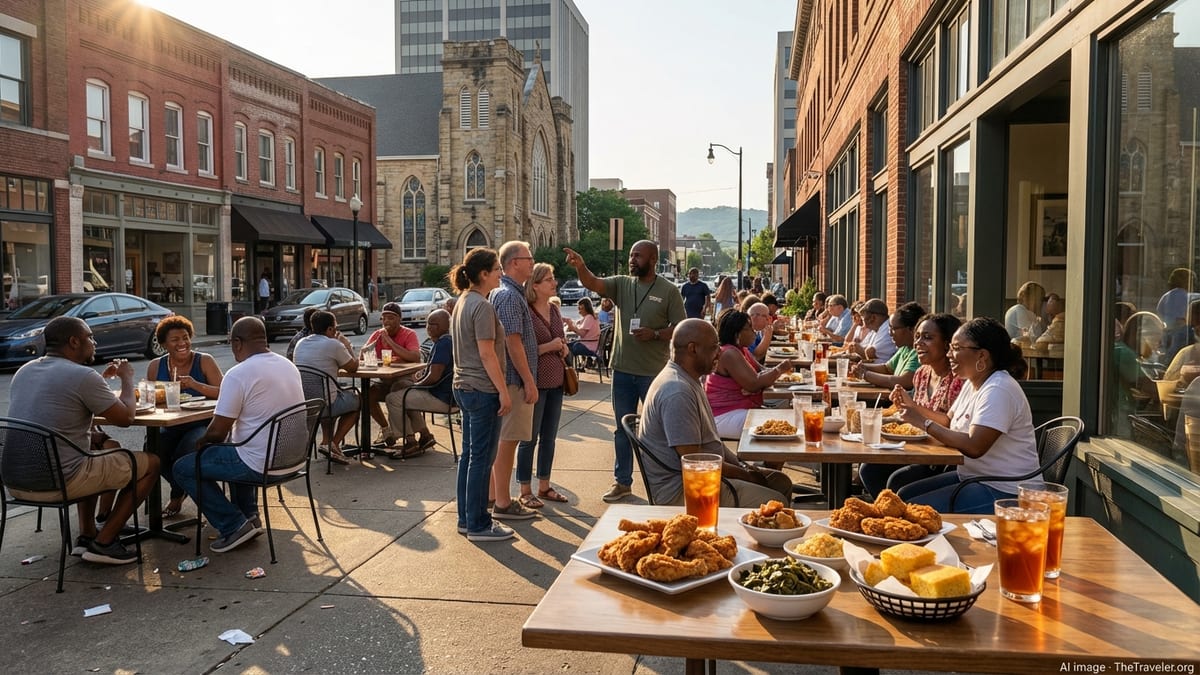
If any single element of Alabama culture embodies both continuity and change, it is food. Across the state, traditional Southern dishes anchor menus: fried chicken, collard greens, cornbread, biscuits, macaroni and cheese and an array of slow-cooked meats. In cities like Birmingham and Montgomery, I found both long-established diners and newer restaurants run by chefs who reinterpret classic recipes with lighter sauces, seasonal produce and global influences.
Locals introduced me to the concept of the “meat and three,” a plate that pairs a central protein with three side dishes. It is less a fixed offering than a framework that allows for endless combinations: fried catfish with turnip greens, black-eyed peas and cornbread one day, then roast pork with okra, squash casserole and potato salad the next. At lunch counters and family restaurants, I watched office workers, construction crews and church groups all order variations on the same comforting theme, turning the mid-day meal into a small communal ritual.
Barbecue in Alabama reflects both regional patterns and local quirks. Across the state, pulled pork is common, but I also encountered ribs and smoked chicken served with an array of sauces. In some spots, a tangy white sauce made with mayonnaise and vinegar accompanied grilled chicken, a style closely associated with northern Alabama. Conversations about barbecue quickly turned into discussions of family traditions: whose grandfather tended a pit overnight, which church hosted the best fundraiser plates and how recipes shifted as new generations came of age.
Desserts and sweet drinks play their own cultural role. Sweet tea appears almost by default at many tables, and homemade pies or banana pudding often close a meal. Rather than mere indulgence, these sweets often came with a story about the aunt, grandmother or neighbor who taught someone to bake. Sharing those stories alongside the food underscored how culinary knowledge in Alabama carries memory and identity forward.
Faith, Music and Gathering Places
Churches, concert halls and informal venues knit Alabama communities together in ways that are both visible and subtle. In many towns, church steeples punctuate the skyline, and Sundays reshape the rhythm of life. Even if visitors do not attend services, it is hard to miss how religious institutions function as cultural anchors, hosting not only worship but also community meals, youth programs and social justice initiatives. In some civil rights museums, exhibits highlight how local congregations once served as organizing hubs and continue to do so for new causes.
Music, too, is central to Alabama’s cultural identity. The state’s northern region, including areas around Muscle Shoals and Huntsville, has long been known for its recording studios and their influence on American popular music. Today, that legacy lingers in small venues, festivals and live-music bars where local bands play blues, soul, country and rock. Even in cities primarily associated with history or government, open-air concerts, jazz events and gospel performances keep music at the heart of public life.
I attended a small outdoor concert in Birmingham where families spread blankets, children chased one another between the food trucks and retirees compared notes on previous festivals. The lineup mixed jazz, R&B and contemporary singer-songwriter sets, but the real performance unfolded in the audience: neighbors greeting one another by name, vendors recognizing regulars and volunteers chatting with visitors about where they were from. That sense of music as a social glue felt deeply Southern, and very much alive in modern Alabama.
From Mountains to Gulf Coast: Landscapes That Shape Culture
One of the most unexpected lessons of my trip was how dramatically Alabama’s landscapes vary, and how much those natural settings shape local culture. In the northern part of the state, rolling hills and forested parks create a backdrop for hiking, waterfalls and mountain vistas. Residents proudly talk about weekend trips to state parks and preserves, where families camp, fish and gather for cookouts that blur the line between outdoor recreation and extended family reunion.
Further south, as the land flattens and the air grows thicker with humidity, river towns and agricultural areas reflect a different relationship with the environment. Here, conversations turned more often to farming cycles, hunting seasons and the practical realities of heat and storms. Outdoor events frequently start early or late in the day to avoid the fiercest sun, and the shaded porch or covered pavilion becomes a vital piece of local architecture. Learning to watch the sky and plan around weather patterns is part of the unspoken cultural curriculum.
On the Gulf Coast, beach towns reveal yet another Alabama. White sand, warm surf and seafood shacks create an atmosphere more associated with vacations than with the weighty history found inland. Yet even here, Southern culture asserts itself in drawled greetings, church marquees near the shore and local festivals that mix coastal traditions with broader regional themes. The sea shapes work, leisure and risk, reminding residents each hurricane season of their vulnerability and resilience.
Complex Conversations About Identity and Change
Perhaps the most important thing Alabama taught me about Southern culture is that it cannot be summarized in a single narrative. Throughout my visit, I encountered people who were deeply proud of their state and people who were candidly critical of its past and present. Often, they were the same individuals, holding affection and frustration in creative tension. In casual conversations, topics like economic inequality, public education, environmental protection and voting access emerged as central concerns, discussed with a mix of pragmatism and hope.
Many Alabamians I met were keenly aware of how outsiders view the South. Some described feeling misrepresented by national media, reduced to caricatures that ignore internal diversity of race, class, religion and political thought. Others acknowledged that the region’s fraught history and ongoing challenges make those caricatures hard to shake. The resulting dialogue, both within communities and between locals and visitors, is part of a larger cultural negotiation about what it means to be Southern today.
What struck me most was how often change in Alabama is driven not by grand statements but by local projects: a restored theater in a downtown corridor, a new gallery in a historic Black neighborhood, a food bank partnership between churches of different denominations, a youth program combining civil rights education with outdoor adventure. These small initiatives, grounded in specific places and relationships, offered a more realistic picture of Southern transformation than sweeping narratives ever could.
The Takeaway
When I think back on my time in Alabama, I do not picture a single city or landmark so much as a mosaic of moments: a museum docent quietly correcting my assumptions, a restaurant server slipping in an extra biscuit “because you ought to try it,” a family sharing the story of a grandparent who marched for voting rights, children dancing under string lights at a neighborhood concert. Together, those scenes formed a portrait of Southern culture that is generous, honest and far more varied than the clichés.
Alabama taught me that hospitality here is not about avoiding difficult subjects but about making enough space, emotionally and socially, to hold them. It is about greeting guests with a smile, feeding them well, then inviting them into the deeper story of a place that has shaped and been shaped by some of the most pivotal struggles in American life. For travelers willing to listen as much as they sightsee, the state becomes less a destination and more a conversation.
Leaving Alabama, I understood that Southern culture is not a static set of traditions but a living process of remembering, arguing, adapting and celebrating. It exists in historic sanctuaries and in new music venues, in courthouse squares and at roadside diners. My visit did not give me all the answers about the South, but it did something more valuable. It gave me better questions, and it showed me that the best way to understand a place is to show up, sit down at the table and let its people tell you who they are.
FAQ
Q1. Is Alabama safe for solo travelers interested in exploring its culture and history?
Alabama’s main cities and popular historic sites are accustomed to visitors, and many travelers explore them safely by following standard precautions such as staying aware of surroundings, securing valuables and asking locals or visitor centers about areas to avoid after dark.
Q2. What is the best time of year to visit Alabama for comfortable weather and cultural events?
Spring and fall are generally the most comfortable seasons, with milder temperatures and many festivals, outdoor concerts and cultural events scheduled to take advantage of the pleasant weather.
Q3. Do I need a car to experience Southern culture in Alabama?
Public transportation is limited outside certain urban areas, so renting a car makes it much easier to visit civil rights sites, small towns, parks and coastal communities that reveal the state’s cultural diversity.
Q4. How can I respectfully engage with Alabama’s civil rights history as a visitor?
Plan time for museums, memorials and guided tours, listen more than you speak, support local institutions through admission or donations and approach sensitive topics with humility and openness.
Q5. What foods should I try to get an authentic taste of Alabama?
Look for barbecue with regional sauces, “meat and three” plates, fried chicken, catfish, collard greens, cornbread, biscuits, banana pudding and seasonal seafood along the Gulf Coast.
Q6. Are there experiences that combine nature and culture in Alabama?
Yes, many travelers pair visits to civil rights landmarks or historic districts with hikes in nearby state parks, river excursions or time on the Gulf Coast, which helps connect landscape and local life.
Q7. How diverse is Alabama’s culture beyond traditional images of the South?
Alabama’s culture reflects a mix of Black, white and Indigenous histories, immigrant communities, urban and rural experiences and a wide range of religious and political perspectives that go beyond stereotypes.
Q8. Can I visit active churches or community spaces as part of understanding local culture?
Many churches and community centers welcome respectful visitors during public events or services; checking schedules in advance and following local customs regarding dress and behavior is important.
Q9. What should I know about social etiquette when talking with locals?
Politeness, patience and a willingness to engage in small talk go a long way; using “yes, ma’am” or “no, sir” when appropriate and avoiding assumptions about politics can help conversations flow smoothly.
Q10. How long should I plan for a trip that meaningfully explores Alabama’s Southern culture?
A week allows time to visit at least one major city, smaller towns, key civil rights sites and a natural area, though even a long weekend can offer a meaningful introduction if you focus your itinerary.