

The first time I saw Hudson Bay, it did not feel like arriving at the edge of a body of water. It felt like stepping off the map. The horizon was a straight, silver line, the sky a pale bowl overhead, and in between stretched pack ice and frigid water that seemed to inhale and exhale with the slow swell of the tide. I had come to Canada’s far north for the names that draw people here: polar bears, beluga whales, northern lights. What I ended up remembering most was the way this place feels in your body: the cold that stings your lungs, the crunch of permafrost under your boots, the silence so deep you hear your own pulse.
Arriving at the Edge of the Map
My journey into the world of Hudson Bay began not with a graceful descent into a major airport, but with a small plane tracing a line across miles of boreal forest and muskeg. Looking down, the land slowly thinned from dense green to tarnished gold and then to a blotchy quilt of rock, water and low scrub. When the pilot finally banked towards the coast, the airplane windows filled with a vast sheet of ice-flecked water, its color somewhere between steel and pewter. It was less like flying over a bay and more like approaching a frozen sea.
On the ground, the first sensation was the air. Even in summer, the atmosphere around Hudson Bay carries a sharpness that feels different from anything farther south. It is cool even when the sun is high, scented faintly with salt, lichens and the tang of wet stone. The second sensation is scale. Towns are small, the port facilities modest, and yet every human structure feels dwarfed by the sweep of the shoreline and the weight of the sky. You quickly understand that you are a guest here, both in human communities and in the larger Arctic ecosystem.
This part of Canada’s north is not an easy place to reach. Access often involves a combination of flights, and in some coastal communities, seasonal rail or ice roads connect residents to the rest of the country. That difficulty of access shapes your mindset. You arrive aware that everything you will experience has been hard won: supplies brought in at high cost, houses anchored into permafrost, and knowledge of the land carried across generations.
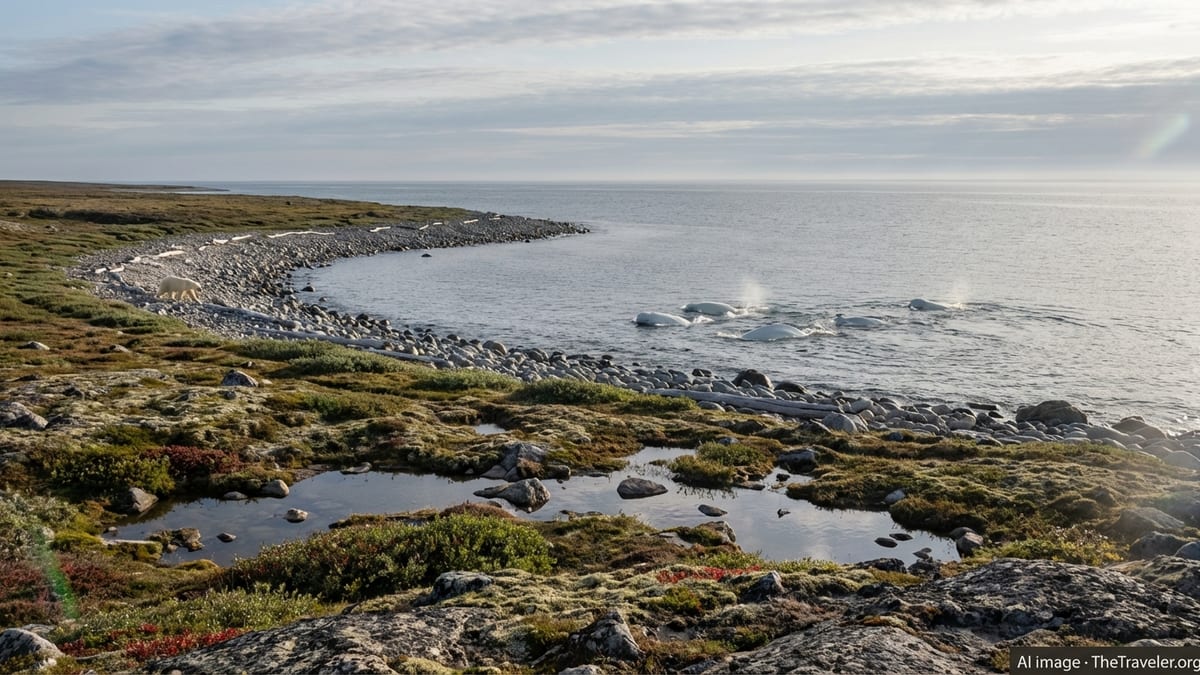
Stepping out for the first walk along the bay, I followed a gravel road towards the water’s edge, passing weathered buildings, sled dog yards and the occasional snowmobile propped for repairs. The shore itself was a tangle of rounded rocks, driftwood and patches of lingering ice, the surface of the bay alternately slick and broken. Even in silence, the place was loud with presence. It felt like standing at the threshold of something immense and implacable.
The Feel of True Subarctic Weather
Hudson Bay teaches you about cold even in the mildest season. In July, when much of southern Canada sweats under summer heat, average temperatures around the bay hover in the single digits to low teens Celsius. On my first morning, I woke to a sky washed in light cloud and a thermometer that would have felt like early spring anywhere else. Layered in wool and a windproof shell, I set out anyway, quickly learning that clothing here is less about style and more about survival-level comfort.
The weather in this region shifts quickly. One hour the bay lay almost glassy, a dull metallic sheen reflecting thin sun. The next, fog rolled in from offshore, swallowing horizon and landmarks alike until only the closest shapes remained. Walking along the coast in that damp mist felt otherworldly. Sound changed its character, muffled and close, the call of distant gulls flattened into a soft chorus. My breath turned to fine vapor, curling away in the chilled air, and the wind bit any exposed skin with a reminder that Hudson Bay ice can linger into early summer and returns again in fall.
On another day, the wind picked up without warning, cutting straight across the low landscape. Out on the tundra, there are few trees to blunt its power, only scattered stands of hardy shrubs and the odd fringe of black spruce set back from the shore. That exposure creates a sensation of being rinsed clean. The cold is not just a number on a weather app. It is a presence that wraps around you, that makes fingers clumsy if you remove your gloves too long to adjust a camera, that turns a short walk into something you have to plan as carefully as a hike in the mountains.
Evenings bring a different feeling. As the light slants low across the tundra, the wind often calms and the temperature nosedives. I remember standing outside one night in late summer, watching a thin ribbon of green start to shimmer across the northern sky. The aurora was not yet the full explosion of color you see in winter, but enough to remind me that this same sky, only a few months later, would arch over deep snow and bitter cold. The bay’s climate is severe, yet it feels oddly honest. There is no pretending you are anywhere but in the far north.
Walking the Tundra and Meeting the Land
If the bay itself is the beating heart of this region, the tundra around it is the skin and muscle. The first time I stepped off the rough road and onto open ground, I was surprised by how alive the surface felt. The ground is not a simple carpet of grass. Instead, it is a mosaic of resilient plants: spongy mosses, lichens in pale greens and rusts, tangles of dwarf birch and willow hugging close to the earth to escape the wind. Each step has a spring to it as the vegetation and thin soil shift over frozen ground below.
The color palette is muted and beautiful. In early summer, small wildflowers brighten the landscape in bursts of yellow, white and purple. Later, the tundra deepens into shades of bronze, burgundy and olive as the short growing season winds down. On clear days, the sky can feel almost overwhelmingly vast, a dome of high, hard blue that heightens the impression of standing on a planet a little closer to its raw edges.
Walking here is not just a scenic pastime. It is also a lesson in humility and caution. Trails may lead from town out to rocky viewpoints or historic sites, but beyond those, you are quickly in wildlife country. Guides emphasize that you never wander far without a plan, a radio and bear awareness training. Even with those precautions, the sense of exposure is tangible. The tundra offers few hiding places. You feel visible, small and very much a part of the food chain.
There are moments of astonishing quiet. Standing on a low rise one evening, I listened and heard almost nothing: no traffic, no distant hum of city life, only the faint crackle of wind moving through dry grasses and the occasional drip of meltwater. In that quiet, the land’s details become sharp. You notice the track of a fox across damp sand, the clean imprint of a caribou hoof in a patch of mud, the delicate arcs of migrating birds overhead. The tundra around Hudson Bay does not shout its beauty. It reveals it slowly, if you are willing to tread lightly and pay attention.
Among Polar Bears and Beluga Whales
For many visitors, the names alone are enough to justify the journey: polar bears and beluga whales. Seeing either species around Hudson Bay is not like a controlled zoo visit. It feels instead like negotiating a respectful truce with some of the most charismatic wildlife on earth, on their own terms and in their own home.
My first close encounter with a polar bear came from the secure height of a specialized tundra vehicle on an organized excursion. Rolling slowly across the coastal flats, we scanned for movement against the patchy snow and pale stones. When the guide finally pointed, it took a few moments for my eyes to separate the bear from the background. Then the shape resolved: a large, powerful animal moving with slow deliberation along the shoreline. Even from a safe distance, the bear’s presence was electric. This was no cartoon mascot, but a predator built entirely for survival in harsh conditions. Watching it pause to sniff the air, shake out its massive shoulders and then continue on its path, I felt a mix of awe and unease that stayed with me long after we drove away.
On the water, the mood is different. In summer, Hudson Bay becomes a gathering place for beluga whales, which move into warmer river estuaries along the western shore to feed, socialize and raise their young. Out on a small boat in the Churchill River and bay, the surface around us suddenly began to dimple and break. Rounded white backs arched through the water, some almost close enough to touch. Calves in softer gray tones surfaced beside their mothers, and the air filled with soft exhalations and distant whistles that we could hear more clearly through a hydrophone dropped overboard.
The feeling of belugas is not of danger, but of curiosity. They approached the boat in loose groups, sometimes riding the bow wave, sometimes turning sideways as if to look up at the strange beings peering down. Local operators here have increasingly strict guidelines designed to protect the whales, limiting how closely vessels can approach or how long they can remain. From a visitor’s perspective, those rules are not a frustration so much as an added layer of gratitude. Every minute in their presence feels like a privilege that exists only because people have agreed to put the animals’ well-being first.
Seeing both species in their own domains alters your sense of scale and time. Polar bears moving along the coast remind you that this region’s frozen seasons and sea ice still shape life, even as the climate shifts. Beluga pods filling the estuary make the water itself feel inhabited in a way that transforms a map into a living system. When I finally returned to shore, the ordinary act of looking at the bay felt changed. Where I had first seen a vast, severe emptiness, I now saw a place thick with rhythms and migrations, with lives intersecting just beyond the comfortable edge of human perception.
Life in the Communities of the Bay
Spend even a few days around Hudson Bay and you realize that the north is as much about people as it is about landscapes and wildlife. Small communities along the coast have long histories that reach back far beyond the arrival of European traders, and those histories are still present in language, food, storytelling and land-based practices. Walking through town, I passed both the familiar outlines of modern life and the unmistakable markers of a deeper relationship with the land: sled dog teams, smokehouses, racks for drying fish, snowmobiles and canoes resting side by side.
In conversations with local residents and guides, you hear the same message repeatedly. Hudson Bay is not a backdrop or a brand. It is home. For Indigenous communities in particular, ties to this region are not nostalgic but current and practical. Hunting, fishing and trapping remain important, both for cultural continuity and for sustenance. Seasonal movements out onto the sea ice or inland along river systems mean that the map many visitors carry in their heads is only a partial picture of how people actually experience this place.
The social atmosphere in town balances resilience with a straightforward realism. The cost of living is high, supplies can be delayed by weather, and the jobs that tourism brings are seasonal. At the same time, there is a visible pride in the ability to thrive in a place that demands so much. Community events, from cultural festivals to evening gatherings, have a warmth that contrasts sharply with the climate outside. One evening, while sharing a simple meal of local fish and bannock, I listened to stories about intense winter storms, close calls with wildlife and long journeys over sea ice. The laughter that followed each tale was the kind that comes from knowing you survived.
As a visitor, you are invited into that world only briefly. Respect means following local guidance, supporting Indigenous-owned operators where possible, and recognizing that your trip is intersecting with lives and lands that are not stage sets. What stays with you after leaving is not just the memory of polar bears and belugas, but the sense of communities that continue to adapt, drawing on both traditional knowledge and modern tools to navigate an environment that many outsiders still see as purely remote.
Seasons of Light, Ice and Silence
One of the most striking things about Hudson Bay is how completely the seasons rework the experience of the place. Visiting in summer, I felt the region in a state of fragile abundance. The tundra was in bloom, migratory birds patrolled the shoreline and the bay’s surface, though still cold, lay largely free of pack ice. Days stretched long, with lingering twilight that painted the western sky in subtle grays and pinks. It was easy, in those moments, to understand why wildlife and people alike concentrate so much activity into this narrow window of relative warmth.
Speak to locals, though, and you quickly understand that summer is only one face of Hudson Bay. By late autumn and winter, ice begins to lock the bay, thickening into a solid plain that becomes a highway for polar bears and, in some areas, a travel route for people. The sun drops lower, days shorten dramatically, and temperatures plunge well below freezing. In those months, the feeling of the north is sharper, more demanding. Travel becomes more complex, clothing and gear become critical, and the line between safe adventure and serious risk narrows.
Even in shoulder seasons, the shifts are dramatic. Spring arrives later than you expect, bringing a season of thaw and refreeze, meltwater pooling on still-frozen ground, and a sense of waiting as flocks of returning birds trace new patterns in the sky. Autumn, when I saw it, came with a quiet intensity. Tundra plants flared briefly into reds and golds before fading, winds stiffened, and a kind of collective exhale moved through both people and wildlife as preparations began for the long cold ahead.
The light may be the most memorable element of all. On clear nights in the darker months, the aurora borealis can emerge as swirling curtains and arcs of green, sometimes accented with pink or violet, rippling across stars that feel closer than they do anywhere farther south. During the day, low winter sun casts long blue shadows across snow and ice, turning even simple tracks and drifts into sculpted forms. Whether you visit in the glow of midsummer or under a winter sky ringing with starlight, the experience of Hudson Bay is intimately tied to how the earth’s tilt plays out at this latitude.
Traveling Responsibly in a Changing North
No trip to Hudson Bay feels complete without acknowledging the changes underway. Conversations with guides and community members often turn to the warming climate, shifting ice conditions and their effects on wildlife and daily life. Freeze-up on the bay does not always follow the patterns that older generations recall, and the reliability of certain travel routes on ice has altered. For species like polar bears, which depend on sea ice to hunt, these shifts are particularly significant. Seeing a bear along a shoreline that, in some seasons, remains open water longer than it once did, you are reminded that the scenes you are witnessing now may not look the same in decades to come.
As a visitor, this reality shapes how you move through the landscape. Choosing operators that prioritize safety and environmental responsibility becomes more than a matter of personal ethics; it is a way of helping reduce cumulative pressure on fragile ecosystems. Many tour providers now follow strict guidelines around wildlife viewing, limiting approach distances and time spent near animals, as well as educating guests on why certain once-common practices, such as closely approaching wildlife or entering the water with belugas, have been curtailed.
Your own small decisions matter, too. Packing reusable items to cut down on waste, respecting local advisories about where to walk, and taking the time to learn about the cultural significance of the land all contribute to a more thoughtful presence. The reward for that care is not only the knowledge that you have tried to tread lightly, but also the deeper level of insight that comes from traveling with intention. When you listen to a local elder describe changes they have seen in the ice, or hear a guide explain how altered migration patterns are reshaping their work, the experience of Hudson Bay becomes less of a postcard and more of a shared story in progress.
Leaving the bay, I carried that sense of shared responsibility with me. The flight south retraced the same broad sweep over forests and wetlands, but the map below felt different now. I knew that somewhere back along that enormous shoreline, the tide continued to rise and fall under shifting ice, polar bears followed their ancient routes, belugas navigated by sonar in murky water, and small communities watched the horizon for both weather and opportunity. Visiting Hudson Bay is not simply about getting to the far north and back. It is about letting the north rearrange your sense of scale, time and obligation.
The Takeaway
Trying to sum up what visiting Hudson Bay feels like is a bit like trying to capture the entire sweep of its coastline in one photograph. The experience is too wide, too layered and too bound up in subtle changes of light, weather and mood. Still, certain impressions linger powerfully. There is the physical sensation of the cold, clean air in your lungs, the spring of tundra underfoot and the way your body relaxes into a slower rhythm dictated not by schedules but by daylight, tides and wind.
There is also the emotional weight of the wildlife encounters. Seeing a polar bear cross a frozen inlet or a pod of belugas surround a boat in milky green water unlocks a childlike sense of wonder that feels increasingly rare in a modern, connected world. Yet those moments come with an adult awareness of fragility, of ecosystems under pressure and communities doing the daily work of adaptation. The magic of Hudson Bay is never separated from the reality of the challenges it faces.
Ultimately, the north leaves its mark less as a checklist of sights and more as a recalibration of perspective. After days spent under a sky that seems larger than any you have ever known, surrounded by a landscape that has no patience for haste or distraction, it is difficult to return home and see traffic, noise and crowded calendars in quite the same way. Hudson Bay asks something different of you: attention, humility and a willingness to feel small in the best possible sense.
If you are considering a journey to Canada’s far north, know that it will likely not be effortless or comfortable in the way an ordinary vacation might be. It will, however, be memorable in ways that continue to unfold long after you leave the shoreline behind. Hudson Bay stays with you, in the sound of distant waves you think you hear on quiet nights, in the memory of green light moving across a black sky, and in the understanding that somewhere beyond familiar maps, a vast and beautiful world continues to breathe in cold air and ancient rhythm.
FAQ
Q1. When is the best time of year to visit Hudson Bay?
The ideal time depends on what you want to experience. Summer, roughly July and August, brings milder temperatures, beluga whale gatherings and tundra in bloom, while October and November are prime months in some areas for polar bear viewing on the coast before the bay fully freezes.
Q2. How cold does it actually feel around Hudson Bay?
Even in summer, temperatures often feel like early spring, especially with wind off the water. In winter, conditions can be extremely cold, with deep subzero temperatures and windchill that demands serious cold-weather gear and local guidance.
Q3. Do I need a guide to explore the area safely?
In most cases, yes. Because of the presence of polar bears, rapidly changing weather and limited infrastructure, traveling with experienced local guides or organized tours is the safest and most responsible way to explore both the tundra and the bay.
Q4. Is it still possible to see polar bears near Hudson Bay?
Yes, this region remains one of the best places in the world to see wild polar bears, particularly in coastal zones where they wait for sea ice to form. Viewing is usually done from secure vehicles or guided platforms that prioritize both human safety and minimal disturbance to the animals.
Q5. Can visitors get close to beluga whales?
Visitors can often see belugas at relatively close range from boats and other approved platforms during summer gatherings in river estuaries. Strict guidelines usually limit how close vessels may approach and how interactions occur, in order to protect the whales’ welfare.
Q6. What kind of clothing should I pack for a trip to Hudson Bay?
Layers are essential. Bring a moisture-wicking base layer, warm mid-layers such as fleece or wool, a windproof and waterproof outer shell, insulated boots, a hat, gloves and a scarf or neck gaiter. Even in summer, you should be prepared for cold, wind and sudden weather shifts.
Q7. How do I get to communities along Hudson Bay?
Most visitors arrive by air on regional flights from larger Canadian cities. In some cases, seasonal train service or winter ice roads serve local residents, but for travelers, flying into a gateway community and then joining local operators is the most practical approach.
Q8. Is traveling to Hudson Bay suitable for families?
It can be, provided families are realistic about conditions and choose age-appropriate activities. Older children and teenagers who are interested in wildlife, science and outdoor adventure often find the experience deeply rewarding, but it is not a typical theme-park style vacation.
Q9. How can I be a responsible traveler in this region?
Choose locally owned and Indigenous-led operators when possible, follow all wildlife viewing rules, minimize waste, respect posted guidelines about where to walk and take time to learn about the cultural and environmental context of the places you visit.
Q10. Is a trip to Hudson Bay worth the cost and effort?
For many travelers, yes. Reaching Canada’s far north requires more planning and expense than a conventional holiday, but the combination of vast landscapes, remarkable wildlife and insight into northern communities creates an experience that often feels life-changing and unforgettable.