

I arrived in Nanaimo with all the usual images in my head: bright ferries gliding into a charming harbour, Nanaimo bars on every corner, and a laid-back island city that would feel like a smaller, cheaper, less touristy Victoria.
After several visits, spread across different seasons and trips around Vancouver Island, I can say some of that is true. But a lot of my time in Nanaimo felt more complicated, more uneven, and in some ways more honest than I expected. This is what it actually felt like to be there, compared with other island cities nearby.
First Impressions: The Harbour City That Feels More Practical Than Pretty
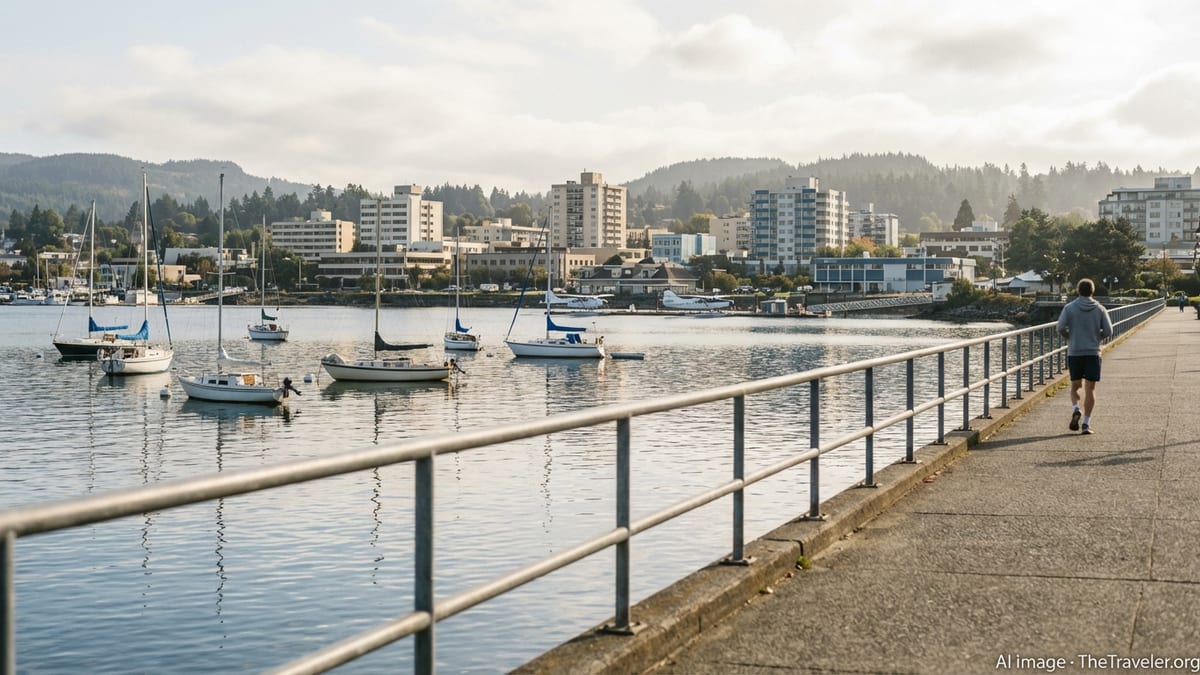
My first real glimpse of Nanaimo was from the deck of a BC Ferries ship sliding into Departure Bay. From a distance it looked exactly like the marketing photos: tree-covered hills, low mid-rise buildings stepping up from the water, floatplanes skimming the harbour. It felt promising, like I was arriving somewhere that quietly knew it had a good thing going. Compared with sailing into Victoria’s Inner Harbour, Nanaimo’s approach is less grand, but there is a certain understated, almost workaday beauty that I actually appreciated.
Once I drove off the ferry and started navigating town, that first impression changed. Nanaimo did not immediately feel like a polished destination city. The roads climbed and dipped more than I expected, funneling me through strip malls, older industrial areas, and residential streets that felt more suburban than coastal. It reminded me more of Courtenay or Campbell River than of postcard-perfect Victoria. I had to work a bit harder to find the charm, and that gap between the ferry approach and the street-level reality set the tone for much of my time there.
Compared to smaller island towns like Parksville or Qualicum Beach, where it often feels like you are never more than a few blocks from the shoreline, Nanaimo’s relationship with the water is less obvious from the car. The city brands itself as a harbour city, and technically that is absolutely true, but the first feeling I had was of a regional hub rather than a seaside retreat. It took me a couple of days and a lot of walking before I could see why locals are so attached to it.
Waterfront Walks, Island Hops, and the Moments That Really Worked
The first place Nanaimo truly clicked for me was along the waterfront walkway. Once I parked the car and just started walking from Maffeo Sutton Park, the city finally lined up with the images I had in my head. Kids were climbing over the inclusive playground, dogs dragged their humans toward the shoreline, and joggers threaded past slow-moving tourists like me. The mountain backdrop across the Salish Sea, especially on a clear morning, is the kind of view that makes you stop mid-sentence.
Compared with Victoria’s Inner Harbour, the Nanaimo waterfront felt less curated, less dressed up for visitors, and more like a shared backyard for residents. I liked that. It still has the marinas and seaplanes and public art, but it also has working docks and a slightly scruffier, honest edge. I could hear construction, see shipyard cranes in the distance, and walk past real people heading to real jobs. It did not feel like a stage set designed purely for cruise passengers.
The real highlights for me, though, were the easy island hops. Taking the short passenger ferry out to Saysutshun (Newcastle Island Marine Park) felt like stepping into a different trip entirely. Within minutes I had traded traffic and strip malls for forest trails, quiet beaches, and looping coastal views back toward the city. Protection Island had a similar offbeat appeal, with its car-light roads and little pockets of community life that felt worlds away even though the skyline of Nanaimo was still right there. These escapes, both so close and so inexpensive, are where Nanaimo really outperforms a lot of other island cities.
If you are comfortable piecing together your own mini-adventures rather than expecting one compact tourist core, the waterfront and nearby islands make Nanaimo feel rich. On one day I walked the harbour walkway in the morning, hopped a ferry to Newcastle for an afternoon loop hike, and still made it back in time for a casual dinner downtown. That combination of access and variety is something I have not found as easily in smaller towns like Parksville or in more formalized cities like Victoria.
Downtown Reality: Artsy Corners, Empty Storefronts, and Safety Trade-offs
Walking around downtown Nanaimo was where my expectations and reality diverged the most. I had pictured a compact, bustling centre filled with independent shops, galleries, and cafes, something halfway between Victoria’s Old Town and the main streets of island communities like Courtenay. What I actually found was a patchwork: blocks that felt lively and creative right next to areas that were quiet, worn, or frankly a bit edgy.
On some streets, I ducked into genuinely excellent coffee shops and small restaurants with thoughtful menus. I browsed an art gallery and a couple of secondhand stores that had real character. There is a solid core of local businesses making the most of what they have, and when you land on those blocks, Nanaimo feels like a city with a grounded, everyday creative energy. I could see why people would choose to live here rather than just visit.
But there were also stretches that felt hollowed out. Empty storefronts, fading signage, and a sense of a downtown in transition. On more than one evening I noticed how quickly the pedestrians thinned out after dark. I was aware of people sleeping rough, of visible drug use, and of residents who clearly felt familiar with these realities. Nanaimo is not alone in this; cities across British Columbia are grappling with the same intertwined issues of homelessness, addiction, and public disorder. Still, as a visitor, I felt myself scanning my surroundings more, especially at night, in a way I usually do not in somewhere like downtown Victoria or even central Parksville.
I never had a specific incident that made me feel truly unsafe, but there were moments when I chose my routes more carefully or cut an evening walk short because the energy shifted. During the day, downtown felt mixed but manageable. After dark, it felt more like a place residents navigate with local knowledge, while visitors retreat to their hotels or up the hill to quieter neighbourhoods. If you arrive expecting a polished urban core, you may find this part of Nanaimo confronting or disappointing.
Comparing Atmospheres: Nanaimo vs Victoria, Parksville, and Other Island Hubs
After bouncing between several island cities, the thing that stands out most about Nanaimo is that it feels less sure of its identity. Victoria, for all its flaws, clearly sees itself as a historic capital and polished visitor destination. Parksville and Qualicum Beach lean hard into their beach-town and retirement-community personas. Courtenay and Comox market themselves as gateways to mountains and rivers. Nanaimo sits somewhere in the middle of all of that, a genuine working hub that happens to occupy a prime stretch of coastline.
That middle position has pros and cons. On the positive side, I felt far less like I was moving through a tourist bubble. Prices in many places were closer to what locals actually pay, especially once I got a few blocks away from the waterfront. There were more everyday services: big-box stores, medical offices, auto shops, and all the practical infrastructure that supports a regional population. If I imagine actually living on the island rather than just passing through, Nanaimo’s practicality starts to look like a major advantage.
On the downside, that practicality sometimes undermined the sense of being “away.” In Victoria, almost every turn in the city centre puts you in contact with heritage architecture, gardens, or the harbour. In Parksville, the long sandy beach is impossible to ignore. In Nanaimo, I often felt that I had to deliberately seek out the scenic pockets: a particular park, a specific viewpoint, a known trailhead. That is not necessarily a bad thing, but it does mean the city can underwhelm if you only have a short time and no local guidance.
Atmospherically, I would describe Nanaimo as a bit rougher, a bit more transitional, and less romantic than its neighbours. It has moments of real beauty and warmth, but they are woven through a landscape of aging malls, car-centric arterials, and in-between zones that feel like they have not yet decided what they want to be. If you come expecting Victoria’s polish, you may be let down. If you come ready for a mixed, evolving, lived-in city, you might find it more interesting than you expected.
Getting Around: Hills, Highways, and Surprising Convenience
One of my unexpected frustrations in Nanaimo was how much the city made me think about transportation. From a macro perspective, this is one of the best-connected places on the island. Ferries fan out to the mainland, smaller islands, and nearby communities. Seaplanes buzz in and out of the harbour. There is a regional airport with direct flights to major Canadian cities, plus a new passenger-only fast ferry linking downtown Nanaimo with downtown Vancouver in about seventy-five minutes. On a map, it is hard to beat.
On the ground, though, I found moving within Nanaimo a bit less intuitive. The topography matters more than any tourist brochure suggests. Those hills I admired from the ferry became long climbs when I tried to tackle parts of the city on foot. Walking between neighbourhoods that looked close on my phone sometimes meant navigating steep grades, busy multi-lane roads, or stretches where the pedestrian realm thinned out to narrow sidewalks beside fast-moving traffic.
Compared with Victoria’s walkable downtown grid or the compact centres of places like Sidney or Duncan, Nanaimo felt more spread out and car-reliant. There are good exceptions: the area around the waterfront walkway is easy to explore on foot, and some residential pockets have pleasant local paths and parks. But if you want to experience the variety of what Nanaimo offers, from shopping areas to viewpoints to university-adjacent cafes, a car or at least a comfort level with local transit is very useful.
That said, the broader connectivity is where Nanaimo shines. Being able to wake up, catch a ferry or seaplane to Vancouver, return the same day, and still end the evening with a walk along the harbour is not something smaller island towns can easily match. As a base for island and mainland exploration, Nanaimo felt incredibly strategic; I just had to accept that within-city spontaneity usually involved getting behind the wheel.
Nature Nearby: Parks, Trails, and How It Stacks Up Against Other Island Escapes
When I talk about Nanaimo with other travelers, I often end up saying: the city itself is fine, but the access to nature is excellent. Within and just beyond the city limits there are hundreds of hectares of parkland and an impressive network of trails. Once I shifted my mindset from “I am here to see a city” to “I am here to use a city as a launch pad,” my experience improved dramatically.
On different visits I walked coastal trails around Newcastle Island, wandered forested pathways near the Nanaimo River, and drove out to lakes and viewpoints that felt comfortably wild but still close to town. The climb up Mount Benson is a local favourite for a reason, and even intermediate hikers can usually handle it with some preparation. Spotting locals heading out with dogs, trail runners, and mountain bikes, I could see how deeply the outdoor culture is woven into everyday life here.
Compared with more compact destination towns like Tofino or Ucluelet, Nanaimo lacks a single defining natural feature, like a world-famous surf beach. Instead it offers variety: rivers, lakes, urban parks, coastal islands, and mountain trails all within a short drive or ferry hop. That breadth more than made up for the absence of one iconic landmark for me. I also appreciated that many of the parks and trails felt like genuine local spaces rather than Instagram backdrops, even though the scenery absolutely holds up on camera.
If your ideal island trip is waking up to a walkable seaside village and spending most of your time within a ten-minute stroll of your accommodation, Nanaimo might not be the best match. But if you want a central base with easy drives to places like Parksville, Ladysmith, Chemainus, and beyond, plus strong local options for hiking and cycling, it quietly does a lot right.
Costs, Comforts, and Where Expectations Didn’t Quite Match Reality
Part of Nanaimo’s appeal, at least in theory, is that it offers a more affordable alternative to Victoria while still giving you urban amenities and scenic surroundings. In some respects, I found that to be true. Accommodation and dining, particularly outside the peak summer season, were often a bit easier on my budget than comparable options in Victoria or on the Pacific Rim side of the island. Grocery stores and everyday services felt like normal city prices rather than tourist-inflated ones.
Where my expectations did not fully line up with reality was in the overall feeling of comfort. I had imagined that a medium-sized island city would naturally feel cozy and relaxed. Instead, there were times when the combination of visible social issues, patchy urban design, and car-heavy streets left me a little on edge or simply less at ease than I had hoped. The city never felt outright hostile, but it did not always feel as welcoming as some of the smaller island communities I visited on the same trip.
Accommodation quality varied more than I expected. I stayed in a couple of places that were excellent value, clean and modern with friendly staff and walkable access to the waterfront. I also spent a night in a dated motel that carried noise and felt more worn-out than the photos suggested. That is not unusual for any regional city, but in Nanaimo the contrast between the scenic surroundings and some of the tired infrastructure made the gaps more obvious.
If I went back, I would spend more time researching exactly where I stayed, aiming either for places right by the waterfront or for quieter residential areas with easy car access to the highway. I would also adjust my expectations: Nanaimo is not a polished resort town, and if you approach it as such you will notice every rough edge. Going in with a mindset of “regional hub with perks” makes its compromises easier to accept.
The Takeaway: Who Nanaimo Is Really For, and How I’d Do It Differently Next Time
After several visits, my honest feeling is that Nanaimo is less of a destination in its own right and more of a highly functional, sometimes surprising base camp. It is more interesting than its reputation as a ferry and shopping stop suggests, but also more uneven than the glossy harbour photos imply. It is a city in motion, with genuine natural advantages and a growing population, but it is still working through real social and urban challenges that you cannot ignore as a visitor.
If your idea of a perfect island escape is a single, picturesque town centre where you can do everything on foot, you will probably be happier in places like Victoria, Sidney, or even Parksville. If you want one of those once-in-a-lifetime, atmosphere-heavy destinations, you will likely aim farther afield to Tofino, Ucluelet, or the Gulf Islands. Nanaimo does not compete on that level, and it is not trying to, at least not yet.
Where Nanaimo shines is for travelers who value convenience and variety over seamless charm. If you want to bounce between mainland and island, explore nearby communities, hike different types of terrain, and still have access to big-city basics, this is a smart place to anchor yourself. It particularly suits repeat visitors to Vancouver Island, people scoping out potential places to live, and anyone who prefers an honest, lived-in city over something polished but fragile.
If I were to repeat the experience, I would spend less time expecting downtown Nanaimo to be the star and more time using it as a launch pad. I would plan my days around early-morning waterfront walks, island hops to Newcastle or Protection, hikes in the nearby parks, and short road trips to other coastal towns. In the evenings I would target specific local restaurants and cafes that I know I like, rather than wandering and hoping to stumble onto a scene. Approached that way, Nanaimo becomes not a disappointment next to other island cities, but a practical, sometimes quietly rewarding centre of gravity for exploring a much bigger, more complex coast.
FAQ
Q1. Is Nanaimo worth visiting if I only have one or two days on Vancouver Island?
If you have just one or two days and want a dramatic, postcard-style experience, I would lean toward Victoria or a smaller, very walkable town. Nanaimo can still work, especially if you pair the waterfront walkway with a quick trip to Newcastle Island, but it rewards a slightly longer stay where you can use it as a base for nearby nature and island-hopping.
Q2. How safe did I actually feel walking around downtown Nanaimo?
During the day I generally felt fine, if a bit aware of my surroundings. In the evenings, especially later at night, I found myself choosing routes more carefully and sometimes heading back earlier than planned. I did not experience any direct problems, but the mix of empty storefronts, visible homelessness, and drug use made parts of downtown feel uneasy after dark compared with places like central Victoria.
Q3. How does Nanaimo compare to Victoria for first-time visitors to Vancouver Island?
For a first-time visitor, Victoria offers a more polished, compact, and obviously scenic experience. Heritage buildings, the Inner Harbour, and major attractions are all close together. Nanaimo is more spread out and less curated, with real strengths in connectivity and access to nearby nature. I see Nanaimo as better for travelers who have already been to the island once or who care more about exploring the broader region than ticking off landmarks.
Q4. Is Nanaimo a good base for exploring other parts of Vancouver Island?
Yes, and this is where the city really shines for me. From Nanaimo it is fairly straightforward to head north to Parksville, Qualicum, and the Comox Valley, or south toward Ladysmith and Chemainus. Ferries and seaplanes connect you to the mainland and smaller islands, and the highway network makes day trips easy. If your goal is to cover a lot of ground, Nanaimo is a very practical hub.
Q5. What surprised me most about Nanaimo compared with other island cities?
The biggest surprise was how much effort it sometimes took to uncover the charm. In places like Parksville or Sidney, the appeal is immediately visible. In Nanaimo, I had to seek out particular parks, viewpoints, and neighbourhood pockets. Once I did, the city became much more enjoyable, but it is not a place where every corner is automatically pretty or visitor-focused.
Q6. Is Nanaimo a good choice for travelers without a car?
It is possible, but I found it limiting. You can enjoy the waterfront, hop ferries to nearby islands, and reach some services on foot or by transit. However, many of the best hikes, lakes, and viewpoints are easier with a car. Without one, I would focus my time around the harbour, Newcastle Island, and a carefully chosen accommodation within easy walking distance of what you most want to see.
Q7. How does Nanaimo feel in terms of cost compared with other island destinations?
Overall, I found Nanaimo slightly more affordable than Victoria and some high-profile resort areas, especially outside the summer peak. Restaurants, groceries, and everyday services felt more like normal city prices than tourist premiums. That said, accommodation quality varies, so it is worth reading recent reviews and being choosy about where you stay.
Q8. Is Nanaimo family-friendly?
Yes, with some caveats. Families will likely enjoy the waterfront playgrounds, parks, and easy ferry rides to Newcastle or Protection Island. At the same time, certain downtown areas feel a bit rough around the edges, especially in the evening, and might not match every family’s comfort level. With some planning around location and activities, it can work very well, but it is not as uniformly gentle as a classic beach town.
Q9. How much time would I personally allocate to Nanaimo on a longer island trip?
On a week-long Vancouver Island trip, I would probably spend two or three nights in Nanaimo, using it mainly as a base for nearby day trips and outdoor activities. I would then balance that with stays in at least one more “destination” town, such as Victoria, Tofino, or a smaller coastal community, to get that more immersive, walkable village feel.
Q10. Would I return to Nanaimo, and what would I do differently next time?
I would return, but with clearer intentions. Next time I would book a place close to the waterfront or in a quiet residential area, plan specific hikes and island visits in advance, and treat downtown as one component rather than the main event. Approached as a convenient, authentic base with pockets of beauty rather than a polished showpiece, Nanaimo fits much more comfortably into my picture of Vancouver Island.