

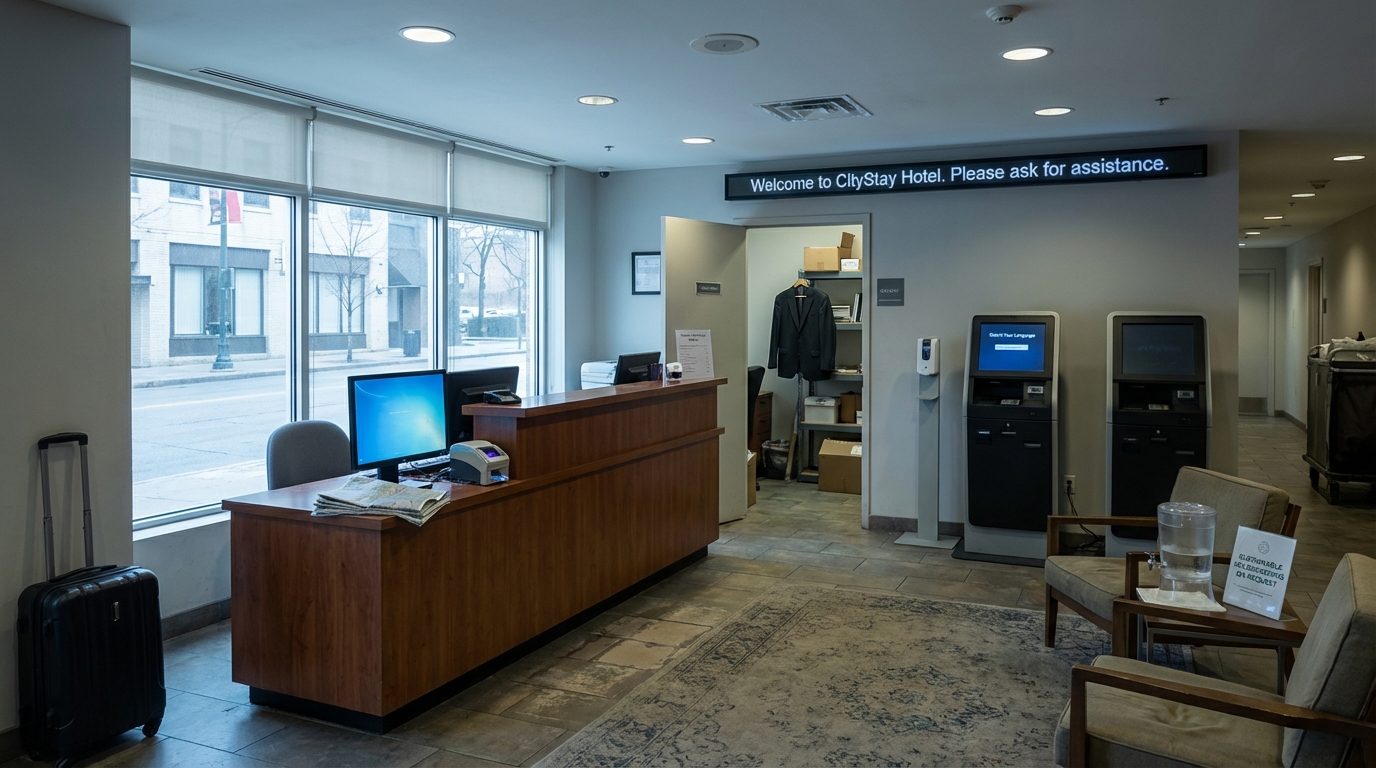
The moment you walk into a hotel lobby now, it can feel like a familiar scene that no longer behaves the way it used to. A front desk that looks open might be staffed by only one person juggling several roles. Check in can be smooth for one traveler, strangely fragmented for the next.
The bones of the experience are the same, yet something about the timing, the attention, the handoffs feels slightly out of sync.
In many destinations, this has settled into a kind of new normal. Travelers arrive expecting a predictable sequence and instead encounter a mix of automation, partial service, and quiet gaps.
The hotel still promises comfort and reliability, but the path from booking to checkout has become less straightforward, more conditional, more dependent on how much the property can actually deliver on any given day.
What stands out in this moment is how uneven hospitality has become. Across regions and price points, hotels are navigating rising costs, ongoing staffing gaps, and shifting guest expectations, and the result is a patchwork of experiences that can vary widely even within the same brand family.
Some properties lean heavily on technology to hold things together, others cut back visible services, and many do both at once.
This instability catches travelers off guard because the hotel stay has long been sold as the steady part of a trip. Flights might be delayed, plans might shift, but the room was supposed to be the constant.
Now, guests increasingly find that basic elements once taken for granted, such as daily room refreshes or fully available facilities, are treated as flexible features rather than default guarantees.
On paper, the industry tends to describe this as optimization. Official language emphasizes efficiency, personalization, and modern guest journeys. Lobbies filled with kiosks and app-based keys are framed as friction reduction.
Less frequent housekeeping is often presented as both environmentally conscious and respectful of privacy. Dynamic pricing is justified as a way to align room rates with real-time demand and value.
For travelers, the same shifts can feel different. What is described as convenience can translate into more work: more forms to fill, more messages to send, more steps to manage alone.
Gaps in staffing show up as slower responses or shorter service windows. Price structures that promise flexibility surface as a haze of surcharges and upgrade prompts that make it harder to understand what a stay will truly cost.
One of the defining patterns is a widening gap between properties that can afford to exceed expectations and those that struggle to meet them. At the top end, some hotels are quietly adding layers of tailored attention and invisible technology, allowing them to keep service levels high while hiding the strain beneath.
At the budget and midscale levels, travelers often encounter stripped-back offerings where the room itself still looks familiar, but almost everything surrounding it feels thinner.
This split creates a subtle psychological shift. Guests who once trusted a brand name or star rating to signal a consistent experience now discover that outcomes can hinge on small variables: the time of arrival, whether key employees are on duty, how stretched housekeeping is that day. Trust, in effect, becomes more local and situational, built property by property rather than guaranteed by the sign out front.
Technology sits at the center of this zeitgeist. Many hotel groups highlight their investment in automation, smart rooms, and AI-driven communication as evidence of progress. The promise is smoother operations, faster answers, and hyper-personalized stays.
In practice, travelers often find a more mixed reality: chat tools that resolve simple questions instantly but stumble with anything nuanced, digital keys that occasionally misfire, and smart controls that are more impressive than intuitive.
These tools are also changing how presence feels inside a property. A lobby that once buzzed with staff activity may now appear oddly quiet, even when occupancy is strong.
Guests communicate from elevators and beds rather than at the desk, and requests move through unseen systems. For some, this creates a welcome sense of autonomy. For others, it deepens the sense that there is no clear person in charge when something actually goes wrong.
Another steady shift is the reframing of housekeeping and amenities. Many hotels now present reduced room cleaning as standard, with fuller service available only on request or through higher-priced categories. Single-use products quietly disappear in favor of refillable options.
The environmental case for these moves is prominent, but the operational advantages are equally significant, and travelers often sense that both forces are at work.
This blend of sustainability language and cost control can blur intentions. Guests who value lower-impact stays might appreciate fewer disposables and less linen turnover, yet they also notice when these adjustments coincide with fewer staff and longer waits. The same initiative that feels ethically aligned can still leave the impression that a stay offers less tangible care than before.
Pricing behavior adds another layer of uncertainty. As more hotels lean into finely tuned revenue systems, room rates and fees can change rapidly, even within a single day.
Travelers report seeing wide swings between what a stay looked like when first researched and what it costs when they eventually feel ready to book. The structure is opaque, and many leave with the suspicion that they have missed some better moment they were never told how to find.
This opacity does not always show up as dramatic overcharging; sometimes it simply erodes the sense of fairness. Guests compare notes and notice that the same category, on the same dates, came with different prices, inclusions, or mandatory add-ons.
Over time, this encourages a more transactional mindset on both sides, with hotels trying to maximize yield and travelers treating loyalty as an optional, case-by-case calculation.
Behind the scenes, persistent staffing challenges shape much of what guests see. Many properties across various markets continue to operate with fewer employees than they would prefer, especially in labor-intensive roles.
Official messaging often highlights resilience and innovation, yet the practical outcome inside the property is shorter opening hours, reduced menus, or longer stretches where no staff member is visibly available.
For travelers, these absences are experienced as small, cumulative inconveniences. A closed bar during posted hours, a concierge desk that exists mostly as a sign, a breakfast room that cannot keep up with a surge in arrivals.
None of these are headline problems, yet together they redefine what a standard hotel stay feels like and how much energy guests must spend filling in the gaps themselves.
All of this leaves the hotel industry in a curious emotional space for travelers. Stays are still happening, rooms are still comfortable, and many visits pass without major incident.
Yet there is a noticeable fragility around the edges, a sense that reliability is being actively managed rather than quietly assured. For anyone planning a trip, this matters less as a reason to worry and more as a reminder that even the most familiar parts of travel are shifting underfoot, in ways that may not settle anytime soon.