

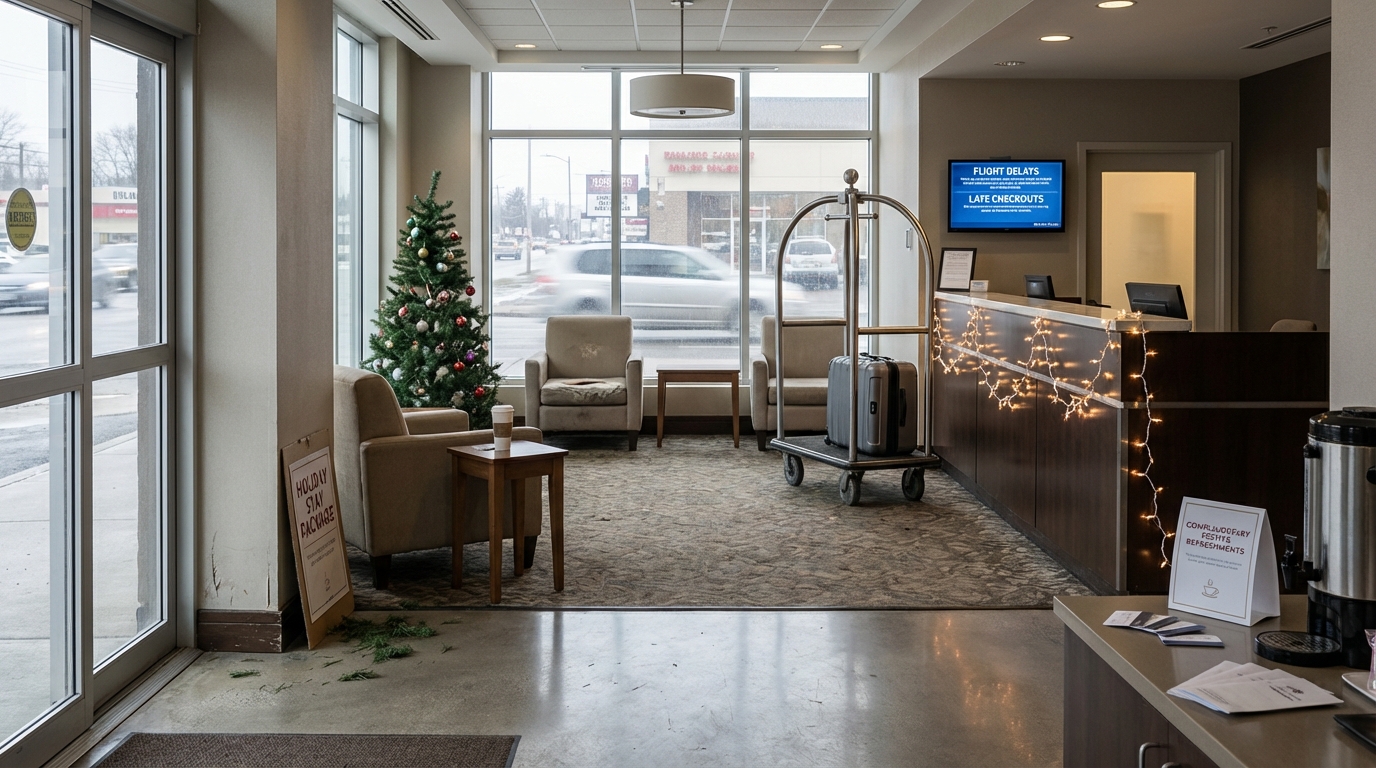
The lights in the hotel lobby look festive enough, but the line at the front desk feels anything but celebratory. A family in matching sweaters negotiates a room change while a night-shift worker quietly refills the coffee urn, eyes fixed on the clock instead of any holiday display.
It is technically a special day, yet the building hums like an ordinary one, full of checkouts, key cards, and misrouted luggage.
Across town, a restaurant kitchen that has been dressed up for the season still moves in the same clipped rhythm of ticket times and table turns. Some staff wear novelty headbands, but they are also counting hours, juggling transport home, and watching messages from people gathering without them.
For many travelers, it is a jarring moment: stepping into a space that claims holiday warmth while the people making it possible are clearly on a different schedule of celebration, or not on one at all.
In many destinations, this contrast has become a defining feature of how the holidays feel for people on the move. Travelers arrive expecting a pause from ordinary life and instead encounter an industry that cannot really pause at all.
Check in, room service, airport transfers and late-night snacks continue without visible interruption, which can create the illusion that the world has gracefully arranged itself around their trip.
Behind that illusion lies a pattern that is quietly reshaping the emotional tone of holiday travel. Hospitality work has been stretching further into family time, personal rituals, and cultural observances, and the boundaries that once separated “on” and “off” have thinned.
Guests notice it in small, awkward moments: the server who mentions their own celebration in passing, the housekeeper who knocks just as someone calls home, the driver who hints at a second job when traffic stalls.
Many travelers are caught off guard because they grew up with a story that special days are when everything stops. Schools close, offices empty, streets quiet. Yet airports hum, resort corridors echo with rolling suitcases, and seaside bars remain open long after home kitchens would have gone dark.
The expectation that holidays are for rest collides with the reality that some of the most intensive hospitality work clusters around them.
Language plays a large role in that surprise. Property notices and marketing copy tend to frame holiday operations as a service, never as a strain.
Guests are told that restaurants remain open as a convenience, that extended hours are a festive benefit, that “round the clock” teams stand ready. The phrasing suggests effort without cost, care without fatigue, and generosity that always fits neatly into a brand story.
Internally, managers in hotels, restaurants, and transport hubs often lean on the same vocabulary. Schedules are described as enhanced coverage rather than stretched staff, and last minute adjustments are framed as flexibility.
The tone emphasizes continuity, reliability, and tradition. Those words reassure guests that their plans are safe, but they also obscure the tradeoffs for the people working through the day when most others are sitting down.
What travelers actually experience can feel very different from the polished promise. Service is not exactly worse, but it can be thinner at the edges. A bar may be technically open, yet handled by a single person covering multiple roles.
Housekeeping might operate on a reduced pattern that leaves some requests hanging until long after guests have left the room. At the front desk, the same few employees may reappear at unexpected hours, quietly revealing how narrow the staffing band really is.
Those gaps do more than slow things down. They change the emotional temperature of a stay. A missed room refresh or delayed meal on an ordinary day is mildly irritating.
During a holiday that many people treat as a marker of belonging or tradition, the same delay can feel sharper, as if the hotel or restaurant has failed to honor an unspoken social promise. Guests sometimes direct that frustration at the person in front of them, who is often the one who has sacrificed the most to be there.
In some regions, hospitality workers have begun quietly resisting the idea that certain dates belong entirely to travelers. Staff trade shifts more aggressively, decline voluntary overtime, or lobby informally for partial closures during peak family hours.
Guests may not see these negotiations, but they feel the result when a favorite venue is open for fewer hours than expected, or when certain services are described as “limited” without much detail.
There is also a growing reliance on temporary or rotating workers to sustain the appearance that everything is available all the time. Travelers notice this when they encounter teams who are unfamiliar with local customs, unsure about menus, or still learning the layout of a property.
The holiday setting masks this in part, as decorations and background music suggest comfort and tradition, yet the actual interactions can feel fleeting and transactional.
Technology adds another layer of distance. In many properties, self-check-in kiosks, QR menus, and automated messaging have become the main interface between travelers and the place they are staying.
This can make operations more efficient at a time when staffing is tight, but it also means that fewer workers absorb more of the emotional weight from guests who insist on speaking to a person when something feels off. Holiday framing can intensify that tension, because guests often arrive with heightened expectations of warmth and recognition.
The result is a subtle dissonance: public spaces dressed for togetherness and private working lives quietly reorganized around shifts, commutes, and split celebrations.
Travelers drift through candlelit lobbies and themed buffets while the people tending those spaces check their messages in back hallways, arrange alternate gatherings, or plan to sleep through the parts of the holiday the guests will talk about later. The celebration exists, but it is staggered, redistributed, and in many cases outsourced to another day.
For travelers, this ongoing pattern matters less as a moral question and more as a practical atmosphere they find themselves moving through. The holidays no longer sit outside the logic of constant service; they have been folded into it. The warmth on display is real enough, yet it rests on a kind of shared pretense that hospitality can be endlessly elastic without fraying.
As more people notice the seams, the experience of celebrating away from home starts to feel a little different: still inviting, still bright, but edged with the awareness that the holiday never truly starts or ends for everyone at the same time.