

I went to Duncan, British Columbia with the vague idea that it would be a quieter, cheaper base for exploring the Cowichan Valley, with a cute walkable downtown and easy access to wineries, hikes, and the ocean.
That was partly true, but the reality of where I stayed and how I planned my days was more complicated. Some things were genuinely lovely and worth the trip. Others left me wishing I had done a little more homework before committing to my accommodations and itinerary.
Why I Chose Duncan as a Base (and What I Missed in the Fine Print)
I picked Duncan almost by default. It sits about halfway between Victoria and Nanaimo, right off the Trans Canada Highway, and every tourism description framed it as the “heart of the Cowichan Region” with a walkable core and strong food and wine scene. On paper, that sounded ideal: a small city with real services, but close to vineyards, hiking trails and rivers instead of big-city traffic.
The problem is that most of that glossy description glosses over how car-dependent the experience still feels. Yes, Duncan’s downtown is compact and easy to walk once you are there, but so many of the region’s highlights are spread across the valley. I underestimated how much driving I would do and how much time I would spend hopping back and forth on the highway instead of sinking into one neighborhood or landscape.
I also assumed, a bit naively, that being a smaller city in the Cowichan Valley would automatically mean a peaceful stay. The reality is that Duncan straddles a major transportation corridor, with trains and highway traffic, and the overall vibe shifts quickly from charming side streets to fairly utilitarian commercial strips. I do not regret choosing Duncan, but I wish I had been more honest with myself that this is a practical base for exploring the region, not a purely atmospheric destination in its own right.
If you go in with realistic expectations, Duncan can absolutely work. If you expect a postcard-perfect, all-in-one vacation town where you can ditch the car and wander from beach to wine bar to forest, you will likely be disappointed.
Where I Stayed: The Tradeoffs of Being Near the Highway
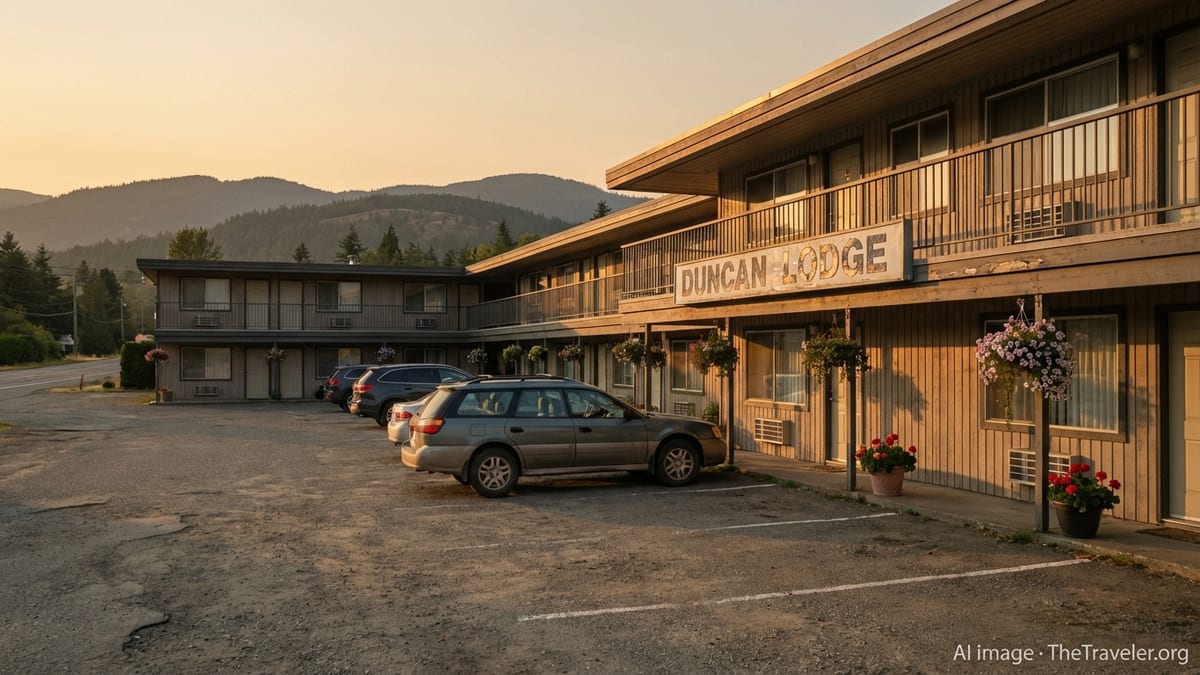
I stayed in a modest motel-style property just a short drive from the core, chosen mainly for price and easy parking. The listing promised “convenient access to the Trans Canada Highway” and “short drive to downtown.” That was accurate, but “highway access” turned out to be code for noticeable road noise and a somewhat anonymous, in-between location surrounded by gas stations, fast food, and other motels.
Inside, my room was mostly what I expected at the price point: clean enough, basic furniture, a bed that was fine for a few nights but not the kind of mattress you eagerly return to. The main frustration was sound. Traffic hummed well into the night, and there was a train line not far away that added intermittent noise. I used earplugs and slept, but it was not the quiet, small-town retreat I had pictured when I booked.
On the positive side, being so close to the main road made day trips simple. I could get to the BC Forest Discovery Centre in a few minutes, or be on the way toward wineries, Maple Bay, or the Koksilah River without winding through residential streets. If your main goal is to drive out each day and you are not too sensitive to noise or atmosphere, this kind of location is practical and affordable.
Still, I came away feeling I had compromised too much on sense of place. When I stepped out of my room, I did not feel like I was in the Cowichan Valley as much as I felt like I was in “generic highway town.” Next time, I would accept slightly higher rates for a room downtown or an inn or farmstay that actually felt rooted in the landscape rather than orbiting the highway.
Downtown Duncan: Charming, But Smaller and Sleepier Than I Expected
Most of Duncan’s promotion leans heavily on its walkable downtown and collection of totem poles. I had imagined something like a compact, constantly buzzing little district full of cafes and galleries. What I found instead was a genuinely pleasant but fairly small core that could be explored thoroughly in a few hours.
The totem poles really are striking in person, carved by Indigenous artists and placed along streets and in small plazas. Walking the self-guided trail and reading the plaques took me out of tourist mode and into something closer to quiet reflection. I especially appreciated seeing them as part of the everyday streetscape rather than behind museum glass. At the same time, once I had done the circuit and wandered past the main cluster of shops, there was not a lot of “new” discovery left within the downtown grid.
The Duncan Farmers’ Market on Saturday did live up to its reputation. It spilled through City Square with produce, baked goods, and local makers, and the atmosphere felt relaxed and genuinely local, not staged. That morning was the closest Duncan came to matching the lively, small-town-comes-alive picture in my head. Outside of market hours, though, the tempo dropped sharply, especially in the early evening when many shops closed and only a handful of restaurants and pubs remained open.
None of this is a criticism of Duncan as much as a reality check on scale. It is a small city serving its region, not a resort town. If you expect a few solid hours of browsing and people-watching, you will be happy. If you are counting on downtown Duncan to provide multiple days of urban-style entertainment, you will run out of things to do fast.
The Day Trips That Made It Worthwhile
Where Duncan really worked as a base was for short drives into the surrounding valley. Using my motel as a starting point, I could be at the BC Forest Discovery Centre in minutes, following the little train around the grounds and wandering through outdoor exhibits about the region’s logging history. It was low-key and slightly old-fashioned in a way I found endearing, and it was an easy, unhurried outing.
Another highlight was heading east toward Maple Bay and the slopes of Mount Tzouhalem. The combination of forested trails and serious views over the water and islands reminded me that the Cowichan region is about landscape as much as towns. The hike itself was not technically difficult, but I did wish I had been more careful with timing. Without an early start, trails can feel busy and parking limited, and on a warm day the sun is stronger than I expected for the latitude.
I also drove out toward Cowichan Bay and the Koksilah River area, where swimming spots and riverside pullouts made for classic summer-in-BC afternoons. None of these places felt especially hidden or undiscovered, but they were exactly what I wanted from the valley: water, trees, and a sense that the pace of life had slowed down a notch.
If I had relied strictly on what is within Duncan’s city limits, I would probably have left underwhelmed. Once I embraced the idea that I would be driving most days and using the city mainly as a place to sleep and eat, the trip made more sense and the region itself started to shine.
Food, Wine, and the Gaps Between the Brochures
Food and drink were a big part of why I chose this area. The Cowichan Valley’s reputation for a long growing season and a dense cluster of wineries, cideries, and farm-to-table restaurants is not marketing hype. The produce tasted fresh, and I found a couple of very good meals in downtown Duncan and nearby. Local wine flights and tastings were a genuine highlight, especially at smaller producers who were happy to talk through the quirks of growing grapes in this climate.
That said, it is easy to over-romanticize the scene. Not every meal was a revelation. Some places were just fine, occasionally leaning too heavily on the “local” label without delivering much complexity or creativity on the plate. And outside of peak times, the energy could feel flat. On a weekday evening, a few promising spots were either closed or very quiet, which undercut the buzzy, “culinary destination” image I had built up in my mind.
I also underestimated the logistics of visiting wineries and farms from Duncan without building a realistic route. Tastings are spread out across the valley, and relying on ad hoc decisions meant I spent more time driving country roads, checking opening hours, and doubling back than actually sipping anything. Next time, I would pick two or three key stops per day, call or check seasonal hours in advance, and accept that I cannot sample the entire valley in a weekend.
In short, the food and wine scene is a genuine strength of the region, and Duncan is a logical jumping-off point for it. It is just not the endlessly bustling, always-open culinary playground that promotional blurbs can imply, especially in shoulder seasons or midweek.
What I Would Do Differently Next Time
Looking back, my biggest mistake was treating Duncan as if it would function like a self-contained destination, rather than the gateway city it really is. I expected to fall in love with the town itself. What actually happened was that I appreciated Duncan as a hub but fell more in love with the surrounding rivers, hills, and coastal corners.
The first change I would make is where I stayed. I would either book a small inn or hotel right in downtown Duncan, even if it meant giving up some parking convenience, or I would go the other way entirely and choose a rural guesthouse, farmstay, or lakeside rental just outside town. Either option would give me a clearer sense of place. Being right off the highway satisfied none of the reasons I had for coming in the first place.
The second change would be to narrow my focus. Instead of trying to “do” Duncan, the wineries, the hikes, the river, and the bay all in one short trip, I would pick a theme for each day: a dedicated winery circuit with a preplanned route, a full hiking day, a slow day in town anchored around the farmers’ market and museum. Constantly switching between urban and rural in the same day left me with a fragmented sense of the region.
Finally, I would pay closer attention to timing and seasonality. On my visit, some experiences felt a bit thin because I was slightly off-peak: fewer events, shorter opening hours, and a general sense that things were either just winding up or winding down. For my own temperament, visiting during a clear high season window, when markets and patios are in full swing, would suit me better, even if that means more crowds.
The Takeaway: Who Duncan Works For (And Who Might Prefer Elsewhere)
Even with the frustrations and mismatched expectations, I am glad I went to Duncan. The city itself did not become my new favorite small town, but it did its job as a practical base to access a genuinely beautiful and interesting region. I left with a better understanding of the Cowichan Valley’s mix of forests, rivers, agriculture, and Indigenous history than I would have if I had only skimmed through on a day trip from Victoria.
If you are the kind of traveler who is comfortable driving most days, piecing together an itinerary from small attractions and outdoor spots, and not expecting nightlife or endless urban diversions, Duncan is a logical and cost-effective place to stay. You will appreciate the easy access to groceries, gas, and basic services, and you will be able to reach hikes, swimming spots, and vineyards without long drives.
If, on the other hand, you want one compact, atmospheric town that delivers everything at your doorstep, you might be happier basing in a more overtly tourist-oriented village or in a rural property that leans harder into scenery and seclusion. Duncan can feel a bit in-between: not quite buzzing enough to be a destination city, not quite tranquil enough to be a retreat.
For me, the lesson was simple but important. Next time I visit the Cowichan Valley, I will choose my accommodation and my daily rhythm more deliberately, but I will still pass through Duncan. I will just treat it as what it actually is for many locals and visitors alike: a functional heart of the region, better appreciated for its role as a hub than as the entire story.
FAQ
Q1. Is Duncan BC a good place to stay without a car?
In my experience, Duncan is not ideal without a car. The downtown is walkable, but most hikes, wineries, and rivers that make the region special are scattered and require driving or arranging transport.
Q2. How many days do I really need in Duncan and the Cowichan Valley?
I felt that three full days was a reasonable minimum: one focused on downtown and the market, one on hiking or river time, and one on wineries or farms. Longer is better if you want slower days.
Q3. Is downtown Duncan noisy at night?
Compared with my highway-side motel, downtown felt relatively quieter. You will still hear normal small-city sounds, but I found it more pleasant than staying right by the main road.
Q4. When is the best time of year to visit Duncan?
I would aim for late spring to early fall, when the farmers’ market is at its most abundant, wineries have more energy, and hiking and river swimming are comfortable.
Q5. Is Duncan a good base for visiting wineries?
Yes, as long as you plan your routes in advance. Duncan is centrally located, but wineries are spread out, so you need to be realistic about how many you can visit in a day.
Q6. Are there many restaurant options in Duncan itself?
There are a handful of solid spots, especially around downtown, but it is not an endless food district. Some evenings felt quiet, and a few places had limited hours outside peak times.
Q7. Is Duncan suitable for families with kids?
Yes, if you are comfortable driving. Kid-friendly outings like the BC Forest Discovery Centre, rivers, and easy hikes are all within reach, but they are not usually walkable from most accommodations.
Q8. Would I stay in a highway-side motel again?
Personally, I would not. The convenience was real, but the traffic noise and lack of atmosphere outweighed the benefits. Next time I would choose downtown or a rural stay.
Q9. Is Duncan safe to walk around at night?
I felt generally safe walking short distances downtown in the evening, though like any small city there are a few less polished corners. I stuck to main streets and felt comfortable.
Q10. Who will enjoy staying in Duncan the most?
Travelers who value practicality, do not mind driving daily, and enjoy piecing together low-key hikes, markets, and tastings will get the most from a stay in Duncan.