

Vatnajökull National Park covers a vast swath of southeast Iceland, stretching from jagged glacier tongues to black sand plains and remote fishing villages. Choosing where to stay around this immense landscape can shape everything about your trip, from how long you spend on the road to how easy it is to catch a sunrise on the ice. Accommodation here is limited, distances are long and demand is high, but with the right base you can experience the park’s most dramatic corners without rushing.
Understanding the Vatnajökull Region and Its Gateways
Vatnajökull National Park is not anchored around a single town. Instead, it spans a long section of Iceland’s south and east, with a string of small settlements and isolated farms scattered along Route 1. For most visitors, the key access points are Skaftafell, Jökulsárlón glacier lagoon, the farms and hamlets around the Öræfi region such as Hof, and the fishing town of Höfn further east. When you decide where to stay, you are really choosing which gateway you want to wake up near.
Skaftafell sits roughly between the villages of Kirkjubæjarklaustur and Höfn and serves as one of the main entrances to Vatnajökull National Park. It has a busy visitor center, campsite and parking area, and it is the starting point for classic hikes to Svartifoss waterfall and glacier viewpoints. Jökulsárlón and the nearby Diamond Beach lie east of Skaftafell along the ring road, clustering boat tours and ice cave excursions around the lagoon where icebergs drift out to sea.
Because this part of Iceland is so sparsely populated, accommodation is concentrated in a few pockets. Around Kirkjubæjarklaustur you will find a modest cluster of hotels and guesthouses that work well if you are driving from Reykjavík and want a base west of Skaftafell. Near the lagoon and throughout the Öræfi district, individual guesthouses and farm stays sit alone or in small groups off the highway. Höfn, about an hour east of Jökulsárlón, is the only real town in the immediate region, with a broader choice of places to stay, eat and refuel.
There are no large resorts or sprawling hotel districts here. Many options are family run, with a limited number of rooms and seasonal opening dates. That intimacy is part of the appeal: you wake up with glacier views, eat local fish or lamb, and chat with owners who know every curve of the coastline. It also means you need to plan ahead, especially from June through August and again during Northern Lights season in early autumn.
Best Base for Hikers: Around Skaftafell
If your priority is hiking, glacier walks or summiting Hvannadalshnjúkur with a guide, the Skaftafell area is the most convenient base. The former Skaftafell National Park now forms one of the southern gateways to Vatnajökull, and hours can disappear on trails that weave through birch scrub, volcanic scree and viewpoints over vast ice tongues. Staying nearby lets you start early, avoid the midday rush in the car park and return to your room or cabin without a long evening drive.
Accommodation immediately around Skaftafell is focused on a handful of hotels, guesthouses and a large campsite. Options here tend to be functional rather than lavish, with simple rooms, sturdy bedding, hearty breakfasts and easy parking. You are paying primarily for proximity to the trails and guided tour meeting points. Views, however, can be exceptional, with many properties looking out towards outlets of the Vatnajökull ice cap and the floodplains that fan out beneath them.
Because the surrounding countryside is lightly populated, even “near Skaftafell” can mean a drive of 15 to 30 minutes. Farm guesthouses and countryside hotels along Route 1 in both directions market themselves to park visitors and typically offer a mix of private en-suite rooms and smaller, older rooms with shared facilities. These are a good fit if you have a car, want quieter nights and do not mind a short commute to the trailheads.
Stays in this zone are ideal if you are planning a one or two night stop while circling Iceland on the ring road. You can arrive from Vík or Kirkjubæjarklaustur in the west, spend a full day hiking or joining a glacier trek, then move on towards Jökulsárlón and Höfn the following morning. In winter and early spring, ask about road conditions and tour departures when you book, since weather can quickly change plans in this exposed landscape.
Glacier Lagoon Stays: Between Jökulsárlón and Öræfi
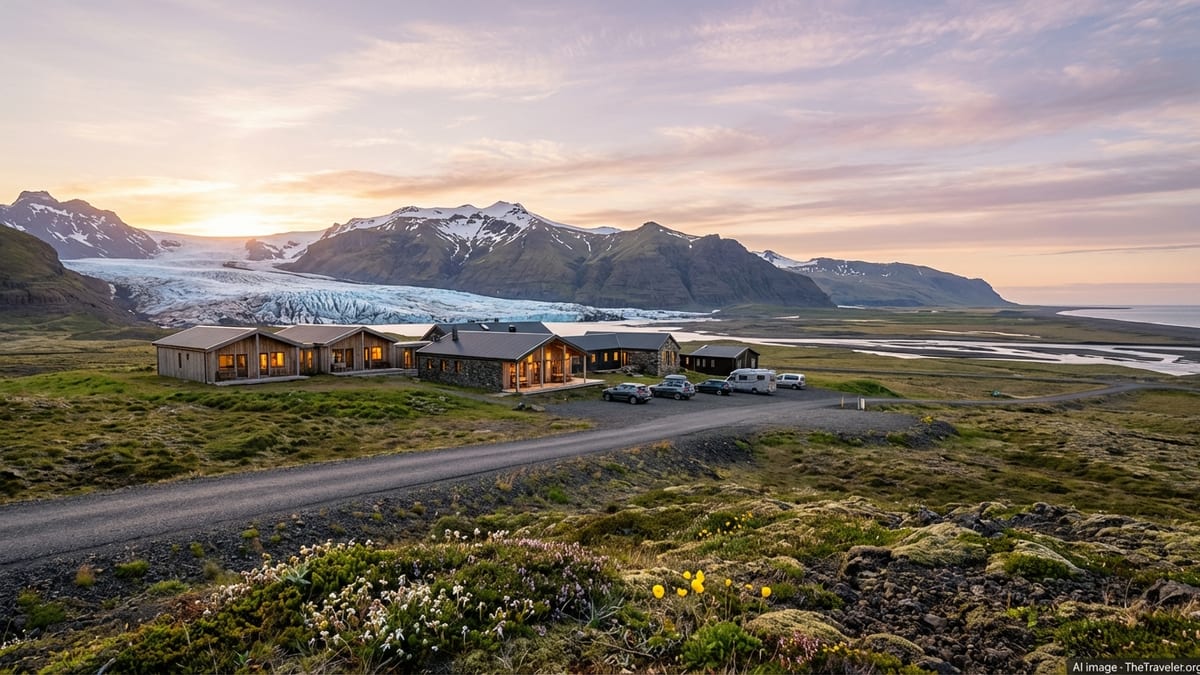
The stretch of coastline between Skaftafell and Höfn includes some of the most photographed sights in Iceland, particularly the Jökulsárlón glacier lagoon and the black sands of Diamond Beach. Here, low-lying farmsteads, turf-topped outbuildings and modern guesthouses dot the narrow band of land between sea and ice. This is where you stay if your dream is to watch icebergs under the midnight sun or photograph glowing blue ice caves on an early-morning tour.
Accommodation around Jökulsárlón itself is limited to a small number of countryside hotels and guesthouses scattered on either side of the lagoon. Many are converted farm buildings that now host travelers in simple but comfortable rooms, sometimes with small on-site restaurants focusing on local lamb, dairy and seasonal vegetables. Others are newer buildings with clean Nordic design, larger picture windows and spacious communal lounges made for lingering on stormy evenings.
Further west and east in the Öræfi region, additional guesthouses sit near hamlets such as Hof. These properties often highlight their proximity to both the lagoon and Skaftafell, making them a good compromise base for travelers wanting to explore in both directions. While some are open year round, others close in the depths of winter or operate on restricted hours, so it is wise to check seasonal schedules before building your itinerary around a particular place.
What you will not find along this stretch are big supermarkets or late-opening services. Most properties recommend that guests arrive with a full tank of fuel and basic snacks, especially outside peak summer. In return, you gain something many visitors never experience: silence broken only by waves and distant cracking ice, uncluttered night skies and very little light pollution. For photographers and anyone chasing Northern Lights on clear nights, this is one of the most rewarding places to stay.
Choosing Höfn as Your Coastal Hub
Höfn is the nearest town of any significant size to the eastern side of Vatnajökull National Park. Perched on a series of peninsulas overlooking fjords and harbor basins, it has a working fishing fleet, schools, shops and local government offices alongside its hotels and guesthouses. For visitors, that means more services in a compact walkable center, plus the comfort of returning to a town rather than an isolated farm at the end of the day.
The accommodations in and around Höfn range from modern hotels with on-site restaurants to small guesthouses, budget-friendly hostels and self-catering apartments. Many are still family run, and several sit just outside town along the ring road with wide views back to Vatnajökull’s white bulk on the horizon. Rooms typically emphasize warmth and practicality: thick duvets, blackout curtains for bright summer nights and solid heating systems that take the edge off Atlantic winds.
Höfn works especially well as a base if you are spending two or more nights in the area. From town, you can day trip west to Jökulsárlón and back, explore quieter lagoons and headlands, or join guided hikes onto lesser-known glacier outlets south of the ice cap. When you are not on the road, there are cafés, bakeries and restaurants to try, many of them serving the langoustine dishes for which Höfn is known. Small supermarkets let you stock up for picnics and self-catering stays.
The trade-off is extra driving time compared with staying right beside the lagoon or at Skaftafell. Jökulsárlón is roughly an hour away in good conditions, and Skaftafell is further still. In the long days of summer that is manageable, but in winter you will want to factor in reduced daylight and potentially icy roads. For those who prefer creature comforts, however, Höfn’s broader choice of accommodation, food and services often outweighs the longer daily drives.
Kirkjubæjarklaustur and the Western Approach
On the western side of the Vatnajökull region, Kirkjubæjarklaustur, often shortened to Klaustur, is a compact village surrounded by low hills, lava fields and winding rivers. It lies between two major glacier systems, Vatnajökull and Mýrdalsjökull, and has long been an overnight stop on the south coast. For modern travelers, it makes a natural base if you are approaching the park from Reykjavík and Vík and want to explore Skaftafell and the western edges of the national park without pushing too far east in a single day.
Kirkjubæjarklaustur offers a small but useful cluster of hotels and guesthouses, some of them low-slung modern buildings with straightforward rooms and others converted from older local structures. Facilities tend to include on-site restaurants or bars, generous buffet breakfasts, and easy parking just outside your door. While you will not find luxury resorts here, there is enough variety to accommodate couples, families and solo travelers on a range of budgets.
From the village, Skaftafell is within day-trip range by car, as are roadside waterfalls, gorges and basalt formations scattered along the ring road. Between sightseeing stops, you can return to Klaustur for a hot meal, a short hike on nearby trails or simply a quiet night off the main tourist circuit. Because the village sits within a geopark and close to major natural attractions, some hotels also offer local walking route information and tips on lesser-known viewpoints.
This area is particularly appealing for visitors who want to balance time in Vatnajökull National Park with other south coast highlights such as Fjaðrárgljúfur canyon, the black sand beaches near Vík and waterfalls further west. It can also work as a fallback if accommodation closer to Skaftafell and Jökulsárlón is fully booked. The main consideration is driving time: you will spend longer on the road each day compared with staying beside the park, but you gain a more varied mix of landscapes around your base.
Guesthouses, Farm Stays and Unique Local Experiences
One of the most memorable ways to stay near Vatnajökull National Park is to choose a small guesthouse or farm stay rather than a larger hotel. Throughout the region, from the foothills beneath the glaciers to the headlands near Höfn, families have converted spare rooms, former barns and outbuildings into simple accommodation. These places may not have spas or elaborate lobbies, but they often offer something harder to find: quiet, character and a close connection to the land.
Guesthouses in this part of Iceland commonly offer a mix of room types, from compact doubles with shared bathrooms to larger en-suite family rooms. Interior design tends to be pared back and practical, with a focus on cleanliness and warmth. Many properties include breakfast, sometimes featuring home-baked bread, local jams and dairy products from nearby farms. In the evening, some open small dining rooms serving a set menu, while others point guests to restaurants in the nearest village.
Farm stays add another layer of immersion. Depending on the property, you might wake up to views of grazing sheep, horses or cattle, or look straight towards a glacier tongue from your window. Owners may be happy to talk about seasonal work on the land, the impact of the glaciers on local life and how the region has evolved with rising visitor numbers. Because many of these farms are also working businesses, guests are typically expected to respect private areas and follow clear instructions about where they can walk.
Staying at these smaller places has practical implications too. Room counts are low, so they sell out quickly in peak season and can book up months in advance. Check whether your room has a private or shared bathroom, what time check-in is available and whether there are cooking facilities or only breakfast. Payment policies and cancellation terms can vary, so it is worth reading details closely when you reserve. In return, you are rewarded with a stay that feels personal and grounded in the local community.
Practical Tips for Booking and Staying Near Vatnajökull
Because accommodation around Vatnajökull National Park is limited and the area covers long distances, a bit of planning goes a long way. Booking early, especially for travel in July and August or during spring and autumn Northern Lights periods, significantly increases your choice of rooms and locations. Many travelers now secure their stays several months in advance, particularly in and around Skaftafell, Jökulsárlón and Höfn, where room numbers are modest relative to demand.
When comparing places, pay close attention to location and driving times as well as price. A hotel that looks only a short distance from a sight on the map may still require a 30 minute drive along the ring road. In winter, road and weather conditions can extend those times, while in summer the near-constant daylight makes longer drives more manageable. If you plan glacier tours or guided hikes, check where the meeting point is and allow generous travel time from your accommodation.
Facilities can also vary more than in city hotels. Some countryside guesthouses lack guest kitchens, while others provide fully equipped shared spaces. A number of properties offer simple dinner menus on site, which can be invaluable on nights when you prefer not to drive back to town in the dark or poor weather. Wi-Fi is widely available but speeds can be slower in remote areas, and mobile coverage may fluctuate closer to the glaciers and in certain valleys.
Above all, keep your plans flexible. Conditions around Vatnajökull can change quickly, and tours may be rescheduled or canceled for safety reasons. Having two nights in one place instead of moving every day gives you more room to adapt if visibility is poor or high winds close certain areas. Communicating with your hosts in advance, especially in the off season, helps ensure that check-in runs smoothly and that you have up-to-date information about access to the sights that matter to you.
The Takeaway
Vatnajökull National Park is a place of superlatives, and the decision of where to stay near it is as important as which glacier tongue or lagoon you visit. The landscape is so expansive that no single base can put everything on your doorstep, so the best choice depends on what you value most: trail access in Skaftafell, iceberg vistas near Jökulsárlón, small-town comforts in Höfn or a quieter village feel in Kirkjubæjarklaustur.
What unites the region’s hotels, guesthouses and farm stays is their intimacy and connection to the surroundings. Many are family run, with owners who have watched the glaciers advance and retreat over decades and seen tourism grow from a trickle to a steady stream. Staying in these places is not just a matter of finding a bed; it becomes part of the experience of traveling in southeast Iceland, with early starts, late sunsets and weather that keeps you looking out the window.
With early planning, realistic expectations and a willingness to embrace the slow rhythms of this remote coastline, you can secure a stay that adds depth and ease to your time in Vatnajökull National Park. Whether you choose a simple room with a glacier view or a hotel in a harbor town, the reward is the same: stepping out into the crisp Icelandic air each morning with some of Europe’s most dramatic ice and mountains just a drive or short hike away.
FAQ
Q1: How far in advance should I book accommodation near Vatnajökull National Park?
For travel in high season from late June through August, it is sensible to book several months in advance to secure preferred locations near Skaftafell, Jökulsárlón and Höfn. Outside peak months, you will usually find more flexibility but should still reserve early for weekends and holiday periods.
Q2: Which area is best to stay in for hiking in Vatnajökull National Park?
If hiking is your main focus, staying in or near Skaftafell is usually the most convenient option. From there, you have direct access to popular trails to Svartifoss and glacier viewpoints, along with easy connections to guided glacier walks that start close to the visitor center.
Q3: Is Höfn too far from Jökulsárlón to work as a base?
Höfn is roughly an hour’s drive from Jökulsárlón in good conditions, so it can work well as a base, particularly in summer when nights are short and roads are usually clear. You will spend more time driving than if you stayed beside the lagoon, but you gain a wider choice of hotels, restaurants and services.
Q4: Are there budget options near Vatnajökull National Park?
Budget travelers can look for hostels, simple guesthouses and rooms with shared bathrooms in villages such as Höfn and Kirkjubæjarklaustur, as well as basic countryside accommodations along the ring road. Prices in Iceland are generally high, but sharing facilities and staying slightly farther from the main sights can reduce costs.
Q5: Can I visit Vatnajökull National Park as a day trip from Reykjavík?
A same-day return between Reykjavík and the main southern gateways to Vatnajökull involves many hours of driving and is not ideal for most independent travelers. It is usually more comfortable to plan at least one overnight stay in the region, preferably two, so you can explore without rushing and adjust to weather conditions.
Q6: Do I need a car to stay near Vatnajökull National Park?
Having a car gives you the greatest flexibility, as public transport in this region is limited and many guesthouses are in rural locations. Some organized tours include transport from Reykjavík or from select south coast pick-up points, but if you want to explore multiple areas independently, renting a car is highly recommended.
Q7: Is it possible to see the Northern Lights from hotels and guesthouses near the park?
Yes, on clear nights between roughly September and April, you have a good chance of seeing the Northern Lights from many accommodations in the region. Rural guesthouses and farms with little light pollution often offer especially good viewing conditions, though sightings are never guaranteed.
Q8: What should I check before booking a farm stay or small guesthouse?
Before reserving, confirm whether your room has a private or shared bathroom, check-in and check-out times, and whether breakfast and dinner are available on site. It is also useful to ask about winter accessibility, parking conditions and any specific house rules, particularly if the property is also a working farm.
Q9: Are accommodations near Vatnajökull open year round?
Some hotels and guesthouses operate throughout the year, especially in places like Höfn, while others close or reduce their services in the darkest winter months. Always check current opening dates and seasonal schedules for your travel year before planning a trip around a particular property.
Q10: Is it better to stay in one place or move between several bases around the park?
Both approaches work, but many travelers appreciate spending at least two nights in one location to reduce packing and allow for weather-related changes. If you have more time, combining two bases, such as Skaftafell or Öræfi with Höfn or Kirkjubæjarklaustur, lets you experience different sides of the region without excessively long daily drives.