

More news on this day
A small but crucial volume of water is playing an outsized role in one of aviation’s most closely watched cargo programs, as Airbus leans on 180 liters of fluid to help validate its new A350F freighter for global service.
Get the latest news straight to your inbox!
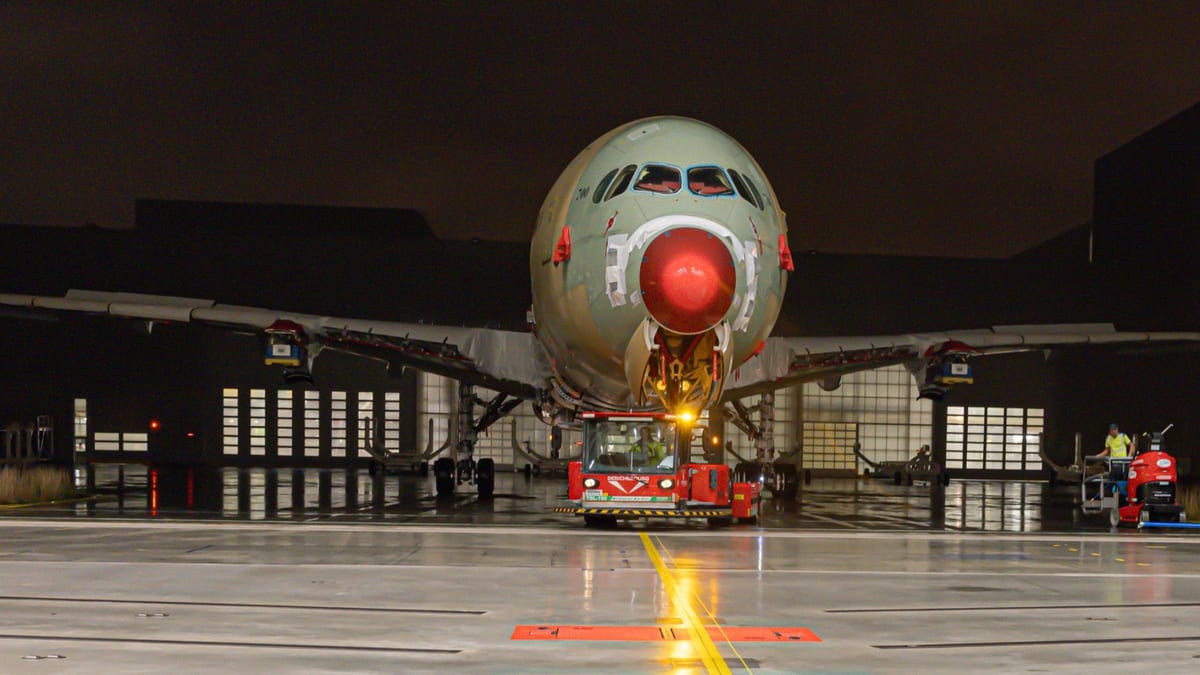
Image by Simple Flying - Aviation News
A Freighter Program Reaching Key Test Milestones
The A350F is Airbus’s dedicated freighter derivative of the A350-1000 passenger jet, launched to compete directly in the high-capacity, long-haul cargo segment. Publicly available information describes it as capable of carrying around 111 tonnes of payload over intercontinental ranges while targeting notably lower fuel burn compared to current-generation freighters. Assembly of the first test aircraft is advancing at Airbus’s final assembly line in Toulouse, with wings and fuselage sections delivered from plants across Europe, and flight testing scheduled to intensify through 2026 ahead of an expected entry into service around 2027.
While attention often focuses on payload figures, range and customer orders, much of the current effort is concentrated on validating the aircraft’s systems and handling. This is where a comparatively modest quantity of fluid, measured at approximately 180 liters, becomes critical. The freighter’s test regime relies on a series of specialized ground systems that circulate water-based mixtures through key components, helping engineers model real-world operating conditions long before the aircraft hauls revenue cargo.
Air cargo operators have already signaled strong interest. Recent agreements reported in industry coverage, including a sizeable commitment from U.S.-based Atlas Air, underline the commercial pressure on Airbus to keep the A350F’s development and certification on track. That, in turn, makes the supporting test equipment and procedures, including the 180-liter system, central to the timeline.
The 180-Liter Reservoir Behind Cooling and System Tests
Technical documentation for A350-series support equipment identifies a ground device that circulates a propylene glycol and water mixture, with a main reservoir volume of about 180 liters. Although external to the aircraft itself, this unit is designed specifically for A350 airframes and is used to simulate and stress-test cooling circuits during development and maintenance activities. The same infrastructure is now part of the broader toolkit preparing the A350F for intensive cargo duty.
Propylene glycol mixed with water is a familiar choice in aviation, combining effective heat transfer with freeze protection for low-temperature conditions. When pumped through aircraft-connected heat exchangers and lines, the 180-liter charge allows engineers to replicate scenarios that might otherwise require extended airborne trials or exposure to rare climatic extremes. That capability is particularly valuable for a freighter expected to operate year-round from polar gateways to tropical cargo hubs.
By adjusting flow rates, temperatures and pressures within this circuit, test teams can evaluate how systems behave under high thermal loads, prolonged ground operations and turnaround conditions common in cargo flying. For a platform marketed on efficiency and reliability, proving that avionics, environmental control and associated equipment remain within safe temperature envelopes is as important as confirming headline performance figures.
Water as a Stand-In for Cargo and Extreme Conditions
Water has long been a quiet workhorse of aircraft development, and the A350 family is no exception. Earlier A350 testing included climatic trials in controlled facilities, where water-based systems in the cabin and structure were monitored under extreme hot and cold conditions. In parallel, established flight-test practice across manufacturers uses water ballast tanks to mimic different loading scenarios, moving liquid between tanks in flight to shift the center of gravity without needing physical cargo.
For a freighter such as the A350F, understanding the full range of payload and balance conditions is essential. While Airbus has not publicly detailed every test configuration, the same principles apply: water, being dense, controllable and easily measured, remains a safe and adjustable way to reproduce the mass distributions that cargo operators might create once the aircraft enters service. This allows engineers to validate handling qualities, structural responses and landing performance across a wide envelope, all before commercial freight is introduced.
Ground-based water systems also complement these airborne campaigns. By cycling coolant and other water-based fluids through representative hardware, Airbus can refine maintenance procedures, assess component durability and verify that the freighter’s systems architecture behaves as expected under stress. Taken together, the airborne ballast techniques and the roughly 180-liter test rig illustrate how versatile water remains as a development tool.
Efficiency Targets Driving Intensive Validation
The A350F is being promoted as a next-generation answer to tightened emissions rules and more demanding efficiency benchmarks in the cargo market. Industry analyses point to its composite fuselage, advanced aerodynamics and modern Rolls-Royce Trent XWB engines as the main levers behind lower fuel burn and reduced operating costs. To deliver on those promises, the aircraft’s systems must support long, heavily loaded missions without sacrificing reliability.
That requirement has direct implications for how thoroughly every subsystem is tested. Cooling performance, in particular, affects avionics longevity, cabin pressurization stability and cargo environmental control. A relatively small volume of liquid in a ground test unit can replicate the thermal demands of high-density cargo operations, helping Airbus tune parameters long before airlines and logistics companies put the aircraft into daily service.
For cargo operators, these behind-the-scenes efforts translate into practical benefits. A freighter that has been validated under realistic thermal and loading profiles is less likely to require unplanned modifications or operational restrictions later. As regulators and customers pay closer attention to lifecycle emissions and reliability metrics, test details such as a 180-liter cooling circuit increasingly become part of the story of how a new aircraft earns its place in the global fleet.
An Unusual Detail That Highlights a High-Stakes Program
From the outside, the most visible signs of A350F progress are new fuselage sections arriving in Toulouse and announcements of additional orders from airlines and cargo specialists. Yet the less visible infrastructure, including the 180-liter water-based test equipment, is just as critical to the aircraft’s path toward certification.
Water may seem a humble material in a program measured in billions of dollars, but its role is central in reproducing the heat, weight and balance conditions that cargo operations impose. By harnessing its predictable properties through carefully engineered reservoirs and circuits, Airbus is working to ensure that the A350F can match ambitious efficiency claims with day-to-day robustness.
As assembly advances and flight-testing ramps up, this combination of sophisticated aerostructures and deceptively simple test media underscores how modern aircraft development blends cutting-edge materials with tried-and-tested engineering tools. For travelers tracking the evolution of long-haul cargo capability, the story of the A350F is a reminder that even 180 liters of water can make a measurable difference in how the world’s goods move by air.