

More news on this day
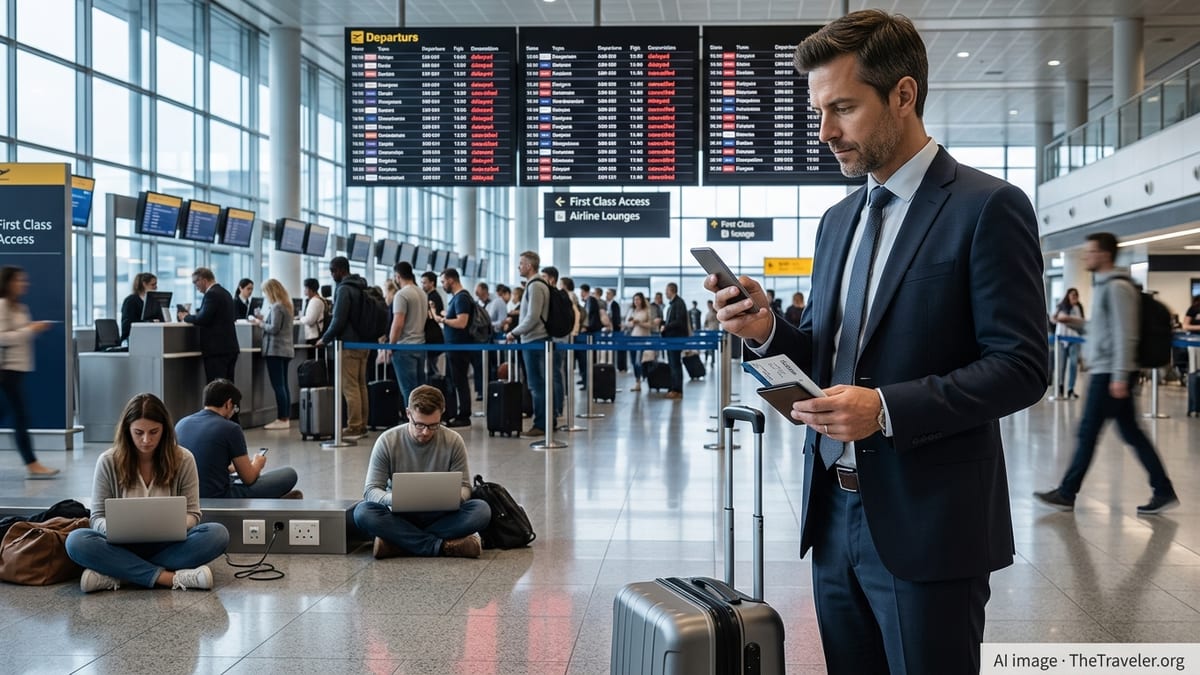
From winter storms in Europe to software outages grounding fleets in the United States, large-scale flight disruptions are becoming a recurring feature of global aviation. At the same time, regulators in key markets are expanding passenger protections, adding new layers of complexity to how airlines handle delays, cancellations and refunds. Against this backdrop, high-net-worth individuals are increasingly treating air miles not just as a path to upgrades, but as a powerful backup tool for keeping global itineraries on track when things go wrong.
Get the latest news straight to your inbox!
Flight Disruptions Are Becoming a Structural Risk
Recent travel seasons have underlined how vulnerable global air travel is to cascading shocks. In Europe, the 2025–26 windstorm season has already produced severe events such as Storm Anna, which led to hundreds of cancellations and delays at major hubs like Amsterdam Schiphol on a single January day. Airlines and airports struggled to clear backlogs as weather, air-traffic constraints and staffing bottlenecks interacted to prolong the disruption.
In the United States, a 2024 technology outage affecting a major carrier triggered thousands of cancellations over several days and highlighted how a single systems failure can ripple through global networks. Publicly available filings show that the incident cost the airline hundreds of millions of dollars in lost revenue and remediation costs, with knock-on effects for travelers far beyond North America.
Academic research into the U.S. National Airspace System has found that the most severely disrupted days, while still a small fraction of the calendar, are becoming more frequent in the post-pandemic period. Analysts point to a combination of denser schedules, tighter staffing, volatile weather and increasingly interconnected technology as drivers of systemic fragility.
For globally mobile travelers, especially those balancing business obligations and high-value leisure plans, the implication is clear: major disruption events are no longer rare anomalies. They are a recurrent risk that must be factored into trip planning and contingency strategy.
Passenger Rights Expand, but Complexity Rises
Regulators on both sides of the Atlantic have responded to recent disruption episodes with a wave of new or revised passenger-rights measures. In the United States, the Department of Transportation finalized rules in 2024 clarifying when travelers are entitled to refunds for cancelled or significantly changed flights and requiring airlines to issue many of these refunds automatically. Guidance released later that year emphasized that consumers should not have to navigate opaque policies or chase carriers to recover money when their trip is fundamentally altered.
In the European Union, policymakers are advancing the most significant overhaul in more than a decade of the flagship air-passenger-rights framework commonly referred to as EC 261. Council documents and parliamentary briefings show that governments are pushing for clearer responsibilities on airlines, standardized claim forms and updated compensation thresholds by distance and delay length. Some proposals would lengthen the delay required before compensation is due on long-haul flights, drawing criticism from passenger advocates who argue this would weaken hard-won protections.
Reports from legal and consumer groups suggest that, even as protections grow, the regulatory landscape is becoming more fragmented. The EU, the United Kingdom and several non-EU states now operate parallel but slightly different compensation regimes, while the United States has focused more on refunds and fee transparency than on mandatory delay compensation. Carriers must navigate these overlapping rules while coping with operational shocks, and travelers are left to interpret a patchwork of rights that can vary by origin, destination, operating airline and cause of disruption.
For high-net-worth individuals who regularly cross jurisdictions, the result is a complicated risk environment. Traditional tools such as premium credit cards, separate travel insurance and legal claims still matter, but they are reactive and often slow. Many HNIs are therefore looking upstream, to loyalty currencies and elite status, as a way to exert more control before disruptions spiral.
How Air Miles Function as a Private Safety Net
Frequent-flyer miles and points have long been marketed as aspirational currencies for upgrades and luxury redemptions. For HNIs navigating an era of turbulence and regulatory flux, these currencies are increasingly being treated as a form of liquidity that can be deployed in the middle of a disruption. Travel analysts note that a well-managed mileage balance across several airlines and alliances can unlock last-minute award seats when revenue cabins are sold out or priced at a steep premium.
Publicly available program materials show that elite members on major global carriers often receive priority waitlisting, standby and rebooking during irregular operations. In practice, this can translate into access to re-accommodation options that are not offered to non-status passengers, including protected seats on partner airlines and earlier departures from congested hubs. For a traveler facing a missed deal-closing meeting or a time-sensitive family commitment, the ability to tap into these hidden inventories can be more valuable than statutory compensation that may arrive months later.
Air miles also allow HNIs to bypass some of the constraints that come with regulatory remedies. Passenger-rights schemes typically deal with money already spent or time already lost; they rarely guarantee that a traveler will reach their destination quickly once disruption occurs. By contrast, a large, flexible mileage balance can function as a private emergency fund, ready to be converted into alternative routing on a different alliance, an upgraded cabin on a later departure or even a positioning flight to a less affected airport.
Industry observers add that loyalty currencies can be especially powerful when combined with premium-cabin strategies. Because fewer seats exist at the front of the aircraft, rebooking into business or first class using miles may be more feasible than securing scarce economy seats during peak disruption. This is particularly relevant on trunk routes between financial centers, where HNIs are most likely to travel and where demand often snaps back quickly after a shock.
Strategic Mileage Management for High-Net-Worth Travelers
Specialist travel advisers who work with affluent clients increasingly frame mileage strategy as part of broader risk management rather than pure reward optimization. The focus has shifted from chasing a single aspirational redemption to maintaining diversified, quickly deployable balances across multiple ecosystems, including airline programs and transferable bank currencies.
Publicly available guidance from loyalty experts emphasizes several tactics that align with this shift. One is concentrating flying and spending enough to secure mid to high-tier elite status with at least one carrier in each major alliance. Another is keeping a meaningful portion of points in flexible bank programs until a disruption occurs, allowing HNIs to top up whichever airline account offers the best emergency option on the day.
Technology is also changing how HNIs mobilize miles during a crisis. Award-search tools, some tailored to corporate and premium leisure clients, scan multiple programs for last-minute space and highlight routes where miles can be used to bypass bottlenecks. Combined with real-time data on delays and cancellations, this allows decision-makers to compare the trade-off between waiting for an airline to resolve the issue under passenger-rights rules and proactively burning miles to restore control over the itinerary.
At the same time, advisers caution that mileage balances are not risk-free assets. Devaluations, tighter inventory controls and program mergers can all erode their usefulness over time. For that reason, HNIs are encouraged to view miles as a working buffer rather than a long-term store of value, and to periodically convert points into concrete trips or backup bookings instead of hoarding them indefinitely.
The New Equation Between Rights, Risk and Loyalty
As regulators expand passenger protections and airlines adapt to more intrusive oversight, the relationship between public rules and private resilience is evolving. For the average traveler, stronger refund rights and clearer delay compensation may reduce some of the financial pain of disruptions. For high-net-worth individuals whose time and commitments carry outsized value, these protections are necessary but not sufficient.
In this environment, air miles and elite status act as a parallel system of soft power that operates alongside formal passenger-rights frameworks. They cannot prevent storms, software failures or airspace closures, but they can significantly influence how quickly a disrupted traveler can re-enter the flow of global mobility. The combination of regulatory safeguards on the back end and loyalty-powered flexibility on the front end is becoming a defining feature of how HNIs approach aviation risk.
For the wider travel industry, these shifts raise broader questions. If the most mobile and affluent travelers increasingly rely on loyalty currencies as a private safety net, airlines may find themselves under pressure to protect the integrity of their programs even as they adjust to new consumer-protection costs. At the same time, policymakers may look more closely at how devaluations or sudden changes in redemption rules affect passengers’ practical ability to respond to disruption. In an age of chronic air travel chaos, the contest over who controls recovery options when flights go wrong is only just beginning.