

More news on this day
Airbus is quietly reshaping the future of its smallest jet family, moving toward a new, larger A220 variant that would push the once-niche aircraft deeper into the heart of the single aisle market.
Get the latest news straight to your inbox!
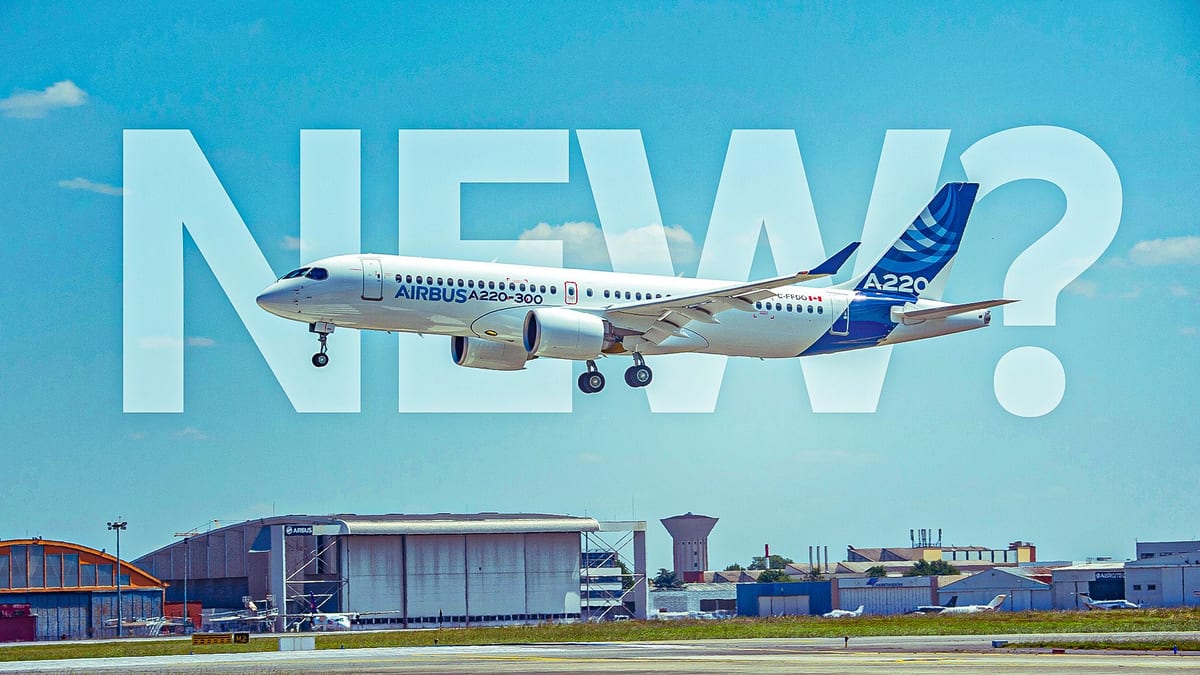
Image by Simple Flying
From Niche Regional Jet to Core Single Aisle Player
The A220 began life as Bombardier’s C Series, designed as a modern, fuel efficient aircraft for thinner regional and short haul routes. Since Airbus took control of the program in 2018, the aircraft has gradually shifted from a specialist product into a key pillar of the European manufacturer’s narrowbody portfolio.
Publicly available information shows that airlines have responded strongly to the type’s performance and economics, with a growing backlog and major commitments from carriers in North America and Europe. Orders from operators such as Delta Air Lines, Air France and, more recently, LOT Polish Airlines signal that the jet is no longer confined to regional missions but is being deployed on trunk routes where costs per seat are closely scrutinized.
As networks recover and expand after the pandemic, many airlines are looking for aircraft that can combine mainline comfort and range with lower trip costs. The A220’s ability to operate efficiently on both short domestic segments and longer sectors of more than five hours has opened additional market space, encouraging Airbus to consider a larger member of the family to capture even more demand.
This evolution explains why attention has increasingly turned to a stretched A220 sometimes referred to as the A220 500. While Airbus has not formally launched the variant, reports indicate that the company is preparing the ground to move beyond the current A220 100 and A220 300 models.
Production Ramp Up Meets Surging Demand
A key driver behind talk of a new A220 is simple capacity. The existing variants are heavily sold, and Airbus is working to lift output at its Mirabel, Canada, and Mobile, Alabama, final assembly lines. Company updates over the past year describe a gradual increase in monthly production, even as supply chain issues force adjustments to earlier, more ambitious ramp up plans.
Industry coverage notes that Airbus has recently revised its A220 production targets, aiming for around 12 aircraft a month in 2026 instead of the 14 originally signaled. The change reflects continued constraints on engines and components, as well as the effort required to integrate structural suppliers and stabilize the industrial system.
Despite these headwinds, the broader trend is upward. Public data from annual press briefings and financial reports shows that A220 deliveries have risen year on year, supported by fresh orders from carriers seeking to renew aging regional fleets and right size capacity on secondary routes. As those aircraft enter service, airlines are building operational experience and, in many cases, expressing interest in more seats on the same platform.
For Airbus, a stretched A220 would allow better use of the investment already sunk into the program. Once production is running at higher rates and unit costs begin to fall, the business case for adding a larger variant becomes stronger, particularly if it can be developed with limited changes to the existing wing, systems and cockpit.
Closing the Gap Between Regional Jets and the A320neo
The strategic logic behind a new A220 centers on the gap between today’s largest A220 and the smallest members of the A320neo family. The A220 300 typically seats around 145 passengers in a standard two class layout, while the A319neo has struggled to attract orders in a market that favors larger narrowbodies with better seat mile economics.
Analysts and trade publications have long suggested that a stretched A220, often described as seating roughly 170 to 180 passengers, could effectively replace the role once intended for the A319neo. By offering similar or greater capacity with a lighter airframe and modern aerodynamics, such an aircraft could deliver lower fuel burn per seat on many short and medium haul routes.
At the same time, airlines are rethinking fleet structures. Many are moving away from smaller regional jets toward a simplified mix of larger narrowbodies and a limited number of widebodies. A stretched A220 would fit neatly into this trend, offering mainline comfort and range in a size band that can flex between high frequency business routes and growing leisure markets.
Reports indicate that Airbus also views the proposed stretch as a bridge to any future clean sheet narrowbody. A larger A220 could cover the lower end of the market for years, allowing the manufacturer to focus research and development resources on next generation propulsion and airframe concepts without leaving a capacity gap for airlines today.
Competitive Pressure in the Single Aisle Market
Competition with Boeing and regional rival Embraer is another reason Airbus is moving toward a new A220. In the small narrowbody segment, Embraer’s E2 family targets many of the same routes and seat ranges as the existing A220, and its largest variant begins to nibble at the lower end of the A320 market.
The United States manufacturer, meanwhile, continues to sell larger versions of the 737 MAX that dominate the heart of the short haul market. Published analysis of order books shows that airlines have overwhelmingly favored higher capacity models on both sides of the Atlantic, highlighting the risk that Airbus could cede share if it does not offer a compelling product in every key size category.
A stretched A220 would strengthen Airbus in the 170 to 180 seat bracket, where per seat economics are particularly important for low cost and hybrid carriers. Several industry commentaries suggest that some airlines could consider shifting part of their future narrowbody demand to the A220 family if a larger variant meets range and payload requirements while offering competitive operating costs.
There is also a timing element. Public reports describe how Airbus is preparing to begin informal marketing of a stretched A220 to airlines and lessors, potentially ahead of a formal launch decision that could be tied to a major air show. Early interest and commitments would help secure the business case and ensure that the new model enters service with a solid base of customers.
Profitability, Program Maturity and Cabin Enhancements
Underlying all of these factors is the financial performance of the A220 program itself. Airbus has acknowledged in past briefings that the type has yet to reach the profitability levels of its more established A320 family, and that higher production volumes and lower unit costs are critical to turning the program into a sustained moneymaker.
Reports indicate that management has linked any decision on a stretched variant to clear progress on that profitability path. As deliveries rise and recurring costs improve, a new member of the family becomes more attractive, spreading development and tooling expenses over a larger pool of aircraft.
At the same time, Airbus is refreshing the A220 with new cabin features aimed at enhancing passenger appeal and aligning the jet with the rest of its portfolio. The Airspace cabin concept, which includes larger overhead bins and updated lighting, is being introduced on the A220 with deliveries scheduled to start around 2026. These enhancements are designed to strengthen the aircraft’s value proposition for airlines, especially those positioning the type as a premium product on competitive routes.
Together, rising demand, a maturing industrial footprint, competitive pressures and the push for better program economics explain why Airbus is now moving steadily toward a new, larger A220. While questions remain over timing and exact specifications, the direction of travel for the smallest Airbus jet family is increasingly clear.