

More news on this day
Airbus is moving closer to a stretched A220 variant often referred to as the A220-500, a move that industry observers view as central to both its product strategy and the long-term viability of the A220 program.
Get the latest news straight to your inbox!
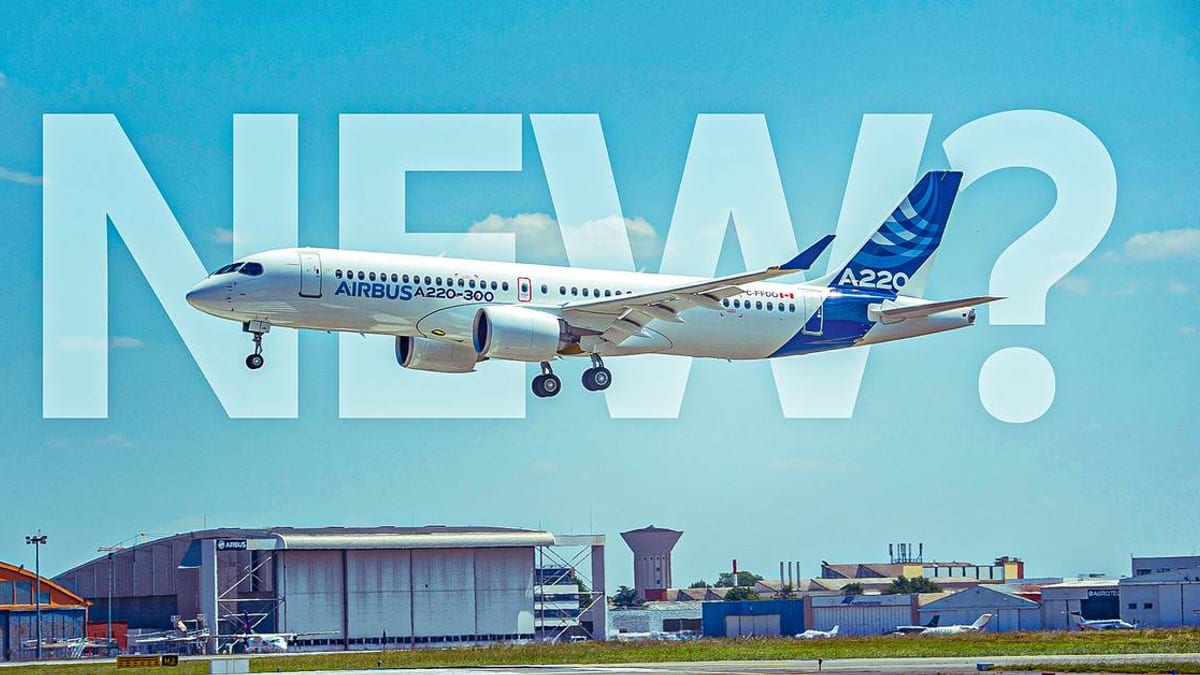
Image by simpleflying.com
From Niche Jet To Strategic Workhorse
The A220 began life as Bombardier’s C Series, a clean-sheet design focused on the 100 to 150 seat market. Since Airbus took control of the program, the aircraft has been repositioned as a key part of the European manufacturer’s single-aisle portfolio, sitting below the larger A320neo family in capacity and range.
Publicly available data shows that the A220 family has accumulated hundreds of firm orders and is in service with carriers in Europe, North America, the Middle East and Asia. The current line-up consists of the smaller A220-100 and the more popular A220-300, which typically seats around 140 passengers in a standard two-class layout.
Reports indicate that airlines have been pressing for a higher-capacity version that can seat around 160 to 180 passengers while preserving the A220’s reputation for fuel efficiency and passenger comfort. This is the gap Airbus is studying with a proposed A220-500, a simple stretch of the existing design that would lengthen the fuselage rather than introduce an entirely new airframe.
Industry analysis suggests Airbus sees this potential variant as more than a niche update. A larger A220 could transform the family from a specialist regional and thin-route aircraft into a mainstream narrowbody platform capable of operating alongside, and in some cases instead of, the A320neo on shorter routes.
Relieving Pressure On A320neo Production
One of the clearest strategic drivers behind a new A220 is production capacity. Airbus faces a substantial backlog for the A320neo family, with assembly lines running at high rates and major customers waiting years for delivery slots. A stretched A220 could serve as an additional tool to address demand for aircraft in the 150 to 180 seat range.
Coverage from aviation outlets indicates that Airbus is examining how the A220-500 might take over some missions currently flown by smaller A320neo variants. By doing so, the company could free up A320neo production capacity for larger and more profitable models, particularly the high-demand A321neo.
Analysts note that this strategy would allow Airbus to rebalance its narrowbody portfolio without launching an entirely new aircraft family. Instead, the manufacturer would leverage the existing A220 platform, production infrastructure in Canada and Europe, and ongoing investments in supply chains and final assembly.
Such a move could also strengthen Airbus’s response to Boeing in the heart of the single-aisle market. While the A220 is not a direct replacement for larger jets, a stretched variant could offer airlines an alternative to the Boeing 737 Max 8 on shorter, high-frequency routes where efficiency and lower trip costs are decisive.
Chasing Profitability For The A220 Program
Despite its technical success and positive feedback from passengers and crews, the A220 program has struggled to reach break-even. Because much of the supply chain and manufacturing footprint was inherited from Bombardier, costs have remained relatively high compared with Airbus’s more mature A320neo family.
Industry briefings have emphasized that management attention is tightly focused on improving unit economics. Airbus has been raising production rates and driving efficiencies at its A220 facilities, but a stretched variant could provide another lever by spreading fixed development and industrial costs across a larger number of higher-revenue aircraft.
Reports from specialist aviation publications describe the A220-500 launch decision as closely tied to program profitability. The company is understood to be weighing whether the additional investment required to stretch the aircraft will be offset by higher volumes and stronger pricing power in the upper end of the A220 segment.
If a stretched model attracts substantial commitments from major airlines, the A220 family could move more rapidly toward financial sustainability. Observers point out that a broader family of variants typically makes it easier for manufacturers to secure long-term fleet deals and aftermarket business, both of which are critical to profitability.
Balancing Technical Risks And Engine Challenges
Technically, the most straightforward path to a new A220 is a simple fuselage stretch using the existing wing and Pratt & Whitney geared turbofan engines. Aviation analysis notes that such a configuration would keep development costs and certification timelines relatively contained compared with more ambitious redesigns involving new wings or new powerplants.
However, the engine choice is not a minor consideration. The current A220 relies on Pratt & Whitney’s PW1500G, and operators have experienced reliability and maintenance challenges that have affected aircraft availability. Published coverage indicates that Airbus has been working with engine suppliers to stabilize the fleet and improve spare parts support.
Some industry commentary suggests Airbus has studied options for a more extensive upgrade, including potential wing modifications or alternative engines at a later stage. These scenarios would aim to preserve range and performance for a stretched aircraft carrying more passengers, but they would also add complexity, cost and time to market.
For now, most reporting points to a pragmatic approach. A simple stretch using current systems appears to be the baseline concept under evaluation, with any more ambitious changes deferred until the A220 production system and engine situation are on a firmer footing.
Positioning For The Next Decade Of Narrowbody Demand
The broader context for a new A220 is the long-term growth in demand for single-aisle jets. Forecasts referenced in industry media anticipate that airlines worldwide will continue to favor efficient narrowbodies for short and medium haul operations, as carriers rebuild networks, open new point to point routes and focus on fuel and emissions performance.
A stretched A220 would give Airbus another tool to segment this market more finely. At the lower end, the A220-100 and A220-300 remain suited to thinner routes and regional operations. At the upper end, a future A220-500 could target busy short-haul corridors and replacement cycles for aging single-aisle fleets, while the A320neo and A321neo continue to dominate higher-capacity and longer-range missions.
Commentary from analysts has highlighted that the A220-500, if launched, may be one of the last entirely new passenger aircraft variants introduced by a major manufacturer this decade. With development resources constrained and sustainability pressures rising, Airbus appears to be seeking incremental advances rather than clean-sheet narrowbody programs.
By carefully timing a launch decision and pre-selling the aircraft to key customers, Airbus is positioning the A220 to evolve from an acquired niche jet into a central pillar of its strategy. Whether the A220-500 ultimately enters service will depend on the strength of airline demand, the pace of industrial improvements and the company’s confidence that the stretched jet can deliver the mix of capacity, efficiency and profitability that the next decade of air travel will demand.