

More news on this day
Airlines are racing to upgrade their mobile apps as flight disruptions remain elevated, rolling out tools that promise faster alerts, clearer explanations and easier rebooking when trips go off schedule.
Get the latest news straight to your inbox!
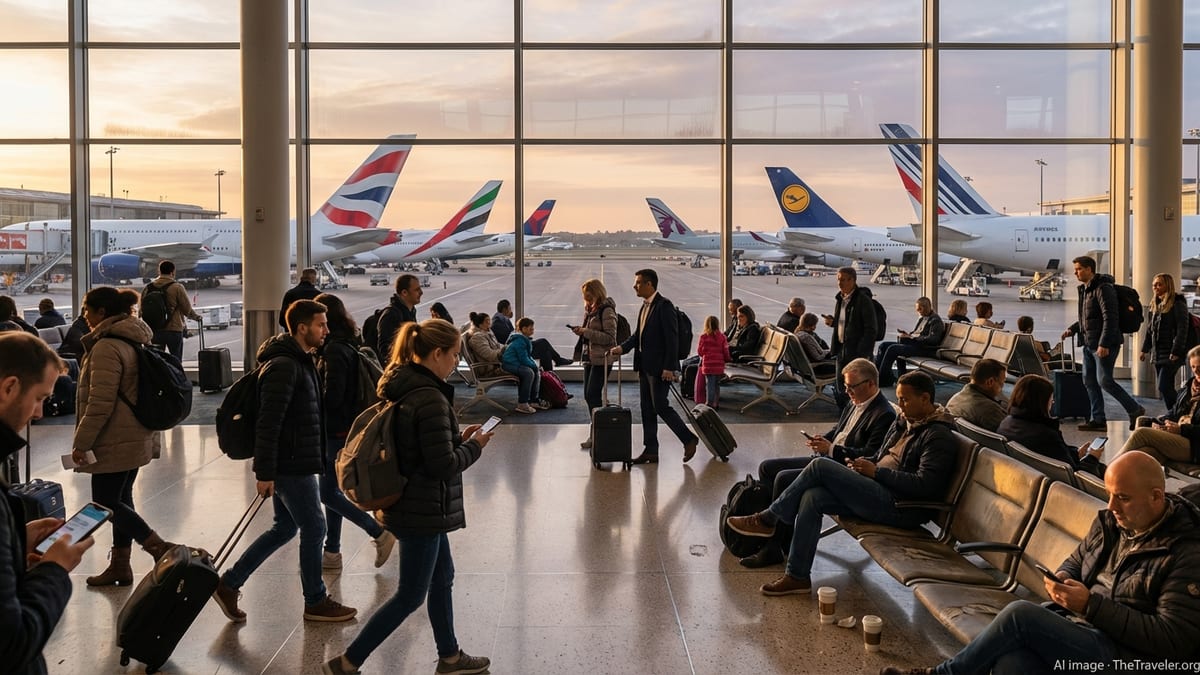
Regulatory pressure and frustrated travelers drive upgrades
Persistent congestion, weather disruptions and staffing constraints have kept delays high in recent years, and publicly available data shows that U.S. carriers continue to face scrutiny over how they communicate with affected passengers. The U.S. Department of Transportation’s Airline Customer Service Dashboard highlights which airlines provide meal vouchers, hotel rooms and free rebooking during significant disruptions, creating public comparisons that amplify pressure on digital customer service tools.
Industry submissions to federal rulemaking proceedings indicate that airlines are leaning heavily on apps, text messages and email to meet evolving expectations for timely status updates. Carriers argue that digital channels allow them to reach passengers more consistently than traditional gate announcements, particularly when weather or air traffic issues trigger cascading delays across a network.
Frequent flyers have also become more vocal about inconsistent notifications, contrasting slow or missing alerts with third-party trackers that sometimes surface disruption details first. Online travel communities increasingly document cases where passengers learned of cancellations or major schedule changes through independent apps before their airline app updated, reinforcing demand for more reliable and transparent airline-controlled tools.
As a result, major carriers are investing in technology platforms that are designed to push information earlier in the disruption cycle, explain causes in more detail and embed self-service recovery options directly inside their mobile apps.
From vague alerts to real-time explanations
Where many airline apps once displayed only a generic “delayed” or “canceled” label, recent updates are shifting toward plain-language explanations that break down what is happening to a flight and why. According to published coverage, American Airlines introduced a new delay transparency platform in March 2026 that uses its mobile app to show passengers whether a disruption is tied to weather, mechanical issues, crew availability or air traffic control constraints, along with estimated resolution times and any potential eligibility for compensation or vouchers.
Industry reporting indicates that this approach goes beyond basic status labels, presenting structured delay reasons in simple terms that are intended to be understandable to non-specialists. The information can include details such as whether an aircraft is waiting on maintenance clearance, whether connecting crew are delayed arriving on an inbound leg, or whether en route weather is forcing an updated departure slot.
Other large carriers have already moved in a similar direction, embedding disruption banners and at-risk connection warnings into home screens that also display mobile boarding passes and gate information. Publicly available app descriptions and travel press coverage describe tools that proactively flag tight connections, highlight minimum connection times at specific airports and warn travelers when their onward flight is likely to be missed even before the first segment has departed.
Alongside these explanations, newer app designs frequently display updated estimated departure and arrival times more prominently, reducing the need for travelers to toggle between screens or rely solely on airport departure boards. For passengers caught in rolling delays, this can offer a clearer view of whether a connection remains realistic or whether a rebooking option should be pursued.
Self-service rebooking as a frontline response
One of the most significant shifts in airline app strategy involves turning smartphones into disruption management desks, with self-service rebooking taking the place of long lines at airport counters. Reports on United Airlines’ mobile app describe features that present personalized alternative flights when a delay or cancellation is detected, allowing travelers to change itineraries with a few taps rather than waiting to speak with an agent.
Similar functionality is increasingly being reported across the industry. Travel coverage of American Airlines’ latest upgrade notes that its app now surfaces alternative itineraries, where available, along with options for hotel, meal and transportation vouchers that can be stored digitally. This aligns with a broader trend toward allowing passengers to make many of the same changes that would traditionally require a call center or airport representative.
Public commentary from frequent flyers suggests that when self-service tools work well, they can significantly reduce stress during irregular operations, often enabling passengers to secure scarce seats on earlier or less crowded alternate flights before they are gone. In some cases, travelers report completing rebooking within minutes of receiving a disruption alert, while lines at physical customer service desks remain lengthy.
However, user feedback shared in online forums also highlights uneven performance between carriers and even between app versions. Some travelers have recently criticized redesigned apps that feel slower or less reliable during disruptions, underscoring that airlines must balance new features with stability, clear navigation and consistent notification behavior.
Data standards, prediction tools and third-party competition
Underpinning this transparency push is a complex web of operational data feeds shared among airlines, airports, air traffic authorities and technology providers. Industry documentation points to standards such as the IATA AIDX format, which defines hundreds of structured data elements covering flight times, disruption codes, aircraft details and resource needs. When integrated into mobile platforms, this data can help apps display more precise reasons for delays and reflect real-time operational changes more quickly.
At the same time, travel technology companies are competing to set the bar on speed and accuracy. Popular independent apps highlighted in tech and travel media use combinations of official airline feeds, airport data, air traffic information and historical performance to predict disruptions before they are formally posted, sending early warnings about likely missed connections or extended ground holds.
These third-party tools have influenced passenger expectations, prompting questions about why an airline’s own app might lag behind an external service in flagging a problem. In response, some carriers are experimenting with predictive layers of their own, using internal operations data and weather modeling to anticipate delays and push preemptive options to affected customers.
There is also growing attention to edge cases, such as diverted flights, rolling departure estimates and aircraft swaps, where timely and accurate information can be particularly difficult to maintain. As airlines refine how they ingest and distribute operational data across their systems, observers expect mobile apps to reflect these improvements with more granular, up-to-the-minute transparency.
What travelers can realistically expect next
While technology investments are accelerating, experts caution that no app can eliminate uncertainty entirely in a system as complex as commercial aviation. Weather, airspace restrictions and mechanical issues can develop quickly, and some operational decisions are made within minutes of departure. Nonetheless, recent upgrades suggest that the typical experience of learning about a delay only at the gate is gradually being replaced by a more continuous, phone-based flow of information.
Travel industry analysis indicates that passengers can increasingly expect airline apps to provide faster push notifications, clearer cause codes, at-risk connection alerts and direct access to same-day change options, all before they reach the airport. The best-performing platforms are moving toward proactive guidance that not only states what has gone wrong, but also immediately presents practical next steps tailored to each traveler’s itinerary.
For airlines, improved delay transparency has become more than a customer service perk. It is also a way to reduce pressure on call centers and airport staff, spread out rebooking demand across digital channels and demonstrate responsiveness in an environment where regulators, consumer advocates and social media can quickly spotlight communication failures.
As disruption patterns and regulatory expectations continue to evolve, the arms race to deliver clearer, faster and more actionable flight delay information through airline apps shows no sign of slowing, reshaping how passengers experience delays even when the underlying operational challenges remain.