

More news on this day
As global air travel demand settles into a post-pandemic rhythm, many carriers are channeling their cabin-investment budgets into premium economy rather than expanding business class, reflecting a shift in how travelers want to fly and how airlines make money from every square meter on board.
Get the latest news straight to your inbox!
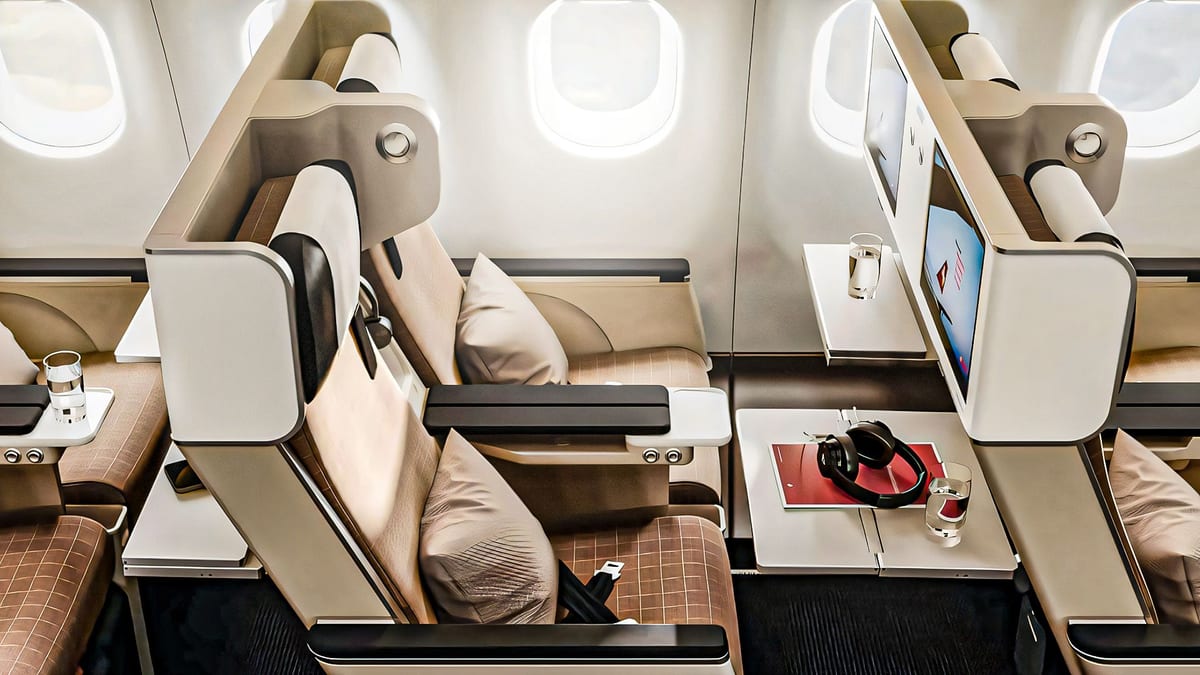
Image by Simple Flying
A Revenue Sweet Spot Between Economy and Business
Premium economy was once an experimental in-between product, introduced on a handful of long haul routes. Today it has become a central pillar of many airlines’ revenue strategies, sitting between high-yield business class suites and increasingly price-sensitive economy cabins. Publicly available financial disclosures and independent analysis indicate that premium economy often delivers the highest revenue per square foot of any non lie-flat cabin, and in some cases even outperforms business class on a space-adjusted basis.
Several large network airlines have reported that revenue from premium seats, including premium economy, has grown faster than capacity since 2019, turning what was once a niche into a core profit engine. Industry commentary describes premium economy as generating fare premiums of roughly 50 to 100 percent over standard economy while using only 40 to 60 percent more space per passenger. That arithmetic compares favorably with business class, where lie-flat beds and direct-aisle layouts consume far more floor area and require much higher fares to break even.
For carriers managing slim overall margins, these dynamics matter. Analysis of recent results across North American and European airlines shows that premium cabins now account for a disproportionately large share of passenger revenue relative to their seat share, and premium economy is one of the most efficient contributors in that mix. It gives airlines a way to upgrade the cabin without committing to the higher fixed costs and complex service model of an all-new business class product.
Corporate Travel Policies Push Demand to the Middle
The structure of business travel demand is another factor tilting investment toward premium economy. Surveys of corporate travel managers and business travelers indicate that many companies that once routinely booked long haul business class have tightened policies, steering staff into lower fare categories or permitting premium cabins only on the longest sectors. In that environment, premium economy has emerged as a compromise that satisfies duty-of-care and comfort concerns while containing costs.
Consulting firms tracking corporate travel trends report that global business travel volumes have broadly recovered, but with more scrutiny on budgets and a sharper focus on value. Premium economy fits that brief: it offers more legroom, wider seats and upgraded service compared with economy, but at a fraction of business-class prices. For travel buyers negotiating with airlines, dedicated premium economy cabins provide a distinct fare category that can be bundled into contracts as a negotiated standard for certain trip lengths or traveler tiers.
Airlines, for their part, are responding to this pattern by enlarging premium economy cabins and reducing the relative share of traditional business class seats on some widebody fleets. Data on seat maps and scheduling since 2019 shows a marked increase in the number of premium economy seats offered on key transatlantic and transpacific routes, even when overall capacity growth has been modest. By matching product design to evolving corporate policies, carriers aim to lock in a dependable base of mid-tier business travel demand.
Affluent Leisure Travelers Fuel Hybrid Demand
Premium economy is not only a corporate story. Industry outlooks for 2024 and 2025 highlight the growing role of high-income leisure travelers in sustaining long haul demand. Households with higher earnings have generally recovered faster from pandemic-era disruptions and remain willing to pay more for comfort on long flights, especially for bucket-list trips and visits to friends and relatives overseas.
Market research from travel consultancies suggests that many of these travelers are trading up from economy rather than down from business class. They are willing to pay a mid-range premium for extra space and better sleep on overnight flights, but they are more price-sensitive than the small segment that regularly pays full-fare business class. Premium economy, with its larger seats and quieter cabins but without multi-course dining or lie-flat beds, aligns closely with their expectations.
This hybrid demand has been particularly visible on transatlantic and transpacific routes, where airlines have reported strong premium-cabin load factors alongside robust leisure bookings. Reports on booking patterns note that premium cabins, including premium economy, have grown faster than standard economy in several major markets, underpinning the decision by carriers to reconfigure aircraft with larger mid-tier cabins targeted at both business and leisure segments.
Cabin Economics and Fleet Flexibility
Beyond demand trends, the hard economics of cabin design encourage investment in premium economy. Each business class suite typically requires more complex seat engineering, greater privacy features, and intensive service elements, all of which increase acquisition and operating costs. Premium economy seats, while larger than economy, are much closer in design and service requirements to standard coach, making them cheaper to install and maintain.
Analysts focusing on aircraft interiors describe premium economy as a high-yield use of floor area with comparatively low incremental cost. Public comments from several airlines and manufacturers have pointed to premium economy cabins delivering double or triple the margin of regular economy, thanks to higher fares and relatively modest cost additions such as enhanced catering and amenity kits. Compared with business class, the absence of fully flat beds, doors and dense galleys simplifies weight, maintenance and training.
Premium economy also offers airlines greater flexibility over the life of an aircraft. Because these seats are structurally more similar to economy, cabins can be resized or reconfigured with less disruption than a full redesign of business class. As route networks evolve and demand shifts between corporate and leisure traffic, carriers can adjust the balance between economy and premium economy more nimbly than they could with a large investment in an additional row of high-end business suites.
Risk Management in an Uncertain Demand Cycle
The lasting effects of the pandemic on travel behavior have made long term demand for top-tier business class less predictable than in previous decades. Studies following traveler intentions in the United States and other major markets show that a significant share of former frequent business flyers expect to take fewer flights in future, partly because of the normalization of video conferencing and hybrid work. While premium travel has broadly rebounded, many airlines remain cautious about overextending the most expensive cabin.
Investing in premium economy helps manage that risk. If economic conditions weaken or corporate budgets tighten, a carrier with a larger share of its cabin devoted to business class may struggle to fill those high-priced seats without deep discounting. Premium economy, priced closer to the mass market, tends to be more resilient, attracting both downgraded business travelers and upgraded leisure passengers when fares fall or promotions are offered.
Industry outlooks for 2025 and 2026 anticipate continued growth in premium cabin bookings, but also highlight potential headwinds from inflation, currency swings and uneven regional recoveries. In that context, premium economy functions as a financial hedge: it allows airlines to participate in premium demand while keeping exposure to the most cyclical, high-cost segment in check. As carriers finalize future fleet plans, that balance is increasingly reflected in order books and cabin retrofit programs that prioritize the middle of the cabin over further expansion of the pointy end.