

More news on this day
After years of vague gate announcements and cryptic app alerts, airlines are starting to spell out exactly why flights are delayed, reflecting growing regulatory pressure and a shift toward greater transparency in air travel.
Get the latest news straight to your inbox!
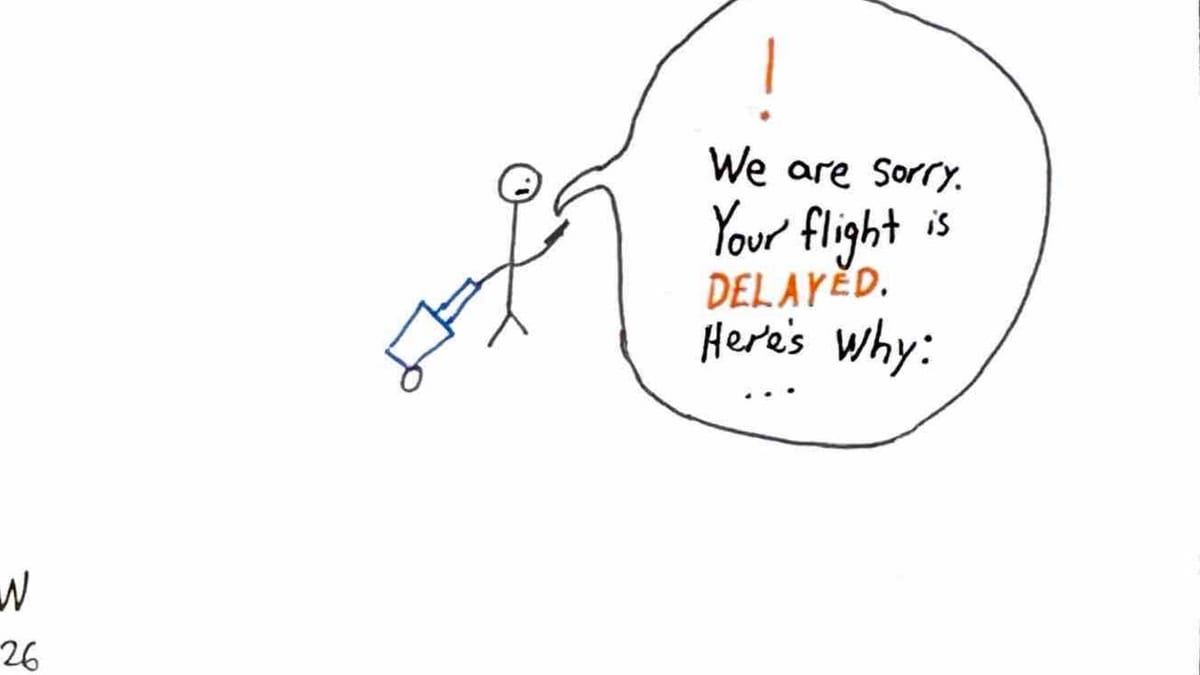
Image by USA Today
From “Operational Issues” to Plain Language
For many travelers, the familiar explanation for a late departure has long been a catchall phrase such as “operational reasons.” In recent months, a growing number of airlines have begun replacing that language with clearer descriptions in their mobile apps, text alerts and gate displays, citing aircraft maintenance, crew scheduling, air traffic control restrictions or weather as distinct categories.
According to published coverage of recent product updates, several large U.S. carriers have expanded the delay information shown in their apps so that passengers see both the length of a disruption and a short explanation. Similar changes are appearing at airport gates, where digital boards are increasingly synchronized with back-end systems that categorize disruptions in more detail.
This move toward specificity reflects a broader effort within the industry to standardize how delays are labeled and communicated. While the depth of information still varies widely by carrier, public-facing messages are gradually coming closer to the internal delay codes airlines already use to report performance data to regulators.
For passengers, that shift is beginning to close a longstanding information gap between what airlines know about a disruption and what travelers are told at the airport or on their phones.
Regulatory Pressure Fuels New Transparency
The push toward more candid delay explanations does not stem solely from voluntary improvements. In the United States, the Department of Transportation has expanded public tools and proposed new rules intended to clarify what happens when flights are disrupted, including what counts as a controllable delay and what support airlines owe passengers when they are responsible.
The Airline Customer Service Dashboard, introduced by the department and updated over time, compiles commitments from major U.S. carriers on when they provide meal vouchers, hotel rooms or rebooking during delays and cancellations. Publicly available information on that dashboard highlights the distinction between disruptions within an airline’s control and those attributed to weather or the broader air traffic system.
More recently, an advance notice of proposed rulemaking on airline passenger rights has explored whether carriers should be required to give travelers more precise and timely information about the status and cause of delays and cancellations. The document discusses how better disclosure could help passengers decide when to leave for the airport, when to seek alternative flights and how to assess eligibility for refunds or accommodations.
Internationally, passenger rights regimes in regions such as the European Union have long tied compensation and assistance to the cause of a disruption, encouraging airlines to keep records and provide written notices about delays and cancellations. New reforms to enforcement and information obligations, adopted or debated in recent years, continue to emphasize that passengers should receive clear explanations of what went wrong with their flights.
Why the Cause of a Delay Changes What You Are Owed
For airlines, classifying the cause of a delay is more than a communications exercise; it is central to determining financial responsibility. In regulatory frameworks in Europe and elsewhere, passengers are often entitled to compensation or extensive care only when a disruption is within the carrier’s control, such as certain technical faults or scheduling issues, and not when it is caused by extraordinary circumstances like severe weather or airspace closures.
Published guidance on European rules indicates that carriers must provide written notice of passenger rights in the event of long delays, cancellations or denied boarding, and that compensation hinges on whether the event was avoidable through reasonable airline planning. Court decisions have further narrowed what counts as an extraordinary circumstance, finding that routine technical problems generally do not exempt carriers from paying compensation.
In practice, this makes the label applied to a disruption highly consequential for travelers. A delay attributed to a late-arriving aircraft or crew shortage could unlock food vouchers, hotel stays or cash compensation under some legal regimes, while the same hours of waiting marked as bad weather might only qualify a passenger for limited assistance.
By making the stated cause of a delay more visible in apps and notifications, airlines effectively expose the categorization that underpins these outcomes. That visibility can make it easier for travelers to challenge decisions they consider inaccurate and to seek recourse through regulators, courts or claims services when they believe a disruption was wrongly labeled as outside the carrier’s control.
How Better Information Changes Passenger Behavior
Clearer reasons for delays are already reshaping how travelers react when plans begin to unravel. When an app message specifies that a disruption is tied to a late incoming aircraft, passengers may infer that departure could move as soon as the plane arrives, and they might decide to stay near the gate. By contrast, a notice that lists air traffic control restrictions or severe weather across a region may signal that disruptions will cascade, prompting travelers to request rebooking before alternative flights fill up.
Consumer-rights advocates note in public commentary that many passengers still do not understand how delay categories affect their entitlements. Even so, greater transparency can influence behavior, encouraging travelers to document events, keep boarding passes and screen captures, and follow up on potential claims after the trip rather than accepting a disruption as unavoidable.
The growing availability of real-time cause codes also supports a cottage industry of technology firms that help passengers file compensation claims under regional regulations. These companies use flight-tracking data, historical weather information and airline communications to reconstruct what happened during a disruption and to argue that a delay should be considered within the airline’s control.
Over time, more detailed communication may shift expectations for customer service. As travelers grow used to seeing explicit reasons for delays, vague explanations can stand out, pressuring carriers that lag behind to match competitors on clarity.
What Travelers Should Watch for Next
Despite the progress, significant inconsistencies remain in how airlines explain disruptions across markets, routes and platforms. A flight that shows a clear cause in a mobile app may still be accompanied by a generic announcement at the gate, or vice versa. Some carriers provide detailed breakdowns only after a trip, in response to formal complaints, rather than in real time while passengers are stranded.
Regulators in the United States and abroad are considering whether to tighten requirements so that airlines must notify passengers quickly when a delay becomes likely and provide material information that helps them make decisions. Proposals discussed in public documents include stronger obligations to send timely notifications, clearer standards on what constitutes controllable delays and potential penalties if airlines misclassify disruptions.
For now, travelers can expect a gradual expansion of delay details in their apps and notifications, especially from large carriers seeking to differentiate their digital experiences. Frequent flyers are likely to see more consistent wording, clearer separation between weather and airline-controlled causes, and closer alignment between what is stated publicly and what is reported to regulators.
As air traffic continues to grow and congestion strains airport and airspace systems, delays are unlikely to disappear. Greater openness about why they happen will not shorten every wait at the gate, but it can give travelers a stronger basis to plan, to seek help when things go wrong and to hold airlines and policymakers to account for how disruptions are managed.