

More news on this day
On the evening of March 18, 2026, as Bali braces for its annual Day of Silence, the island’s streets will erupt in one of Southeast Asia’s most immersive public spectacles: the Ogoh-Ogoh parades, a night when towering demons, deafening drums and dense crowds collide in a ritual that many visitors now regard as the most unforgettable experience of a trip to Bali.
Get the latest news straight to your inbox!
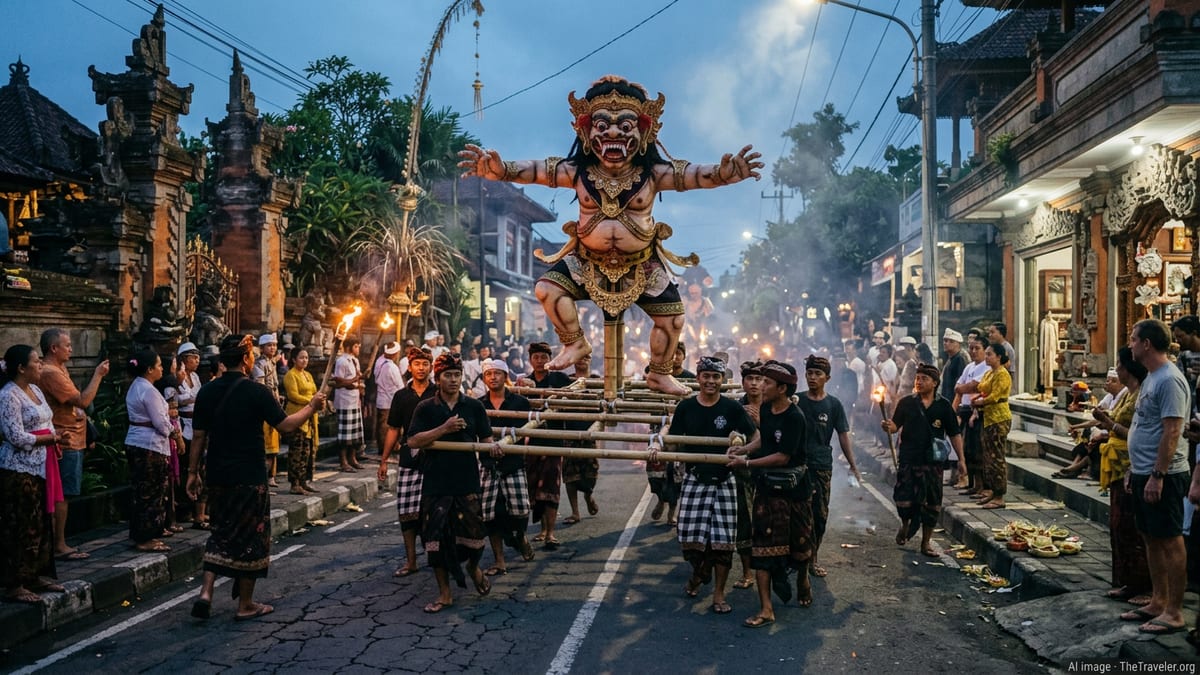
A One-Night Carnival Before an Island Falls Silent
The Ogoh-Ogoh parades take place on the eve of Nyepi, Bali’s Hindu Day of Silence, which in 2026 falls on March 19. Publicly available guidance notes that the giant effigy processions are scheduled for the evening of March 18, typically from around sunset until late into the night, just hours before all activity on the island grinds to a halt for 24 hours.
This compressed timeline creates a dramatic contrast. For one night, villages and resort towns across Bali become stages for processions featuring bamboo-lifted monsters, fire torches and clashing percussion. The next morning, the airport closes, streets empty and even beaches fall quiet as Nyepi restrictions take effect, leaving many travelers with a vivid sense of having witnessed a final, intense burst of sound and color before enforced stillness.
Recent travel advisories and tourism guides highlight this juxtaposition as a defining element of the modern Nyepi experience. For visitors who plan dates carefully around March 18 and 19, the parades effectively serve as the climactic centerpiece of a Bali trip, rather than a marginal cultural add-on.
Hand-Built Giants and Months of Youth-Led Creativity
The effigies themselves, known as Ogoh-Ogoh, are central to the allure. Cultural references describe them as large, often grotesque statues representing disruptive forces and malevolent spirits from Balinese Hindu cosmology, constructed in each banjar, or local community. Many stand several meters tall, with exaggerated fangs, bulging eyes and outstretched arms that loom over narrow streets.
Local reports on preparations for 2026 describe how youth groups have been working for months in temporary roadside workshops, layering bamboo frames with styrofoam, papier-mâché, paint and intricate costume details. In some regencies, competitions with regional finals are already underway, intensifying the craftsmanship and theatrics as teams vie for recognition and prizes.
For travelers who arrive early in March, the build-up is increasingly visible. Effigies can be seen emerging under tarpaulins in village lanes or on vacant lots, providing an informal preview before parade night. Observers note that seeing these works-in-progress during the day and then watching them come alive atop swaying bamboo platforms at night adds depth to the experience, revealing the community effort behind the spectacle.
Island-Wide Spectacle From Ubud to the Southern Beaches
Unlike some festivals confined to a single city square, Ogoh-Ogoh parades unfold simultaneously across Bali. Travel guides for Nyepi 2026 point to key hubs such as central Denpasar, Ubud, Canggu, Kuta, Legian, Seminyak, Sanur and Nusa Dua as especially popular viewing areas, but note that almost every village organizes its own procession.
In Ubud, visitors can expect parades threading past landmarks and through densely packed intersections, often accompanied by traditional gamelan orchestras and chanting. In southern beach districts, the routes wind through commercial strips lined with bars, shops and hotels, where many businesses temporarily dim their lights and pause operations as the effigies and marching groups pass.
Recent traveler reports suggest that traffic closures now begin earlier than many first-time visitors anticipate, with some main roads restricted by late afternoon on March 18. Advisory notices recommend arriving at a chosen viewing area several hours before sunset, emphasizing that moving between neighborhoods once the parades start can be difficult, and that last-minute airport transfers or intercity journeys may be heavily delayed.
A Deep Ritual of Cleansing Wrapped in Street-Party Energy
Behind the vivid visual drama lies a complex ritual meaning that differentiates Ogoh-Ogoh from ordinary festivals. Cultural explanations describe the parades as part of a larger Bhuta Yajnya ceremony, intended to restore balance between humans, nature and unseen forces. By crafting and then parading these monstrous figures, communities symbolically confront and cleanse negative elements before Nyepi’s day of self-reflection.
In practice, this theology merges with an almost carnival-like street atmosphere. Drums pound, firecrackers crack and young carriers deliberately rock the bamboo platforms to make the effigies appear to lunge toward spectators. In some areas, the statues are later symbolically destroyed or ritually purified, underscoring the transition from chaos to calm.
Observers note that this blend of devotional ritual and exuberant performance is what many travelers describe as uniquely memorable. Unlike passive sightseeing, the experience unfolds at close quarters, often within arm’s reach of crowds and performers, immersing visitors in a cultural event that is both sacred and intensely communal.
High Rewards for Travelers Who Plan and Behave Respectfully
The intensity of Ogoh-Ogoh night comes with logistical and cultural expectations that can catch unprepared visitors off guard. Air travel analyses and Bali-focused travel advisories for 2026 underline that Ngurah Rai International Airport will be closed for Nyepi from the morning of March 19 until the morning of March 20, with many booking platforms still slow to highlight the shutdown. Travelers are encouraged to avoid flights on March 19 and to reach their accommodations well before traffic bottlenecks on the evening of March 18.
On the ground, recent accounts from residents and visitors describe heavy congestion, limited availability of ride-hailing services and ad hoc roadblocks as parades claim intersections and village centers. Guidance commonly advises wearing light, respectful clothing, carrying water, and preparing to walk significant distances around closed streets rather than relying on vehicles once festivities are underway.
Local commentary also stresses etiquette. Communities increasingly express frustration with tourists who treat the event as a party, obstruct processions for photos, or enter sacred spaces without permission. Travel guides now emphasize standing back from the routes, following directions from local organizers and remembering that the parades are first and foremost a religious and communal rite, not an entertainment product.
For visitors who accept these boundaries and plan travel dates around the Nyepi calendar, reports indicate that Bali’s Ogoh-Ogoh parades offer a rare chance to witness an entire island move collectively from explosive celebration to profound silence, a transition that many later describe as the moment that defined their time on the island.