

More news on this day
As Boeing’s long-delayed 777X edges toward airline service, attention is increasingly shifting from its dramatic folding wingtips to a quieter but equally strategic transformation inside: an all-new, wider and more flexible cabin architecture intended to reset passenger expectations on the world’s longest routes.
Get the latest news straight to your inbox!
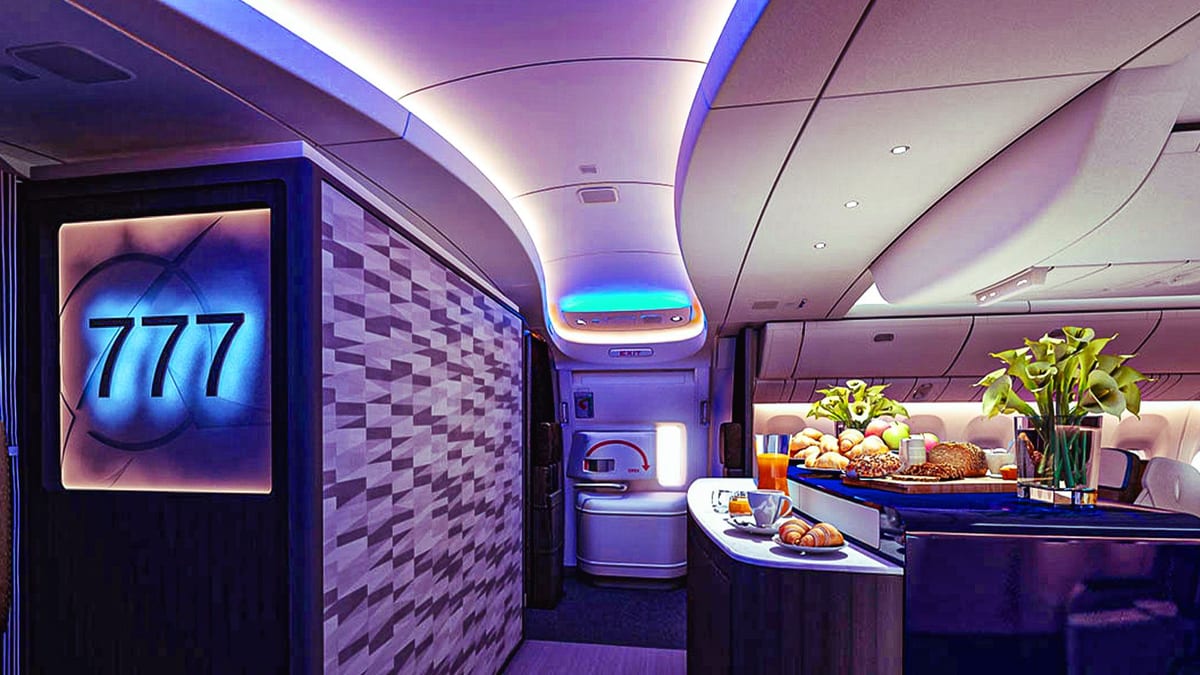
Image by Simple Flying
A Wider Cabin To Defend The Long-Haul Flagship
At the heart of the 777X redesign is a fuselage cross-section that gains roughly four inches of internal cabin width compared with the current 777 family, according to Boeing reference data. The change may sound modest, but for airlines trying to balance seat counts, comfort and premium products, those extra inches open up new possibilities in both economy and business class.
Publicly available technical material from Boeing describes the 777X cabin as an “innovative new interior architecture” that is wider than the existing 777 and paired with windows about 30 percent larger than before. The combination is intended to deliver a more spacious feel at a time when rival widebodies such as the Airbus A350 and Boeing’s own 787 Dreamliner have raised passenger expectations for long-haul comfort.
Industry analysis indicates that the wider cross-section helps the 777X retain its appeal in dense 10-abreast economy layouts while still giving operators a little more room to tweak seat width and aisle space. That flexibility is important as airlines look to differentiate their product on highly competitive trunk routes without giving up the low unit costs that made the original 777 a long-haul workhorse.
The cabin geometry also supports a new generation of premium seating. With more floor width to work with, carriers can integrate enclosed business-class suites and high-density premium cabins while maintaining direct-aisle access and generous work surfaces, features that have become standard on newer long-haul types.
Borrowing The Dreamliner Playbook On Passenger Wellbeing
The 777X cabin carries over several comfort-focused technologies first seen on the 787 Dreamliner, reflecting Boeing’s effort to standardize a higher baseline of onboard wellbeing across its long-haul portfolio. Technical documents highlight a lower effective cabin altitude than previous 777 models, improved air filtration and humidity control, and a comprehensive LED-based lighting system.
Lower cabin altitude and higher humidity are designed to reduce fatigue, dry eyes and dehydration on ultra-long sectors. Analysts note that these features have become key talking points in airline marketing, especially as more carriers schedule flights lasting 15 hours or longer. By integrating similar environmental controls into the 777X, Boeing aims to ensure the aircraft feels like a step forward rather than a legacy holdover when placed alongside newer types.
The 777X also adopts Boeing’s Sky Interior philosophy, a holistic approach that coordinates ceiling contours, sidewalls, stowage bins, windows and lighting to create a more unified visual experience. Coverage from specialist cabin publications describes sculpted ceiling arches, smoother sidewalls and reshaped bins that open upward to increase headroom and simplify boarding.
Lighting plays a central role in the new architecture. Full-spectrum LEDs allow airlines to program boarding, mealtime and sleep scenes that support passengers’ circadian rhythms, helping to ease jet lag. Reports on cabin trials suggest these sequences can subtly shift color temperature and intensity over time, reinforcing the sense that the interior is a single, integrated environment rather than a collection of independent components.
Modular Architecture For Rapid Reconfiguration
Beyond aesthetics, the 777X cabin introduces a more modular underlying structure intended to speed refits and lower lifecycle costs. Aviation industry coverage describes a new architecture that groups attachment points, systems conduits and monuments in more standardized “zones,” allowing airlines to change layouts with fewer structural modifications and shorter downtime.
This modularity addresses a longstanding challenge for long-haul operators. As premium demand fluctuates and new seating products emerge, carriers increasingly want the ability to add or remove business-class rows, re-balance premium economy and economy, or trial new concepts in smaller sub-fleets. A more plug-and-play interior framework is designed to make those changes less disruptive.
Reports indicate that the architecture extends to galleys, lavatories and storage areas, which can be repositioned within defined ranges to support different service concepts. For airlines, that means the same aircraft can be tailored for ultra-long flights with high-yield premium traffic or dense regional missions, all without the kind of deep, one-time interior overhauls that were common on earlier widebody types.
From Boeing’s perspective, a cabin that can be more easily refreshed over time also guards against obsolescence. As new inflight entertainment systems, connectivity solutions and seat designs enter the market, the 777X is structured to accept upgrades with less custom engineering, potentially stretching the commercial life of each airframe.
Bigger Windows, Quieter Ride And A More Cohesive Space
One of the most visible changes for passengers will be the 777X’s enlarged windows. Boeing marketing material and independent reporting both note that the new windows are roughly 30 percent larger than those on the current 777 and are positioned higher so the broadest part aligns more closely with passengers’ eye level.
Cabin design publications have highlighted how the new window geometry interacts with recontoured sidewalls to create a cleaner transition from seat to fuselage, reducing the sense of being boxed in at the window seat. More natural light and improved sightlines contribute to a perception of space that airline-focused analysts say can be as important as actual seat measurements in shaping comfort impressions.
The 777X program also targets a quieter cabin. Technical descriptions point to a redesigned engine nacelle for the GE9X powerplant, higher-bypass engines, new acoustic insulation in the sidewalls and a reworked air distribution system that uses more nozzles running at lower velocity. Together, these measures are intended to trim background noise relative to earlier 777 variants, a key factor on overnight flights.
By treating windows, lighting, acoustics and structural elements as parts of a single architecture rather than separate add-ons, Boeing is positioning the 777X cabin as a cohesive environment crafted around long-haul passenger experience. Industry observers suggest this integrated approach will be central to how airlines market the aircraft when it eventually enters regular service.
Strategic Response To Competition And Changing Demand
The decision to invest in an all-new cabin architecture for a derivative program reflects broader competitive pressures. Analysis in aviation media links the move to the success of Airbus’s A350, the passenger-friendly reputation of the 787 and a growing willingness among travelers to pay a premium for comfort on long sectors.
Publicly available commentary from airline and manufacturer briefings indicates that carriers are seeking aircraft that can deliver both strong seat-mile economics and a cabin experience capable of supporting high-yield premium products. The 777X’s combination of composite wings with folding tips, new engines and a modernized interior is positioned as Boeing’s answer to that requirement.
For hub-focused airlines, the new cabin architecture offers a way to refresh their flagship product without taking on an entirely new fleet type. The 777X promises commonality with existing 777 operations alongside a cabin that looks and feels aligned with newer generation jets. That balance of familiarity and novelty is a central part of the aircraft’s pitch to the market.
As certification progresses, attention is likely to focus not only on performance and operating economics but also on how airlines choose to deploy the 777X’s interior flexibility. The way carriers configure suites, premium economy and high-density layouts within this new architectural framework will determine whether Boeing’s investment in a more elegant and adaptable cabin translates into a visible advantage for travelers.