

More news on this day
At a time when many airlines quietly retired their Airbus A380s, British Airways has turned its dozen superjumbos into frontline assets at London Heathrow, using the double-deck giant to squeeze more seats, more premium cabins and more revenue out of one of the world’s most congested hubs.
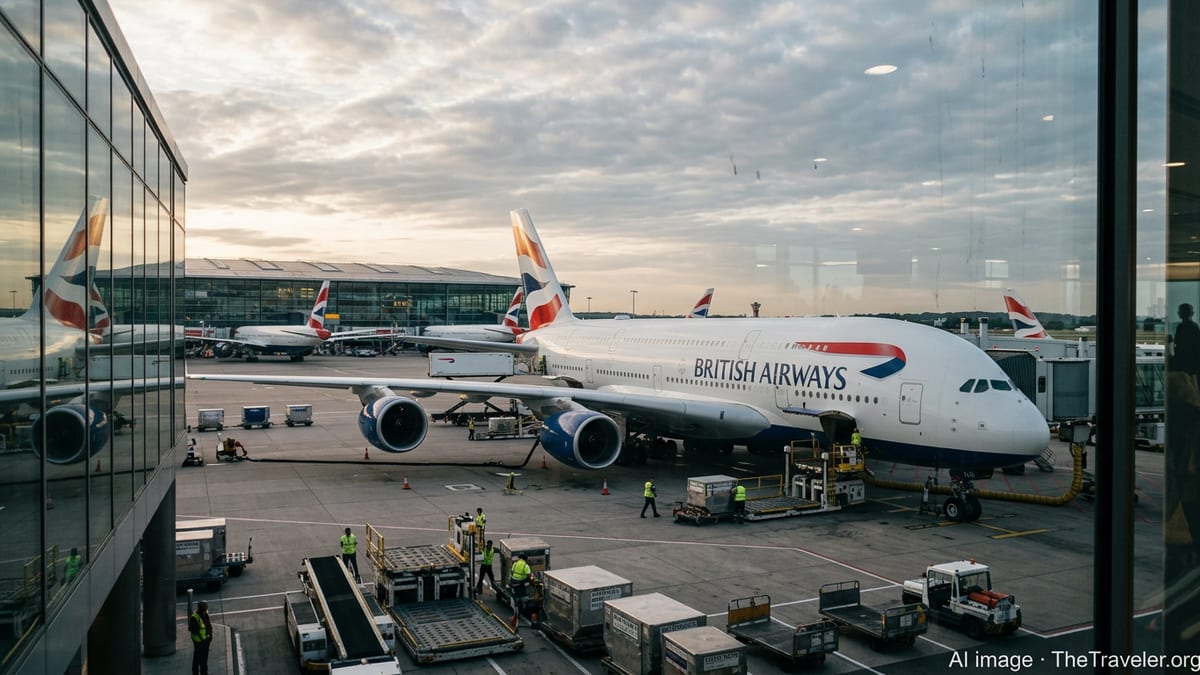
Superjumbo as a Slot-Saver at a Crowded Hub
For British Airways, the A380 is less a nostalgic icon and more a hard-nosed response to Heathrow’s chronic capacity crunch. With runway movements tightly capped and a long-debated third runway facing regulatory and political headwinds, BA has only limited room to add extra frequencies on its most lucrative intercontinental routes.
Instead, the airline is leaning on the A380’s size to grow by adding seats rather than slots. Each of BA’s 12 A380s carries more than 450 passengers in a four-cabin layout, allowing the carrier to upgauge select departures on high-demand corridors instead of trying to negotiate additional takeoff and landing rights. It is a strategy that aligns with Heathrow’s role as a global transfer hub, where thick flows of connecting traffic can support very large aircraft.
Recent fleet planning data show that BA’s A380 seat capacity from Heathrow has remained broadly stable even as older Boeing 747-400s disappeared and more fuel-efficient twinjets such as the A350-1000 and 787-10 joined the long-haul roster. In effect, the A380s have taken over part of the “heavy lifting” once done by jumbos, underpinning BA’s ability to defend market share on key transatlantic and Asia-Pacific routes while newer widebodies focus on frequency and network breadth.
The arrangement also gives BA a hedge against Heathrow’s contentious expansion plans. The airport is lobbying regulators to approve a multibillion-pound third runway and terminal complex, arguing that the cost per passenger will be modest over time. Airlines, including BA’s parent International Airlines Group, have pushed back, warning that higher airport charges could squeeze fares. In that context, sweating existing assets like the A380 is cheaper than banking on near-term physical expansion.
Heathrow Heavyweight on Transatlantic and Tech Routes
The A380’s role in BA’s network is most visible across the Atlantic, where the aircraft has been deployed on routes linking Heathrow with major US hubs and tech capitals. According to recent schedule data, BA currently uses the A380 on multiple North American destinations including Los Angeles, Miami and San Francisco, pairing high-capacity metal with some of its strongest corporate and premium-leisure demand.
From April 2025, aviation planners note that BA will operate the A380 on hundreds of monthly flights to a small set of carefully chosen long-haul cities, five of them in the United States. On the San Francisco route alone, the superjumbo is scheduled for up to 60 flights in each direction per month, a clear signal of how important Bay Area traffic has become in BA’s long-haul portfolio.
Dallas and Washington are also part of the evolving A380 story. BA is set to restore A380 service to Dallas/Fort Worth in 2025 after a pause, even as it withdraws the type from Washington Dulles later that year in favour of a mix of A350s, 787s and 777s. The shuffle underlines how BA is using the superjumbo as a flexible capacity tool rather than a one-size-fits-all flagship, moving it between markets as yields and demand patterns shift.
On these trunk routes, the A380 acts as a “Heathrow heavyweight” that can consolidate multiple smaller departures into one high-capacity flight at peak times. That is particularly valuable in the morning and late-evening banks, when slots are at a premium and connecting waves from Europe and the UK regions feed into long-haul departures.
Premium Cabins and a New First Class Bet
If raw capacity explains why BA keeps the A380 in the schedule, the aircraft’s premium real estate helps justify its ongoing investment. The superjumbo offers some of the largest floor space in the fleet for first and business class, and BA is gearing up for a significant cabin refresh that underscores its faith in the type’s long-term value.
The airline has confirmed plans to introduce a completely new first class on its A380s from mid 2026, positioning the aircraft as a showcase for its most exclusive product. The new suite will feature a wide, fully flat bed and higher walls for greater privacy, along with a larger in-flight entertainment screen and space to dine face to face with a companion. It is a clear signal that BA still sees room for a distinct first class above its latest business cabins on key Heathrow routes.
Retrofit work is set to coincide with broader interior upgrades, including refreshed business and premium economy sections, modernised lighting and updated in-flight entertainment systems. By rolling out its newest hard product on the A380, BA aligns the aircraft with its “premium leisure” strategy, targeting high-spend travellers heading to sun destinations, tech hubs and gateway cities from one of the world’s wealthiest catchment areas.
The investment also sends a message to corporate buyers and frequent flyers that the A380 will remain central to BA’s offering well into the next decade, rather than serving as a stopgap until more A350s and 787s arrive. For an airline that competes daily with US and Gulf carriers on service and comfort, elevating the on-board experience is as important as maximising seat counts.
A Wider A380 Resurgence Shapes BA’s Thinking
British Airways is not alone in rethinking the A380’s future. Several other major carriers have reversed or paused retirement plans as long-haul demand snapped back faster than expected and deliveries of next-generation widebodies fell behind schedule. This broader resurgence has strengthened the case for BA to hold and improve, rather than retire, its own fleet.
In Europe, Lufthansa has now returned all eight of its remaining A380s to service, basing them in Munich and reopening routes to destinations such as Los Angeles, Denver and Bangkok. In Australia, Qantas has completed a painstaking restoration and refurbishment of its A380 fleet, with the final aircraft returning to Sydney in late 2025 after years in desert storage and heavy maintenance abroad. Emirates, the largest A380 operator, continues to signal that it expects to fly the type into the 2040s.
This collective vote of confidence has had practical effects. A stronger secondary market for maintenance and components helps keep operating costs predictable, and continued investment by major carriers encourages suppliers to support the type for the long run. For BA, which operates more A380s than any other European airline, that ecosystem reduces the risk of being stranded with an orphaned fleet.
The superjumbo’s appeal is further reinforced by traffic forecasts that point to a doubling of global passenger numbers over the next two decades. While twin-engine jets will dominate new deliveries, the A380 offers near-term “instant capacity” for airlines like BA that face both full order books and crowded home hubs. In that environment, the aircraft looks less like a relic of pre-pandemic ambitions and more like a bridge to an even busier future.
Balancing Efficiency, Risk and Heathrow’s Future
Keeping the four-engine A380 in frontline service is not without trade-offs. The aircraft is less fuel-efficient per flight than newer twinjets and requires significant ground infrastructure, from dual jet bridges to specialised stands. Its economics only work on routes where cabins can be filled consistently at profitable fares, something that can be tested by geopolitical shocks or economic downturns.
BA’s broader fleet strategy attempts to balance those risks. Newer A350-1000s and 787s, which offer better fuel burn and more flexible capacity, are deployed on thinner or developing long-haul markets, while the A380s are concentrated on high-density, high-yield city pairs where Heathrow’s slot scarcity makes their size an advantage rather than a liability. This mixed approach allows BA to dial capacity up or down route by route while retaining the option to move A380s as conditions change.
Heathrow’s own trajectory will also shape how long BA’s A380 era lasts. The airport’s proposed expansion has become a flashpoint between its owners, regulators and airlines that fear higher fees. BA’s parent group has warned that the current plans could significantly raise per-passenger costs and, ultimately, ticket prices. Until the regulatory dust settles and concrete is poured, BA appears content to let its superjumbos carry more of the load at its primary hub.
For now, the calculus is clear. As long as Heathrow remains slot-constrained and demand for premium-heavy long-haul travel holds up, British Airways will keep betting big on the Airbus A380, turning the superjumbo into both a symbol and a workhorse of its Heathrow strategy.