

More news on this day
On long-haul routes from Europe to Asia and the Middle East, carriers like Singapore Airlines, Qatar Airways, Emirates and Lufthansa are quietly rewriting the rules of comfort, offering business class cabins where personal space can exceed economy by more than 30 percent and, in some cases, feel closer to a boutique hotel room than a traditional airline seat.
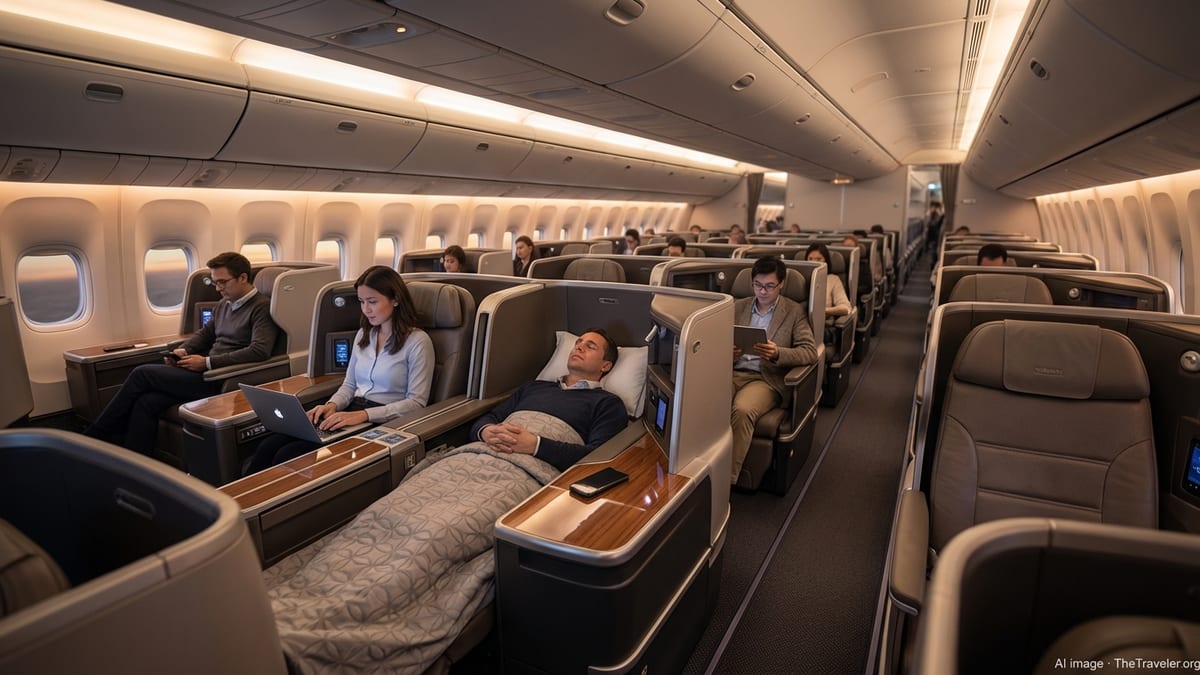
The New Space Race at 35,000 Feet
For years, the headline competition in aviation revolved around ticket prices and route maps. In 2026, the most telling battleground is measured in inches, not miles. Seat pitch, bed length and shoulder room have become critical metrics as leading full-service carriers seek to pull travelers out of increasingly crowded economy cabins and into higher-yield premium seats.
Among the most aggressive are Singapore Airlines, Qatar Airways, Emirates and Lufthansa. Their latest-generation business class products offer fully flat beds, privacy doors and dedicated storage, but the most striking statistic is space. On many of their long-haul aircraft, business class seat pitch now ranges from roughly 55 to over 80 inches in bed mode, compared with around 31 to 32 inches in economy, delivering well above 30 percent more usable room per passenger. In width, business seats typically offer several additional inches, and far fewer seats are squeezed into each row.
This spatial advantage is not only about comfort. It is at the heart of each airline’s profitability strategy. By creating cabins that feel dramatically different from economy, these carriers are encouraging travelers to trade up, whether by paying cash, using frequent flyer miles or leveraging corporate travel budgets.
The result is a widening gap between the front and the back of the plane. On a modern widebody, the experience of flying business versus economy is now less a matter of incremental upgrade and more akin to choosing a different mode of transport altogether.
How the Numbers Add Up: Pitch, Width and Personal Real Estate
To understand what “30 percent more space” looks like in practice, it helps to translate airline jargon into real-world terms. Seat pitch, the distance from one point on a seat to the same point on the seat in front, is the key indicator of legroom. On many Qatar Airways long-haul aircraft, for example, economy pitch typically runs about 31 to 32 inches, with seat widths around 17 to 18 inches. In business class, Qatar’s flagship Qsuite can stretch to about 103 inches of pitch in bed mode, with a width around 21 inches, creating room for a fully flat sleeping surface and side tables rather than a simple reclining seat.
Emirates’ latest A380 business class similarly moves from a 3-4-3 economy layout to a 1-2-1 configuration upstairs. While economy seats generally offer a pitch in the low 30s and a width just under 18 inches, Emirates’ business seats on the A380 are staggered, with pitch of up to roughly 48 inches in seated mode and a fully flat bed extending to around 70 to 72 inches, plus an 18.5-inch-wide seat and generous console storage. The reduction in seats per row and the additional length translate into a tangible perception of space when passengers stand, move or sleep.
Singapore Airlines and Lufthansa have followed a similar playbook. Singapore’s latest long-haul business class, deployed on Airbus A350 and Boeing 777-300ER aircraft, uses a 1-2-1 configuration with wide, sculpted shells that pivot into beds. Across its long-haul fleet, economy class still clusters passengers in 3-3-3 or 3-4-3 layouts at around 32 inches of pitch. Lufthansa’s new Allegris business class, rolling out across its long-haul fleet, is built around the same principle: fully flat beds, direct aisle access, and varied seating positions, compared with a relatively tight 31-inch pitch and 2-4-2 or 3-3-3 layouts in economy.
When analysts talk about a 30 percent space gain, they are often referring to a combination of longitudinal room, seat width and the extra footprint created by reducing the number of seats per row. On a cabin cross-section, this can be visually dramatic: where ten economy passengers once shared a row on a Boeing 777, a business class layout might seat just four, adding not only legroom, but also elbow room, storage and personal surfaces.
Singapore Airlines: From Quiet Luxury to Lie-flat Suites
Singapore Airlines has long used comfort as a calling card, and its most recent cabin investments deepen that strategy. In economy, the airline still stands out for solid ergonomics, with sculpted seat backs, adjustable headrests and a pitch that compares favorably with many global rivals. Yet even here, the push toward higher-density layouts on certain aircraft has made space more precious, with passengers often sharing ten-abreast rows on large twinjets.
Business class tells a different story. On its A350-900 and 777-300ER long-haul routes, Singapore Airlines offers wide, leather-clad business seats in a 1-2-1 layout that convert into beds stretching to around two meters. The design emphasizes both horizontal and vertical space, with high shells, side cubbies and expansive armrests. For many travelers, the feeling is less of sitting in a scaled-up seat and more of inhabiting a compact private room.
The carrier’s ultra long-haul services, such as the nonstop Singapore to New York flights, underscore how central space has become to its proposition. On those routes, there is no standard economy cabin; instead, the aircraft is configured with premium economy and business class only, effectively drawing a line under the older model where every passenger endured the same tight quarters on the world’s longest flights.
For leisure travelers connecting from the United States or Europe through Singapore to Australasia and beyond, the arithmetic is simple. With sectors routinely exceeding 10 hours, the extra inches of pitch and width in business class translate directly into better sleep, less physical strain and a working day that is not lost to jet lag at the other end.
Qatar Airways and the Qsuite: Space as a Private Room
Doha-based Qatar Airways has been one of the most forceful advocates for turning business class into a quasi-first-class experience. Its Qsuite, now flying on many Boeing 777 and Airbus A350 aircraft, encapsulates the trend. Enclosed by a sliding door, configured 1-2-1 across the cabin, and offering a bed up to roughly 79 inches long with a pitch over 100 inches in some configurations, the Qsuite gives each passenger far more personal real estate than the airline’s 10-abreast economy cabins.
In standard economy on Qatar’s long-haul fleet, travelers can expect around 31 to 32 inches of pitch and a seat width close to 17 to 18 inches. On the same aircraft, Qsuite transforms that footprint into an individual pod with an armchair-style seat, expansive side table, personal wardrobe-style storage and a large entertainment screen. For couples or families, center suites can be combined to form a shared space, further blurring the line between aircraft seat and living room.
Industry observers note that Qatar’s strategy is particularly focused on premium-heavy global routes where corporate travel and affluent leisure demand justify the hardware. The airline couples the extra space with soft-product touches such as dine-on-demand menus, premium bedding and amenity kits, aiming to make the hours aloft feel closer to a high-end hotel stay. That stands in contrast to economy, where even with well-regarded service and complimentary meals, passengers remain confined to a compact seat for flights that can stretch to 14 or 15 hours.
The appeal of that extra room is borne out in real-world behavior. Travel agents report that on overnight sectors such as Doha to Dallas or Doha to London, travelers are increasingly willing to use frequent flyer miles or cash upgrades to move into Qsuite, particularly when work commitments demand that they arrive rested enough to be productive immediately.
Emirates: A380 Flagship Comfort and a New A350 Era
Emirates has built its global brand on the back of cabin comfort, and its flagship Airbus A380 continues to anchor that message. In economy, the airline operates high-capacity cabins with a 3-4-3 layout on the main deck and, on some aircraft, a 2-4-2 layout on the upper deck, with pitch in the low 30-inch range. While service standards and entertainment are strong, the physical space per passenger remains constrained, especially on full flights.
Business class on the A380, by contrast, is arranged 1-2-1 on the upper deck, giving every traveler direct aisle access and a fully flat bed. Seats offer around 18.5 inches of width with substantial side consoles, and the pitch extends to create beds around six feet in length. The cabin design emphasizes open walkways, an onboard bar and social area, and large storage bins, collectively enhancing the perception of space well beyond the raw numbers.
The airline’s ongoing retrofit program for its Boeing 777-300ER fleet and the introduction of its new A350-900 aircraft further sharpen the divide. The A350-900, which began entering service on routes such as Dubai to Adelaide, features a next-generation cabin with 32 business class seats inspired by automotive design, as well as new premium economy and refreshed economy sections. The quieter interior, higher ceilings and wider aisles of the A350 design amplify the space gains in business class, while economy remains comparatively dense to preserve overall seat counts.
For travelers, this means that the comfort gap between front and back is growing precisely on the routes where fatigue is most acute. On a 14- or 15-hour ultra long-haul, the ability to stretch out fully, move easily to the aisle and work or dine without disturbing neighbors is increasingly becoming a deciding factor in airline choice, even for cost-conscious passengers.
Lufthansa’s Allegris Program and Europe’s Premium Push
In Europe, Lufthansa is leading a significant reshaping of cabin layouts with its Allegris program, a multi-billion-euro investment that introduces an entirely new generation of long-haul seats across all classes. While economy retains relatively familiar dimensions, typically around 31 inches of pitch in nine- or ten-abreast layouts on widebodies, business class undergoes a far more radical change.
The Allegris business cabin uses a 1-2-1 or staggered layout that provides all passengers with direct aisle access and fully flat beds. Seats come in multiple variants, including extra-long beds and suites with doors, but all occupy more floor area than the outgoing product, which itself already offered lie-flat seating. Compared with the economy rows further back, the new business class pods deliver substantially more width, legroom and privacy, making the cabin feel more exclusive and spacious.
Lufthansa’s strategy highlights a trend among European network carriers: economy cabins are being optimized around efficiency and price competitiveness, while business class is positioned as a premium, space-rich environment aimed at both corporate accounts and high-spend leisure travelers. The airline pairs this with upgraded lounges and enhanced ground services, reinforcing the sense that buying a business class ticket is effectively buying into a separate end-to-end travel experience.
The bet is that travelers connecting through hubs like Frankfurt and Munich will not only pay more for extra space, but will actively choose routings and schedules that allow them to fly in these new cabins rather than older products on rival airlines.
Why Extra Space Matters: Sleep, Health and Productivity
The focus on adding more than 30 percent extra personal space in business class is about more than aesthetics. Medical research and passenger feedback have long pointed to the physical stresses of long-haul economy flying, from stiff joints and poor sleep to an elevated risk of deep vein thrombosis in cramped conditions. By offering stretch-out space and the ability to lie fully flat, airlines are directly addressing these concerns for those willing or able to upgrade.
Quality of sleep is one of the clearest differentiators. In economy, even a relatively generous 32-inch pitch and decent recline rarely allow for more than a semi-upright doze. In business class, fully flat beds, high partitions and quieter, more sparsely populated cabins make it possible for many travelers to achieve several hours of genuine rest. That can translate into sharper decision-making on arrival, less time lost to recovery and, over repeated trips, a meaningful reduction in travel fatigue.
Space also plays into productivity and mental wellbeing. With larger personal tables, power outlets, adjustable lighting and more elbow room, business class travelers can realistically treat time on board as an extension of the office, working on laptops or holding conversations without contorting their bodies. For leisure passengers, the same space encourages a more relaxed experience, with room to move, stretch and enjoy meals at a comfortable distance from neighboring passengers.
For airlines, these benefits support a premium narrative that justifies higher fares and, increasingly, premium economy cabins that sit between the two extremes. But the clearest advantage still resides in full business class, where the scale of the space increase is most dramatic and most immediately felt.
When It Makes Sense to Upgrade Your Flight
With fares for business class often several times higher than economy, the decision to upgrade is rarely taken lightly. Yet the new generation of cabins introduced by Singapore Airlines, Qatar Airways, Emirates and Lufthansa is changing the calculus, particularly on routes exceeding eight hours. Travelers are weighing not only the in-flight comfort, but the value of arriving rested, avoiding an extra hotel night, or maintaining productivity on multi-city trips.
Frequent flyer programs and fare sales are widening access to these products. On certain off-peak dates, business class fares on connecting itineraries can narrow the gap with flexible economy tickets, especially when checked bags, seat selection and change fees are taken into account. Corporate travel policies are also evolving, with some companies permitting business class on overnight sectors or when flights exceed a specified duration, recognizing the impact on employee wellbeing and performance.
For individual travelers, a pragmatic rule of thumb has emerged. On short daytime hops of three or four hours, modern economy cabins on these airlines can be perfectly acceptable, particularly when paired with priority services or extra-legroom seats. On overnight or ultra long-haul journeys, especially when work or important events await on arrival, the more than 30 percent space premium and lie-flat bed of business class increasingly tip the balance.
As airlines continue to roll out these upgraded cabins through 2026 and beyond, the front of the plane is becoming not only more luxurious, but more distinct. For those who can find a suitable deal or deploy miles strategically, moving from economy into business is less about indulgence and more about reclaiming time, rest and personal space in an era when every inch on board counts.