

More news on this day
A deepening trade dispute, fresh tariffs and a harsher political tone out of Washington are reshaping how Canadians vacation, with millions now quietly rerouting trips away from the United States and toward friendlier, more predictable destinations.
A Sharp Drop in Canadian Visits South of the Border
For decades, the United States has been Canada’s default winter escape and long-weekend playground. That pattern is now breaking. Recent travel data from Statistics Canada and the U.S. National Travel and Tourism Office point to a steep, sustained drop in Canadian trips to the United States through 2024 and into 2025, even as overall outbound travel by Canadians recovers or grows.
Industry analysts say that decline has accelerated since the latest round of U.S. tariffs on Canadian steel, aluminum and key manufactured goods took effect in early 2025, triggering what observers now openly describe as a trade war. In February 2025, Canadian travel to the United States fell by around 40 percent compared with the same month a year earlier, a contraction that one major travel analytics firm projects will translate into roughly 4 million fewer Canadian visitors this year than in 2024.
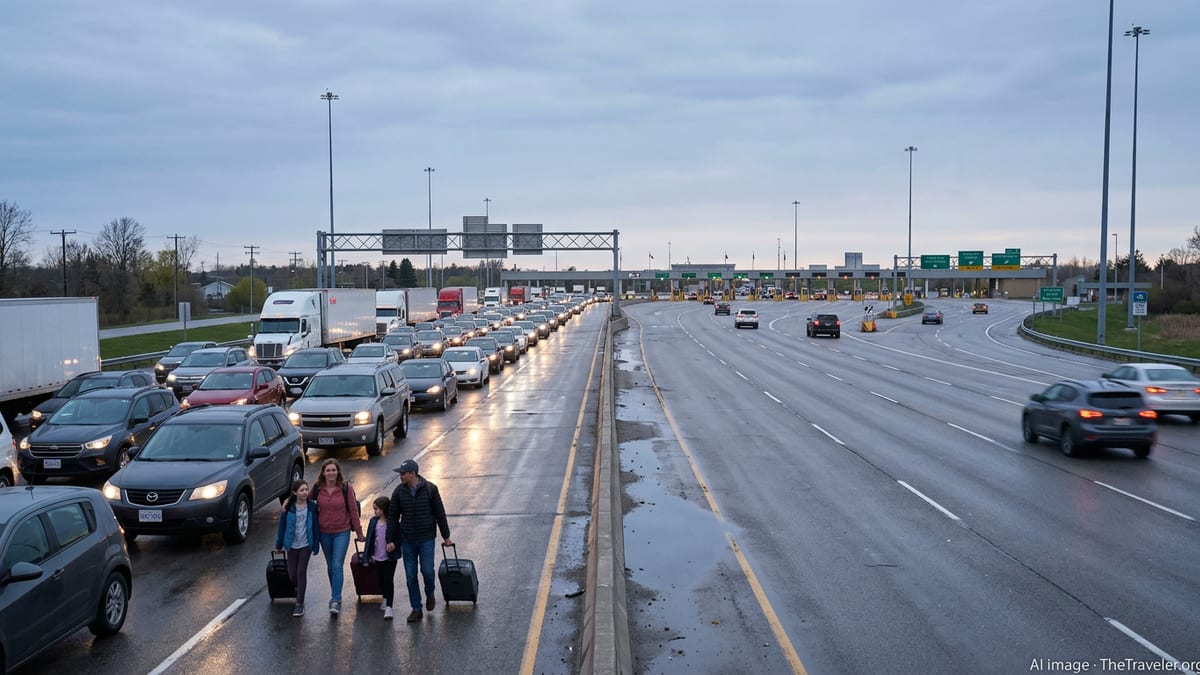
Border statistics tell the same story at ground level. Land crossings by Canadian residents have posted double-digit year-over-year declines for many consecutive months, with some reports citing drops of 28 to more than 30 percent in peak spring and summer travel periods. Airports are seeing similar patterns: flight bookings from Canada to U.S. cities plunged by as much as 70 percent in late winter and early spring, forcing airlines to cut capacity on cross-border routes.
That reversal is striking for two economies that share the world’s longest land border and historically dense tourism flows. Until very recently, Canadians accounted for more than three-quarters of all international trips taken by their own citizens that involved a foreign destination, and the vast majority of those journeys were to the United States.
Tariffs, Trade War and the Pocketbook Effect
The economic backdrop to this travel shift is bruising. The current U.S. administration’s tariffs on a wide swath of Canadian exports, framed as part of a broader effort to secure “fair trade,” have rippled far beyond boardrooms and factory floors. They have pushed down business confidence, stoked nationalist sentiment in Canada and weakened the Canadian dollar relative to the U.S. currency, making already pricey American vacations feel out of reach for many middle-income households.
Polls conducted in early and mid-2025 show clear spillover from trade tensions into travel choices. In one widely discussed survey, roughly 60 to 63 percent of Canadian adults said they were less likely to visit the United States in the next year because of U.S. politics and policy. Among those who cited policy concerns, large majorities pointed specifically to U.S. tariffs and economic brinkmanship as negative factors, on par with worries about border treatment and political rhetoric.
Tour operators north of the border say they have watched the shift unfold in real time. Agents who once specialized in shopping weekends in Buffalo, skiing in Vermont or golf in Arizona report a wave of cancellations and rebookings toward domestic or overseas trips. Many customers, they say, openly frame their decision as a personal response to tariffs and trade friction, blending principle with pragmatism as the weaker Canadian dollar inflates hotel bills and restaurant tabs south of the border.
The result is a double hit for U.S. destinations that have long depended on Canadian tourists to fill hotel rooms and outlet malls, especially in border states like New York, Michigan, Washington and Minnesota. Tourism agencies in those states have begun to acknowledge the damage in public, with some putting major marketing campaigns on hold while they wait for political winds to shift.
Politics at the Border: From Friction to Fear Factor
While economics matter, politics may be the more visceral driver of Canada’s pullback. The rhetoric around the trade dispute, including pointed remarks about Canada’s sovereignty and suggestions that it could be treated as a “51st state,” has landed badly with a population that traditionally sees the United States as both neighbor and friend. In multiple national polls over the past year, solid majorities of Canadians now describe the United States as an unreliable or even threatening actor, a dramatic reversal from historical views.
That unease is magnified at the border itself. High-profile stories of travelers detained for secondary screening, questioned about their views on U.S. policies or asked to hand over electronic devices have ricocheted through Canadian media and social networks. Even when such incidents are statistically rare, they feed a perception that entering the United States has become unpredictable, stressful and, for some, demeaning.
Travel researchers say this “border anxiety” has real behavioral consequences. Surveys by firms that track Canadian intent to travel show a clear correlation: those who express concern about U.S. political leadership and law enforcement practices are far more likely to say they will avoid the country altogether in the coming year. Many mention that they do not want their vacation to double as a political statement or a potential confrontation with an immigration officer.
In this climate, the calculus for families planning a holiday has shifted. The question is no longer only about beach quality or flight price, but whether crossing into the United States aligns with their values and tolerance for uncertainty.
Where Canadians Are Going Instead
The winners from this realignment are close to home. Canadian provinces from British Columbia to Prince Edward Island are reporting record or near-record visitor numbers, much of it driven by residents who previously might have booked a week in Florida or an outlet-shopping road trip to the nearest American border town. Local tourism boards highlight a surge in demand for lakeside cottages, urban food weekends and Indigenous-led cultural experiences.
Internationally, Canadian travelers are casting a wider net. Data from major tour operators and airlines indicate growing interest in destinations perceived as politically stable and welcoming, including Western Europe, the Caribbean and parts of Asia and Latin America. In many cases, package deals and favorable local price levels offset flight costs, narrowing the price gap with the United States, especially when the strong U.S. dollar is factored in.
Some Canadian agencies now market entire campaigns around the idea of “tariff-free vacations,” subtly positioning Europe, Mexico and domestic options as stress-free alternatives to U.S. travel. Industry insiders say this is not just opportunistic branding; it reflects genuine feedback from customers who say they want their spending to support countries they feel are treating Canada fairly in trade negotiations.
For Canadian travelers, the shift has tangible upsides: closer engagement with their own expansive backyard, new long-haul adventures and, in many cases, better value for money. For U.S. destinations long reliant on Canadian dollars, it is a warning that goodwill at the border can no longer be taken for granted.
A Structural Test for Cross-Border Tourism
Tourism leaders on both sides of the border increasingly describe the current downturn not as a short-lived boycott but as a structural test of a once-effortless travel corridor. Organizations representing U.S. attractions, hotels and state tourism boards have begun lobbying Washington for clearer, more welcoming messaging to Canadians and for tourism to be explicitly considered in future trade and border-policy decisions.
Policy specialists say the upcoming review of the United States–Mexico–Canada Agreement in 2026 could serve as an inflection point. Proposals circulating in industry circles would give travel and tourism officials a formal role in trade talks for the first time, ensuring that the economic importance of cross-border leisure and business travel is weighed against tariff strategies and political signaling.
In the meantime, Canadian travelers appear content to sit out the standoff. With polls suggesting that more than 60 percent plan to avoid U.S. trips for at least the next year, and travel behavior already reflecting those intentions, it may take more than a single policy tweak to restore the easy familiarity that once defined north-south tourism. The longer the chill lasts, analysts warn, the greater the risk that Canadians permanently rewire their vacation habits away from the United States.
For now, every missed long weekend in a U.S. border town and every diverted winter escape to a Canadian ski hill or European beach tells the same story: trade tariffs and political friction have turned what was once an almost automatic trip into a complicated choice, and millions of Canadians are choosing to stay away.