

More news on this day
In a city famed for complex rail maps and eccentric transit lore, a quiet corner of south east London has unexpectedly become a social media star, as TikTok users fixate on Catford’s two side by side train stations and the surreal experience of stepping off one network and onto another in just a few strides.
Get the latest news straight to your inbox!
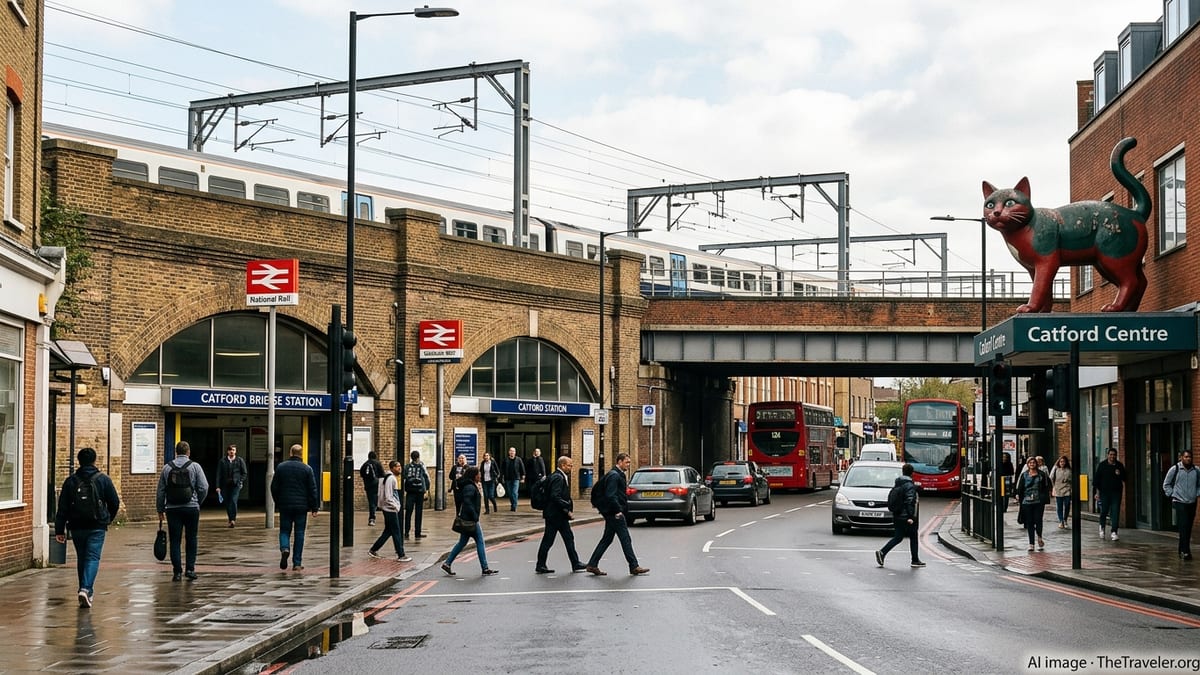
The South London Junction That TikTok Discovered
Catford, in the London Borough of Lewisham, is hardly a household name for overseas visitors, but recent TikTok clips are rapidly changing that perception. Short videos showing Catford’s two separate stations, Catford and Catford Bridge, sitting almost back to back have gathered hundreds of thousands of views, as creators spotlight what many describe as one of the United Kingdom’s oddest transport quirks.
The videos typically follow a simple format. A train pulls into Catford Bridge on the Mid Kent Line, serving London Charing Cross, Cannon Street and Hayes. Moments later, the creator walks a few metres, climbs a short ramp or set of steps, and emerges at Catford station on a different line entirely, used by Thameslink services running towards central London and Kent. The cut between the two platforms, often set to trending audio, creates a sense of jumping between parallel rail networks in seconds.
What has long been a local convenience is now being framed as a curiosity worth travelling to see. For TikTok audiences fascinated by unusual infrastructure, the proximity of two separately named, separately managed National Rail stations, each with its own signage, timetables and service patterns, feels almost like a deliberate social experiment in British transport eccentricity.
For many Londoners outside south east London, the viral clips are also an introduction to an area they might otherwise only pass on a map. Catford, once better known for its traffic-choked South Circular and postwar shopping precinct, is being reintroduced to a new audience through the lens of its overlapping rail lines and the strangely theatrical journey between them.
Two Stations, Two Histories, One Very Short Walk
The quirk at the heart of the TikTok trend is rooted in Victorian railway rivalry. Catford Bridge opened in the mid nineteenth century on what is now the Mid Kent Line, while Catford station arrived later on a separate route. Each line developed its own pattern of services into central London, and the two stations were never combined into a single complex, even as the city grew around them.
Today, Catford Bridge sits beside the River Ravensbourne, handling services operated by Southeastern towards central London and Hayes. A few metres away, slightly elevated on a separate viaduct, Catford station sits on the Catford Loop Line, used by Thameslink trains running towards London Blackfriars, St Pancras and beyond. On paper they appear as distinct points on the rail map. On the ground, they are so close that, on quiet days, announcements at one station can be heard from the other.
Transport enthusiasts have long noted the anomaly, but social media has given it fresh prominence. Creators frequently highlight the contrast between the two networks, filming the different liveries, platform architecture and passenger flows. Some videos dwell on the experience of tapping in and out with a contactless card as they move between the stations, underscoring how one short walk can switch a journey from one set of routes and fare patterns to another.
Publicly available planning documents for Catford town centre also underline how unusual the arrangement is. The area is described as a major junction where the South Circular road meets the A21, framed by two National Rail stations positioned within a compact town centre. For everyday commuters this is primarily a matter of convenience, but for TikTok’s algorithm, it is precisely the sort of distinctive, easily explained oddity that travels well.
The Catford Cat and a Sense of Place
The TikTok spotlight on Catford’s rail oddities has also revived interest in another of the area’s distinctive features: the oversized, stylised cat that peers out from a sign on the shopping precinct near Catford station. The sculpture, long a local landmark, has become a frequent cameo in videos that move from the platforms out into the surrounding streets.
For content creators, the Catford cat offers a visual punchline. A typical clip might show viewers the quick hop from Catford Bridge to Catford station, then cut to the giant cat as a final reveal, leaning into the idea that the neighbourhood has embraced its feline identity. The combination of twin stations and cat iconography has given the area a recognisable brand on social media that distinguishes it from other suburban centres.
Travel and property commentators have previously described Catford as an emerging neighbourhood, with improving public spaces, a growing food scene and significant regeneration proposals under consideration. The viral attention on its rail nodes is now intersecting with that broader narrative, presenting Catford as both an accessible transport hub and a place with its own eccentric visual culture.
For visitors intrigued by the trend, the reality on the ground remains resolutely everyday. Commuters move between buses, trains and local shops, while the cat sign watches over traffic on the South Circular. Yet the internet’s ability to reframe familiar streets as curiosities means that the area is now making brief cameos in travel wishlists and comment threads far beyond London.
Algorithm-Friendly Infrastructure Tourism
The sudden interest in Catford’s stations is part of a wider shift in how people discover and experience cities. Social media platforms have already turned colourful staircases, unusual crosswalks and strangely shaped buildings into micro-destinations. In the transport world, that same logic is now being applied to junctions, sidings and station layouts that once only appealed to dedicated railfans.
Catford’s appeal lies in its legibility. TikTok viewers do not need specialist knowledge to grasp what makes the location unusual. Two stations, two names, two operators, a few metres apart: the premise can be understood in a moment, and the video evidence is straightforward. The built environment becomes a form of real world puzzle, solved in under a minute of vertical video.
For London’s vast rail network, this sort of attention is largely benign. Catford’s stations are already established commuter stops within fare zone 3, and social media exposure is unlikely to radically alter passenger flows. However, it does contribute to a growing genre of so called infrastructure tourism, in which travellers seek out oddities in signalling, track layout or station design as part of their itinerary.
Other quirky junctions and paired stations across the United Kingdom are beginning to appear in recommendation threads, prompted by the interest in Catford. Viewers trade tips on where platforms overlap, where lines cross at unusual angles, or where multiple modes of transport converge in tight urban spaces. Catford’s moment in the spotlight may prove to be a gateway to a deeper curiosity about how railways have shaped cities over time.
What It Means for Travellers
For visitors to London inspired by TikTok to explore beyond the city’s more familiar landmarks, Catford offers a compact lesson in how Victorian rail competition still shapes twenty first century journeys. Within a small radius, travellers can experience two different sets of services, interchange between them on foot, and see how main roads, river valleys and high streets have been threaded between viaducts and embankments.
Publicly available guidance from transport authorities highlights Catford and Catford Bridge as strategic points in south east London’s rail network, connecting suburban communities with central employment hubs. The current town centre planning framework treats the stations as anchors for future improvements to streets, cycling links and public spaces, indicating that the rail oddity attracting online attention is also a key part of longer term urban strategies.
For now, however, the main impact of the viral clips is reputational rather than structural. Catford’s twin stations and watchful cat have turned into shareable symbols of everyday British eccentricity, feeding an appetite among global audiences for unexpected details in familiar cities. Visitors tempted to see the quirk for themselves will find functioning commuter infrastructure first and a social media curiosity second, tucked into the fabric of a changing south London neighbourhood.