

More news on this day
In a city famous for complex transport maps, it takes a lot to surprise Londoners, yet the south-east suburb of Catford has suddenly found itself trending on TikTok thanks to a bizarre rail layout that puts two separate train stations barely a short walk apart.
Get the latest news straight to your inbox!
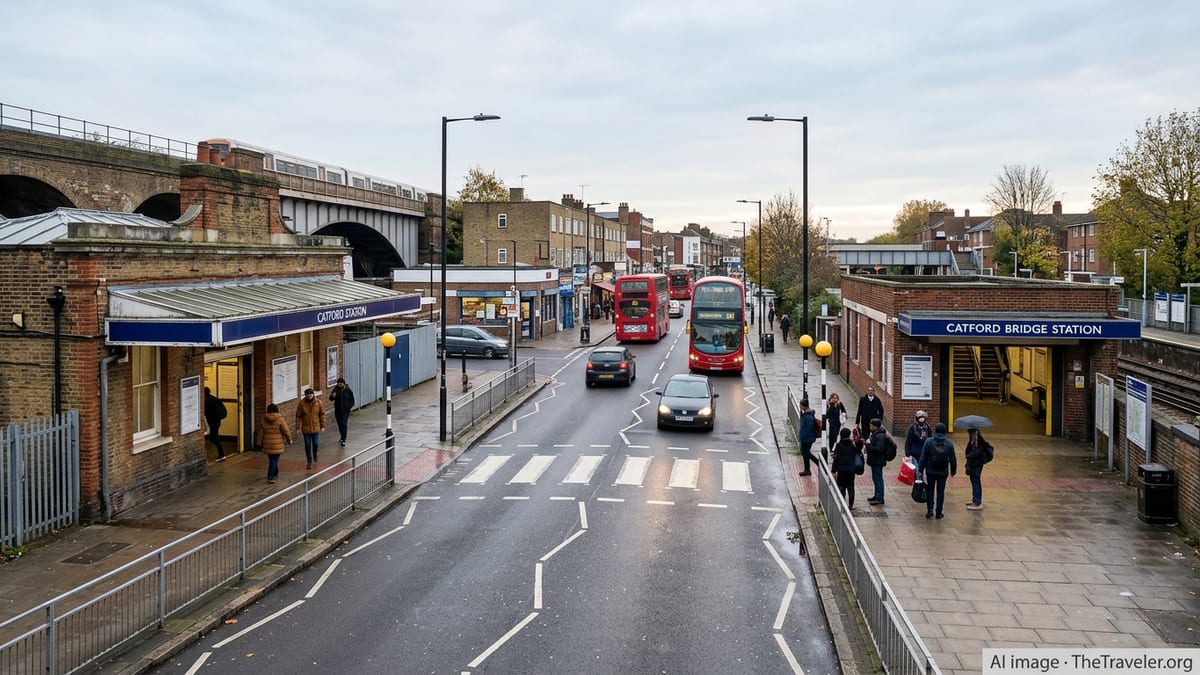
The UK’s Closest Stations, Hiding in Plain Sight
Catford and Catford Bridge stations sit on different railway lines but are separated by only around 90 metres of pavement and a small slice of the River Ravensbourne. Publicly available station data and rail commentary describe them as the closest pair of National Rail stations in the United Kingdom, a distinction that has recently been rediscovered and amplified by TikTok users.
Catford, on the Catford Loop Line, is managed by Thameslink services heading between central London and destinations such as Sevenoaks. Catford Bridge, on the Mid-Kent Line, is served by Southeastern trains running between central London terminals and Hayes. Despite providing access to entirely different sets of services, the two stations are so close that travellers report being able to hear platform announcements from one while standing on the other.
For decades the pairing was treated as a niche fact for transport enthusiasts and local commuters. That changed when short videos began circulating on TikTok showing creators stepping out of one station, crossing the road and arriving at the other in less time than it takes to swipe through a clip. The visual punchline of two discrete stations, each with its own signage, ticket gates and platforms, effectively side by side has proved ideal for the looping, attention-grabbing language of social media.
How a Victorian Rail Rivalry Became a Social Media Meme
The odd arrangement in Catford has its origins in the competitive world of nineteenth-century railway expansion. According to historical accounts and rail histories, Catford Bridge opened first in the 1850s as part of the Mid-Kent network. Catford station followed later in the 1890s, when a separate railway company constructed the Catford Loop to increase capacity and reach new markets.
Rather than integrate the two operations into a single shared complex, the rival companies built adjacent but independent facilities. Each line followed its own alignment, one carried over the main road on a viaduct and the other dipping beneath, with platforms sitting at different levels. The result was two entrances, two sets of platforms and no unified brand, even as the surrounding suburb grew around them.
Today, modern operators, fare zones and timetable planning have layered over that Victorian legacy, but the physical layout remains intact. Transport planners and bloggers have occasionally highlighted Catford’s twin stations as a textbook example of how historic competition can hardwire quirks into the network. TikTok creators have now turned that textbook example into shareable content, animating maps, tracing routes on phone screens and staging “station to station” challenges.
Clips often contrast the complex story of corporate rivalry and incremental engineering with the simple experience of walking a few seconds between two different station nameboards. The gap between that messy history and the tidy absurdity of the modern view has become part of the appeal.
From Quiet Commuter Stop to TikTok Curiosity
Catford’s stations have long been functional rather than glamorous. Local commentary and community reports describe them as busy commuter stops with basic facilities, linking residents to hubs such as London Bridge, Blackfriars and Charing Cross. They sit just off the South Circular Road, amid heavy traffic, a tangle of bus routes and a town centre that is undergoing gradual regeneration.
Yet on TikTok and other short-form platforms, the stations are being reimagined as an example of peculiarly British infrastructure logic. Creators highlight the mismatch between expectations of a joined-up transport network and the reality of two almost-touching stations that are treated, timetabled and branded as entirely separate. Some videos focus on the practical question of why the pair has never been formally merged, while others simply revel in the strangeness.
The format lends itself to discovery. One popular style of clip opens on a map screenshot, zooms into south-east London, and then cuts to street-level footage of the short stroll from Catford to Catford Bridge. Another trend involves timing the walk and comparing it with officially stated interchange times, underlining how fleeting the connection feels on the ground.
Comment sections beneath these clips often fill with viewers expressing surprise that they had never heard of Catford, despite years of living in London or visiting the city. For some, it becomes a piece of trivia to deploy on future trips; for others, it is a prompt to plan a detour and see the layout for themselves.
What the Viral Moment Reveals About London Transport
The Catford phenomenon is part of a wider social media fascination with the hidden patterns of urban mobility. In recent years, accounts dedicated to unusual bus routes, odd interchange quirks and forgotten railway spurs have gained large audiences. Catford’s twin stations fit that trend precisely: they are both mundane, as everyday commuter stops, and quietly astonishing once their proximity is fully appreciated.
Publicly available planning documents and transport assessments identify Catford and Catford Bridge as important local gateways, while also flagging challenges such as road congestion, noise and fragmented pedestrian routes in the surrounding town centre. Online commentators have suggested that the viral attention could strengthen conversations around how people move through the area, from clearer signage between the two stations to broader public realm improvements.
There is also a broader lesson about how historic infrastructure decisions continue to shape contemporary experience. The distance between Catford and Catford Bridge may be measured in a handful of seconds on foot, but it is also the product of more than a century of evolving rail ownership, route planning and urban growth. TikTok’s short clips compress that long story into a striking visual punchline, prompting viewers to look again at the systems they use every day.
For now, Catford’s oddest transport quirk remains an amusing detour on the digital map of London. Whether the sudden burst of attention results in physical changes, or simply cements the stations’ reputation as a cult trivia favourite, it has already ensured that a small corner of south-east London occupies a disproportionately large space on the internet’s mental map of the city.