

On a bright Caribbean afternoon at Maho Beach on the island of Sint Maarten, it feels as if the sky itself is dropping onto the sand. A wide‑body jet appears over the turquoise water, growing bigger and louder until it roars over the crowded shoreline, so low you can see the rivets on its belly.
For many visitors, this is the moment they came for. Yet behind the viral videos and stunned reactions lies a logical aviation story: those planes are not “buzzing” the beach for fun. They are simply following a standard, regulated approach into one of the world’s most geographically constrained airports.
Understanding why they fly so low at Maho Beach means looking at runway design, aircraft performance, strict safety margins and the sometimes uneasy relationship between tourism and risk.
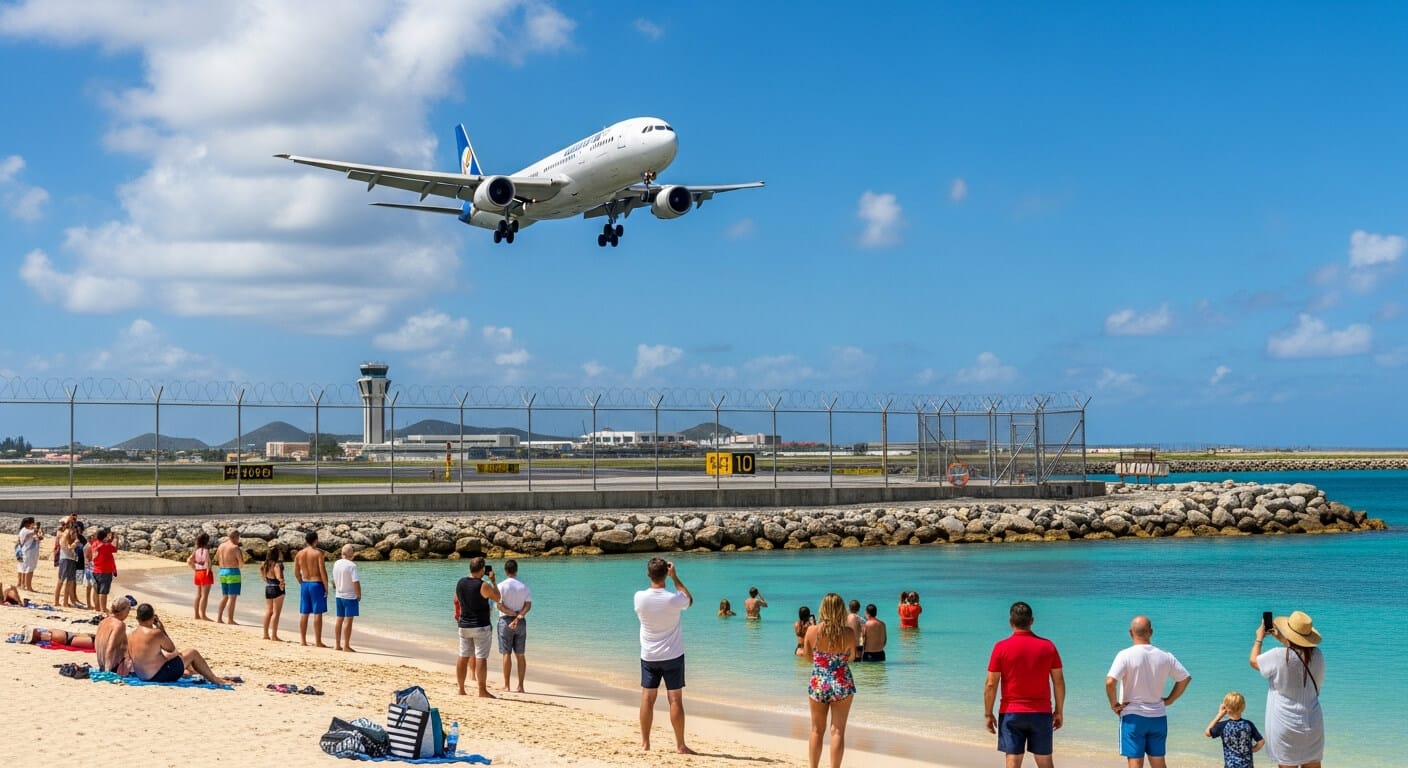
Where Maho Beach Meets Princess Juliana Airport
Maho Beach sits on the Dutch side of the island of Saint Martin, in the country of Sint Maarten, directly beside Princess Juliana International Airport. At the eastern edge of the beach, a narrow two‑lane road and a chain‑link fence are the only barriers before the airport’s single runway.
There is almost no buffer between sunbathers and one of the Caribbean’s busiest aviation gateways, which serves long‑haul flights from North America and Europe as well as regional turboprops.
The runway itself, designated 10/28, is about 2,300 meters long and roughly 45 meters wide. It begins just a short distance behind the beach, with the approach end of Runway 10 aligned almost exactly over the shoreline.
Aircraft landing from the west line up over the ocean, descend on a standard three‑degree glide path, then cross the beach and road just seconds before touching down near the runway’s threshold. This geometry is what makes Princess Juliana world‑famous among plane spotters and what makes Maho Beach feel like front‑row seating at an aviation show.
Unlike many larger airports that are built well inland with extensive clear zones, Princess Juliana is shoehorned between the sea on one side and built‑up terrain on the other. That lack of spare land means the airport’s operating surfaces and public spaces exist in extremely close proximity. The beach is not an “air show” area; it is simply a public beach that happens to lie directly under a fully standard approach path.
The Short Runway and Why It Matters
The perception that aircraft are unusually low at Maho Beach begins with the runway’s length. At around 2,300 meters, Princess Juliana’s runway is significantly shorter than those at many major international hubs that regularly handle wide‑body jets.
While modern airliners are certified to operate safely on runways of this length, doing so leaves much less room for error, particularly in hot, humid conditions that reduce engine performance and lift.
Landing distance calculations assume that an aircraft crosses the runway threshold at a defined point and altitude, typically about 50 feet above the surface, and then touches down near the 300‑meter or 1,000‑foot “aiming point” markers painted on the runway.
At Princess Juliana, there is no extra pavement beyond the far end that pilots can casually squander. If they arrive too high or float too long before touchdown, they risk running out of runway during braking or an aborted landing. The only practical way to maintain healthy safety margins is to adhere very closely to the standard glide path and touchdown point.
That requirement is magnified on days when winds blow from the east, which is common in the Caribbean. Aircraft then land on Runway 10, the direction that brings them directly over Maho Beach and the bay.
Tailwinds on landing are generally avoided; at Sint Maarten, this further nudges operations toward approaches over the beach whenever conditions allow, increasing the frequency with which tourists experience those seemingly low passes.
The Three‑Degree Glide Slope Explained
One of the most persistent myths about Maho Beach is that pilots deliberately dive low to thrill spectators. In reality, they are flying a standard three‑degree glide slope, the same descent profile used at countless airports around the world. Navigation aids and visual systems guide crews along this path so that if they maintain it correctly, they will cross the threshold at the right altitude and speed for a safe landing.
On short final approach, that three‑degree path brings a large jet to roughly 50 feet above the runway threshold itself. Behind that threshold lies a narrow strip of land, the perimeter road and Maho Beach. By the time the aircraft reaches the beach, it is slightly higher than it will be over the threshold, but the visual effect from ground level makes it appear startlingly close.
The wingspan of a wide‑body aircraft and the roar of its engines amplify the impression of height, or lack of it, especially when you are standing directly beneath the flight path.
Importantly, local regulations prohibit aircraft from flying below defined minimum altitudes over beaches and populated areas except when necessary for landing and takeoff. At Princess Juliana, those approaches are conducted either with satellite‑based guidance or visually in good weather, but in both cases pilots must remain on or above prescribed descent profiles.
When video clips occasionally show aircraft that seem dramatically lower than usual, investigators and aviation professionals often analyze the data afterward to determine whether the crew merely flew at the lower edge of the allowable envelope or actually dipped below it.
Geography, Engineering and the Limits of Expansion
The reason planes appear so close to beachgoers is not only the short runway but the inability to push that runway farther out to sea or farther inland. Princess Juliana is hemmed in by Maho Bay on the west and a built‑up area with hills on the east.
Extensive reclamation into the bay would be enormously expensive, environmentally controversial and technically complex. Expanding inland would require the relocation or demolition of existing neighborhoods and infrastructure, which is equally impractical.
Instead of major lengthening, the airport has added safety features at each end to comply with international requirements. These include runway end safety areas and engineered zones designed to reduce risk if an aircraft overruns. For arrivals over Maho Beach, one result of such changes has been a slightly displaced threshold that moves the effective touchdown point farther from the water’s edge.
To the casual observer on the sand, however, the difference in altitude overhead remains small. A plane crossing at 60 or 70 feet still feels astonishingly close compared with the distant silhouettes most travelers see from airport terminals.
Topography also influences the choice of approach direction. The eastern side of the runway faces more varied terrain and higher ground, and approaches from that side must be carefully managed. Approaches from the west, over the flat expanse of the sea, give crews a more predictable visual environment.
Meteorological patterns reinforce this preference, with prevailing trade winds usually favoring arrivals over the bay. All of these factors concentrate low‑altitude traffic directly over Maho Beach, even though the underlying approach path remains entirely conventional by global standards.
Tourism, Thrill‑Seeking and Real Risks
Over the years, Maho Beach has evolved into a global pilgrimage site for aviation lovers. Bars and restaurants beside the sand often display flight arrival boards or screens so visitors can time their swim or photo session with the next dramatic landing.
During peak days in the high winter season, a succession of regional turboprops, narrow‑body jets and occasional wide‑body aircraft passes overhead, each greeted by a forest of phones and cameras pointed skyward.
This culture of thrill‑seeking has a more dangerous dimension when it comes to departing aircraft. While arrivals skim reasonably safely over the beach, departures roll in the opposite direction, and their engines generate powerful exhaust streams known as jet blast.
In the past, tourists routinely clung to the perimeter fence or stood on the roadside to feel the hurricane‑force winds as aircraft applied takeoff power. Videos of people being hurled into the surf or knocked off their feet have been shared widely online, turning a risky practice into a perverse badge of honor for some visitors.
The consequences have sometimes been severe. Over the last decade, several beachgoers have suffered injuries ranging from scrapes and bruises to broken bones after being thrown against rocks, walls or into the water by jet blast. In one widely reported incident in 2017, a woman standing at the roadside fence was blown backwards into a concrete structure and later died from her injuries.
Despite prominent warning signs posted by local authorities that jet blast can cause serious injury or death, incidents continue to occur when visitors underestimate the force involved or treat the warnings as part of the attraction.
How Safe Is the Approach for Pilots and Passengers?
A natural question is whether these low overflights are as hazardous for those inside the aircraft as they appear to observers on the sand. Aviation safety records at Princess Juliana are reassuring. Despite the airport’s challenging layout and narrower margins, there have been very few serious accidents directly linked to operations there.
Airlines typically designate Sint Maarten as a “special airport,” which means crews require additional training or briefing material before operating into it. Some carriers provide simulator sessions that replicate the visual cues and short‑field landing techniques needed to fly the approach safely.
Aircraft performance is also carefully managed. Flight crews calculate landing distances before arrival, taking into account landing weight, winds, temperature, runway condition and any inoperative systems such as thrust reversers or spoilers. If these calculations indicate insufficient margin on the day, the crew must delay, divert or adjust their landing configuration rather than attempt an unsafe approach.
Modern cockpit warning systems monitor descent profiles and terrain during final approach and will issue audible alerts if the aircraft descends below certain thresholds or approaches the ground too steeply.
Nonetheless, the airport’s configuration leaves little room for sloppy technique. Investigations into near‑misses have shown that a small deviation below the ideal glide path can dramatically reduce the clearance over the beach and perimeter fence. That is why aviation authorities and airlines pay close attention to approach stability at Sint Maarten.
From the passenger’s perspective, the experience may feel dramatic: a sudden view of people on the sand only a short distance below the wing, or the sense of racing toward the water until the runway appears almost at the last moment. Yet when executed properly, the approach is simply a tight but routine example of precision flying within well defined limits.
Rules, Signage and Local Efforts to Balance Safety and Spectacle
As Maho Beach’s fame has grown, local government and airport officials have had to find ways to balance tourism appeal with public safety. The beach itself remains open and free, and its position under the approach path is not about to change. Instead, authorities focus on managing the most dangerous behaviors that occur around the perimeter fence and takeoff area rather than on normal landings overhead.
Large, multilingual warning signs are prominently placed on the road and barriers near the runway end. These signs caution that jet blast can cause serious injury and even death and that standing near the fence during takeoff is extremely dangerous.
After high‑profile incidents, officials have reinforced these messages through media campaigns and by increasing physical barriers between spectators and the runway. Additional fencing has been installed in recent years behind Runway 10 to reduce the temptation for visitors to cling to the primary perimeter fence.
Police and security personnel periodically patrol the area during periods of heavy traffic, asking people to move away from the most hazardous spots before large jets line up for departure. Bars and restaurants near the beach, whose businesses benefit from the location, often remind patrons of the risks and encourage safer vantage points such as elevated terraces instead of the roadside.
Yet the sheer magnetism of the phenomenon means there will likely always be visitors willing to test the limits for a dramatic photograph or viral video, even as officials continue to stress that the low approaches themselves are not stunts and should not be copied in any way on the ground.
Experiencing Maho Beach Responsibly
For many travelers, watching an aircraft appear over the sea and pass close overhead is an unforgettable highlight of a trip to Sint Maarten. The key is to enjoy the spectacle without putting yourself or others in harm’s way.
Standing or swimming along the main stretch of Maho Beach during landings is relatively safe as long as you remain clear of rocks, walls and the road, and keep an eye on your belongings, which can be whipped up by the wind of a large aircraft passing low overhead.
Where visitors most often get into trouble is at the very edge of the road facing the runway, especially when a departing jet is lined up for takeoff. The temptation to stand directly behind the aircraft or hold on to the fence can be strong, but the risk of being slammed into hard objects or dragged along the ground is genuine.
Choosing a viewing spot farther down the beach or at one of the nearby bars, where you still feel the power of an approaching or departing aircraft but with more distance and elevation, is a far safer option.
Ear protection, while not essential, is worth considering if you plan to spend several hours watching constant arrivals and departures. Young children in particular may find the noise overwhelming, and having a plan to step away from the shoreline just before a large jet roars past can make the experience more comfortable.
Ultimately, the very thing that makes Maho Beach unique is the controlled nature of the spectacle: professional pilots flying well rehearsed procedures. The uncontrolled part comes from crowd behavior, which is where personal responsibility becomes as important as any airport regulation.
The Takeaway
Planes fly low over Maho Beach not because pilots are showing off but because Princess Juliana International Airport is built in a tight corner of an island, with a relatively short runway that begins just beyond the sand. To land safely, aircraft must follow a precise three‑degree glide slope and aim to touch down at a specific point, which happens to place them a few dozen meters above beachgoers on final approach.
Geography, engineering constraints and prevailing winds all channel traffic directly over this narrow strip of shoreline, turning an ordinary landing profile into an extraordinary spectator experience.
From a safety standpoint, the approach is demanding but well understood. Airlines treat the airport with respect, regulators set clear rules and modern avionics help crews maintain safe altitudes. The greater hazard lies not in the low passes themselves but in the human desire to get as close as possible to power and risk, especially around departing jets and jet blast.
Local authorities, businesses and aviation professionals continually work to remind visitors that while Maho Beach may feel like an open‑air theater, it is also the edge of an active international runway where physics, not bravado, sets the limits.
For travelers willing to respect those limits, Maho Beach offers a rare chance to see commercial aviation from an almost surreal vantage point. You can float in clear Caribbean water while an airliner streaks overhead, close enough to read the registration on its belly, yet still following all the rules. It is a vivid reminder that what looks breathtaking from the ground is, in the cockpit, a carefully managed exercise in routine precision.
FAQ
Q1: Are pilots intentionally flying low over Maho Beach to impress tourists?
Most pilots are not trying to impress anyone; they are simply following a standard three‑degree glide slope designed to bring the aircraft safely to the runway. Because the runway threshold lies so close to the shoreline, this normal descent path happens to pass just above the beach, creating the dramatic visual effect.
Q2: How high are planes typically when they pass over Maho Beach?
Exact heights vary by aircraft type and slight differences in approach, but airliners generally cross the beach somewhere in the range of a few dozen feet above ground level before descending to about 50 feet over the runway threshold. To people on the sand, that proximity feels much lower than it actually is.
Q3: Is landing at Princess Juliana considered dangerous for pilots and passengers?
The approach is challenging and requires precision, but it is not inherently unsafe when flown correctly. Airlines often classify Princess Juliana as a special airport and provide extra training or briefings for crews. Safety records show that despite the airport’s fame and tight margins, serious accidents on approach are rare.
Q4: Why can’t the runway be extended so planes fly higher over the beach?
Physical and environmental constraints limit expansion. The airport is bordered by the sea on one side and developed land and hills on the other. Significant runway lengthening would require major land reclamation or large‑scale relocation of existing neighborhoods, which is difficult, costly and controversial.
Q5: What makes the jet blast at Maho Beach so dangerous?
Jet engines at takeoff power produce intense exhaust streams that can exceed hurricane‑force winds close behind the aircraft. People standing near the perimeter fence or on the roadside can be knocked off their feet, thrown into hard objects or swept into the water, leading to serious injury or worse.
Q6: Have there been fatalities connected to jet blast at Maho Beach?
Yes. There have been incidents in which beachgoers standing too close to the runway fence during aircraft departures were blown into solid structures, resulting in severe injuries and at least one well publicized fatality. These events underscore that the warnings about jet blast are not just theoretical.
Q7: Are there official rules about how low planes can fly over the beach?
Aviation regulations set minimum altitudes for aircraft over beaches and populated areas, with exceptions only for landing and takeoff. Approaches into Princess Juliana are designed so that aircraft remain on a defined glide path that meets these standards. Surveillance, cockpit systems and airline procedures all work together to ensure crews respect those limits.
Q8: What safety measures have local authorities put in place?
Authorities have installed prominent warning signs about jet blast, reinforced and added fencing, and at times deployed police or security patrols to move people away from the most hazardous spots during busy periods. Nearby bars and restaurants also often remind guests about safe viewing areas and discourage fence‑clinging behavior.
Q9: How can visitors enjoy plane spotting at Maho Beach safely?
Staying farther down the beach, avoiding the roadside directly behind departing aircraft, and watching from elevated terraces or bar balconies all reduce risk significantly. Visitors should respect warning signs, keep a firm footing on sand or in shallow water, and move away from rocks, walls and the road when large jets are landing or taking off.
Q10: Is Maho Beach unique, or are there other places where planes fly this low over people?
While there are a few airports worldwide where runways sit close to public roads or beaches, Maho Beach is one of the most extreme and famous examples because of its combination of a short runway, long‑haul jet traffic and a fully accessible public beach beneath the approach path. That combination makes it unique in how dramatic, and photogenic, the low overflights appear.