

More news on this day
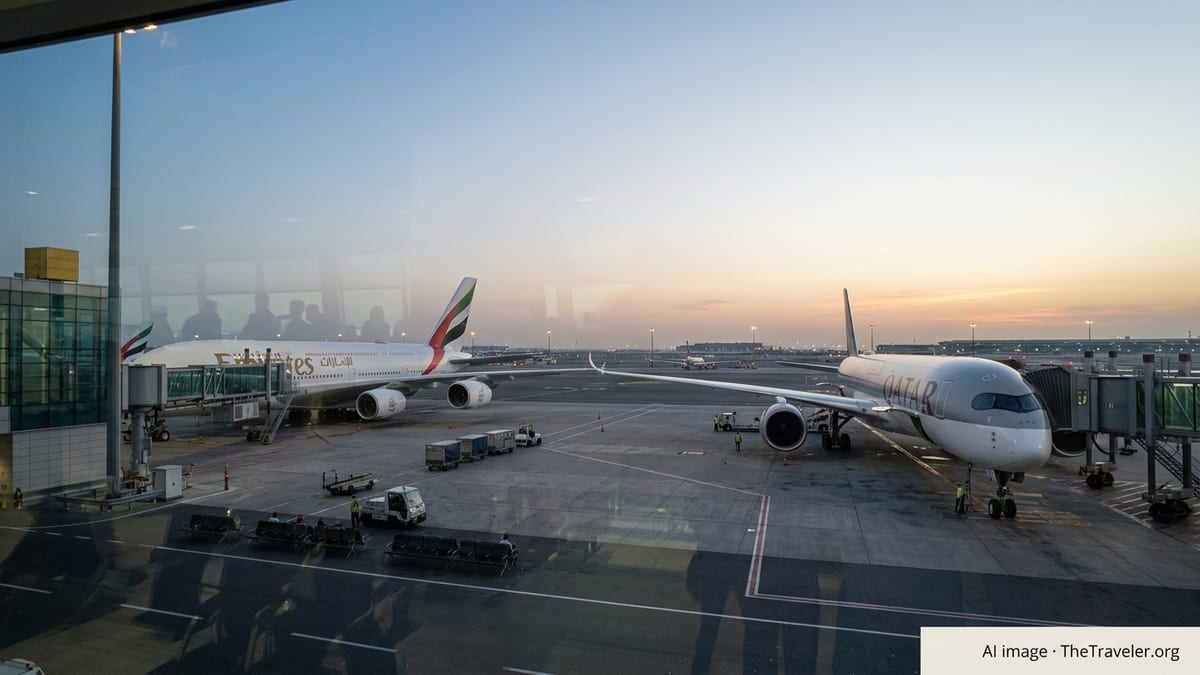
In an era of packed cabins and rising airfares, some of the most premium seats in the sky are still taking off half empty as Emirates and Qatar Airways operate what aviation watchers describe as “ghost flights” across the Middle East and beyond, raising questions about the economics of ultra-luxury travel in the Gulf.
Get the latest news straight to your inbox!
How Ghost Flights Happen in a Premium-Obsessed Market
In commercial aviation, the term “ghost flight” typically refers to a scheduled service that departs with a very low passenger load compared with the aircraft’s capacity. In the Gulf, this increasingly plays out in the most exclusive parts of the cabin, where first class suites and top-tier business seats can remain sparsely occupied even when the rest of the plane is reasonably full.
Emirates and Qatar Airways operate some of the densest premium cabins in the world on widebody aircraft such as the Airbus A380 and Boeing 777, betting heavily on high-yield travelers. Publicly available information shows that these airlines have continued to invest in first class suites, lie-flat business seating and, more recently, premium economy cabins, even as demand patterns have shifted toward more value-conscious premium products.
Reports from aviation analysts and passenger accounts indicate that on certain routes and dates, especially outside peak seasons or during network transitions, these aircraft can depart with only a handful of passengers in first class while the operating costs of the flight remain roughly the same. The result is a visually striking contrast: lavish onboard lounges, private suites and elaborate dining offerings used by just a small number of travelers.
While such flights are not empty overall, the underutilisation of the most expensive cabin space has fuelled debate over whether the Gulf superconnectors are maintaining more luxury capacity than today’s market can consistently support.
Network Strategy: Positioning Aircraft and Protecting Hubs
One explanation for these ghost-like operations lies in the hub-and-spoke strategies built around Dubai and Doha. Both Emirates and Qatar Airways schedule banks of arrivals and departures to maximise connections, accepting that some individual sectors will run with low loads in order to feed more lucrative long-haul traffic before or after the Middle East stop.
Industry coverage of Gulf aviation strategy indicates that these carriers sometimes deploy large widebodies on short- or medium-haul sectors primarily to position aircraft for high-demand long-haul flights or to maintain schedule integrity for onward connections. In those cases, the priority is keeping the network flowing rather than filling every premium seat on each leg.
Slot and gate access also plays a role. At congested airports across Europe and Asia, retaining key timings can justify operating flights even when forward bookings look thin. Analysts note that adjusting capacity purely to match short-term demand risks losing valuable operating windows, so airlines may choose to run relatively empty premium cabins as the cost of defending long-term market share.
For Emirates and Qatar Airways, whose brands are closely tied to global connectivity, the reputational and commercial value of reliable schedules can outweigh the optics of lightly used first class suites on certain services, particularly during shoulder seasons or network changes.
Premium Economy’s Rise and the Squeeze on First Class
Another structural factor behind these ghost flights is the shift in customer preference from ultra-luxury first class to more attainable tiers of comfort. Market research cited in recent coverage of Emirates shows growing demand for premium economy cabins, which offer extra space and upgraded amenities at a significant discount to business or first class.
Emirates has been expanding its premium economy network and retrofitting A380s and Boeing 777s with this cabin, aiming for millions of premium economy seats annually by the middle of the decade. Qatar Airways is pursuing a parallel strategy of concentrating investment in its Qsuite business product, which effectively blurs the line between traditional business and first class on many routes.
As premium economy and advanced business-class products become the default choice for many corporate and affluent leisure travellers, first class demand has become more volatile. Published reports on long-haul pricing trends in 2024 and 2025 describe strong load factors in premium economy contrasted with softer uptake in the highest fare buckets, prompting airlines to reconsider the size and deployment of first class cabins.
This imbalance leads to a familiar pattern: cabins filled with travellers seeking value in the middle of the pricing ladder, and first class sections that sometimes carry only one or two passengers. When such flights still operate on large four-cabin aircraft, they contribute to the perception of ghost flights at the very top end of the market.
Revenue Management: Why Empty Suites Can Still Fly
Despite the optics of empty suites and quiet onboard bars, revenue-management logic can still justify operating these flights largely unchanged. Airlines increasingly rely on sophisticated forecasting models that weigh not just point-to-point demand but also through-ticket revenue, cargo income, loyalty-program value and the strategic importance of specific routes.
Analysts writing about Gulf carriers note that a flight with a lightly loaded first class cabin can remain profitable if business and premium economy sections are healthy and the service carries significant connecting traffic. High-yield itineraries that combine several legs, such as North America to Asia via the Middle East, can spread revenue across multiple flights, making it commercially viable to maintain a premium-heavy configuration even when one sector looks weak on paper.
Published guides to Emirates and Qatar Airways pricing practices also highlight how last-minute fare buckets and mileage upgrades are managed to protect yields. Rather than discounting first class seats aggressively far in advance, the airlines often prefer to keep inventory closed or release it only close to departure, prioritising flexibility for full-fare travellers. This strategy can leave cabins looking empty until very late, and occasionally still underfilled at take-off, but helps preserve the perceived exclusivity and pricing power of the product.
From this perspective, the ghost flight label reflects a snapshot of visible occupancy rather than the full commercial picture behind each operation.
Brand Image, Competition and the Future of Gulf Luxury Flying
There is also a branding dimension to why these flights persist. Emirates and Qatar Airways have built their global reputations on the promise of over-the-top service, spacious cabins and cutting-edge in-flight amenities. Maintaining that image sometimes means flying products that exceed immediate demand, especially as both carriers compete not only with each other but with European and Asian rivals that are trimming or eliminating first class.
Coverage of A380 deployment strategies shows that Emirates, in particular, continues to view the superjumbo as a flying showcase for its premium brand, even as other airlines retire the type or restrict it to a handful of routes. Qatar Airways, meanwhile, has leaned into Qsuite as a differentiator in the crowded business-class market, accepting that not every flight will see every suite occupied.
Looking ahead, industry observers expect more fine-tuning rather than a wholesale retreat from luxury. Some routes are already seeing smaller first class cabins or a shift toward two- or three-class configurations, while investment flows toward premium economy and upgraded business seats. Yet as long as the Gulf carriers rely on hub connectivity and brand prestige, there will likely remain moments when ultra-luxury aircraft cross the skies of the Middle East with surprisingly few people enjoying their most exclusive spaces.
For travellers able to secure an upgrade or a competitive fare, those ghost flights can offer a rare experience: near-private access to products designed for a full cabin of high spenders, on airlines that continue to see premium spectacle as central to their global appeal.