

More news on this day
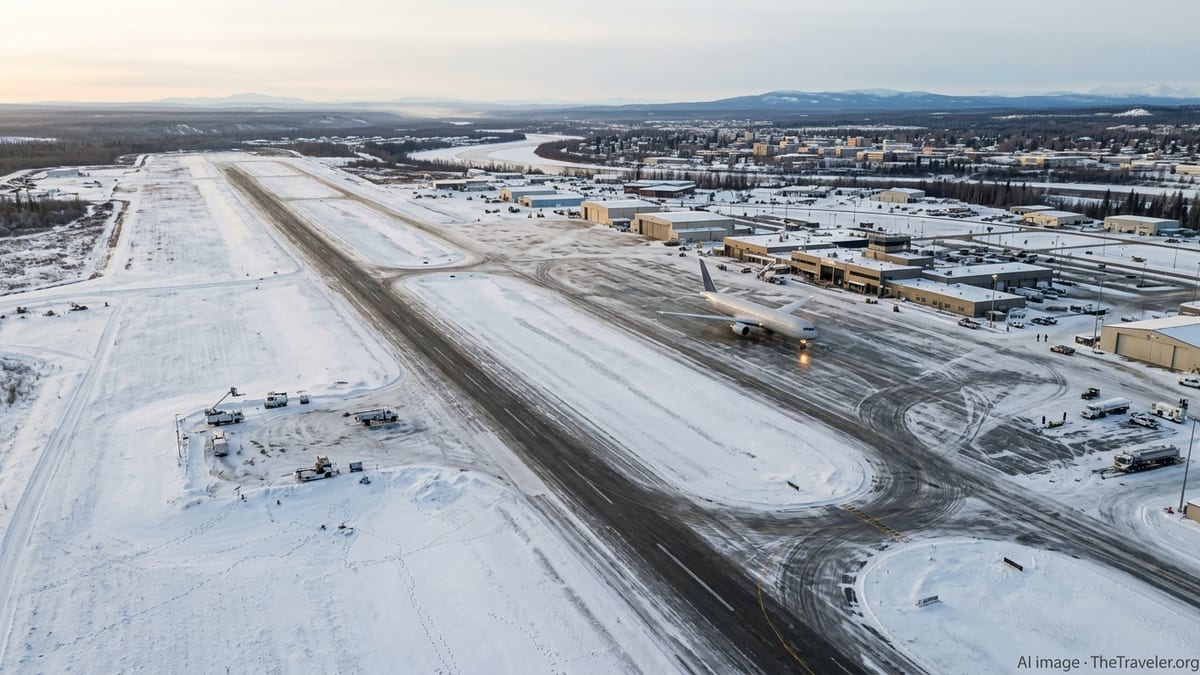
As airlines redraw global routes around closed airspace and volatile weather, Fairbanks International Airport in Alaska is reemerging as a quiet but critical safety node for aircraft crossing the top of the world between Asia, Europe, and North America.
Get the latest news straight to your inbox!
Polar Routes Push Traffic Back Toward Alaska
The closure and restriction of Russian airspace since 2022 has reshaped long haul flight planning between Tokyo and Western Europe. Published coverage of Japan to London services, for example, shows aircraft now tracking far north over the Arctic to avoid Siberian corridors that were once routine. These polar arcs bring intercontinental jets back over or near Alaska, restoring a geographical logic that had faded when Russia first opened key overflight corridors in the mid 2000s.
Ted Stevens Anchorage International Airport has attracted most of the attention as a refueling and diversion point for these reconfigured routes, particularly for cargo operators and some eastbound passenger flights. Reports on recent medical diversions from Tokyo to Paris illustrate how Anchorage has become the default option when a serious issue occurs over the North Pacific or Arctic, with aircraft turning toward Alaska instead of continuing along a polar track toward Europe.
Yet Anchorage is not the only Alaskan airport positioned along these contingency paths. State planning documents and airport system analyses describe Fairbanks International Airport as the northern anchor of the Alaska International Airport System, located farther inland and closer to great circle tracks between northeast Asia and points in Europe and the central United States. As polar routings proliferate, Fairbanks sits near an emerging latticework of contingency corridors rather than on the sidelines.
Flight planners also weigh geopolitical risk and military activity when designing diversion options. Recent reporting on North American Aerospace Defense Command intercepts of Russian bombers and other military aircraft in the Alaska Air Defense Identification Zone underscores that the region is once again a frontline strategic airspace. In this context, a civilian facility like Fairbanks gains significance as a stable, well equipped alternate in a complex operating environment.
From Cargo Hub Aspirations to Diversion Specialist
Fairbanks International Airport has long had global ambitions. A master plan prepared for the airport notes that Fairbanks once handled a share of transpacific cargo traffic when rights to cross Russian airspace were limited. Jet freighters between Asia and the United States used Alaska as a refueling and crew stop, and planners envisioned Fairbanks as a secondary gateway complementing Anchorage’s dominant role.
That traffic largely evaporated after 2005, when more permissive Russian overflight arrangements and long range aircraft enabled nonstop flights that bypassed Alaska. Fairbanks pivoted toward handling regional and intrastate cargo, as well as military and government operations tied to Interior Alaska. The airport’s infrastructure, including a long runway, deicing facilities, and around the clock operations, remained in place even as its global profile diminished.
The current era of renewed airspace fragmentation is nudging Fairbanks back toward the international stage, albeit in a different capacity. Instead of acting as a routine fuel stop, the airport is increasingly positioned as an alternate for aircraft that need to divert due to medical issues, technical problems, volcanic ash, or severe weather along polar and transpacific paths. Aviation planning studies for the Alaska International Airport System highlight Fairbanks’ utility for these contingency operations, emphasizing runway performance in cold temperatures and the ability to handle heavy freighters without payload restrictions.
This role aligns with broader industry trends in risk management. Business aviation guidance published in recent years describes how operators have had to rebuild diversion playbooks in the North Pacific, balancing options in the Aleutian Islands, interior Alaska, and the Canadian Arctic. Fairbanks appears frequently in these matrices as a dependable facility with customs capability, support services, and relative accessibility compared with more remote alternatives.
Managing Risk on Routes From Tokyo and Northeast Asia
Flights linking Tokyo with Europe and North America are particularly sensitive to diversion planning across the high latitudes. Publicly available tracking of recent services shows jets skirting the Arctic Ocean north of Alaska or threading a path just inland over the state. When a serious problem develops hours from either origin or destination, the nearest suitable airfield can make the difference between a manageable diversion and a prolonged emergency.
Recent coverage of a Tokyo to Europe flight that spent nearly fourteen hours in the air after turning back over the Arctic illustrates the stakes. In that case, the carrier ultimately chose to return to Tokyo, but the aircraft’s position near Alaska underscored the importance of viable alternates in the region. Fairbanks, sitting inland from the Arctic coastline yet directly under several great circle tracks, offers an option that can shorten decision making and flight time when conditions permit.
Environmental hazards further elevate Fairbanks’ strategic value. Volcanic eruptions in the Aleutian chain and on the Kamchatka Peninsula have repeatedly disrupted traffic flows into and out of Alaska, according to local reporting and aviation advisories. Ash plumes can close or restrict operations at coastal airports, including Anchorage, forcing carriers and air ambulance operators to look inland. Social media and community reporting from Fairbanks have noted instances where larger aircraft were expected to divert north when coastal routes were compromised by ash or strong winds.
For passengers departing from or connecting through Tokyo, these dynamics are largely invisible, but they shape how airlines schedule crews, fuel loads, and alternates. Fairbanks’ position along contingency routings helps carriers maintain regulatory compliance for maximum diversion times on twin engine aircraft, especially on extended operations across sparsely populated terrain. That technical reality quietly influences seat maps and schedules on many of the world’s longest flights.
Infrastructure and Community Preparedness in the Interior
Supporting a diversion role requires more than a long runway. State transportation updates and local planning documents describe an ecosystem of services at Fairbanks International Airport, including firefighting and rescue capabilities shared with the University of Alaska Fairbanks, medical response coordination centers, and facilities for handling international arrivals. These resources are scaled for the region’s needs but can be flexed to support widebody aircraft in irregular operations.
Fairbanks’ cold weather expertise is another asset. Aviation contingency plans for Interior Alaska note that air travel schedules are routinely affected by extreme temperatures, snow, and ice. Over decades, the airport and its partners have developed routines for snow clearance, deicing, and operating in prolonged darkness during winter. For a flight diverting from a relatively temperate origin like Tokyo, arriving into subzero conditions can be challenging, but it also means landing at an airport that treats such weather as standard rather than exceptional.
There are practical constraints. Unlike Anchorage, Fairbanks does not see a steady stream of international widebody passenger services, which can complicate ground handling, immigration processing, and passenger care during a large diversion event. Commentators on previous diversions to Alaska have noted how carriers relied on third party partners to manage everything from catering to hotel arrangements when unexpected long haul arrivals appeared in the middle of the night.
Even so, state level communications indicate ongoing investment in the Alaska International Airport System, including Fairbanks, to ensure resilience amid evolving global traffic patterns. Contingency planning exercises, emergency response coordination, and infrastructure upgrades all factor into how effectively the airport can absorb unplanned arrivals from across the circumpolar world.
A Quiet but Strategic Node in a Fragmented Sky
Fairbanks’ resurgence as a strategic diversion point reflects broader shifts in global aviation. As geopolitical tensions, environmental hazards, and infrastructure disruptions complicate direct routings, airlines are rediscovering the value of robust alternates in sparsely populated regions. The North Pacific and Arctic are no longer simply empty spaces on a map, but corridors that demand carefully layered safety nets.
While Anchorage and major Canadian airports draw more attention, Fairbanks occupies an important niche at the intersection of polar, transpacific, and domestic U.S. routes. Its history as a cargo stop, its modern role in the Alaska International Airport System, and its geographic position near great circle tracks from Tokyo and other northeast Asian hubs combine to give it outsized influence relative to its passenger volumes.
For travelers glancing at moving maps on long haul flights, Fairbanks may appear only as a name in the high latitudes, briefly visible as an icon on a screen. Behind that icon lies a web of planning assumptions, regulatory calculations, and emergency scenarios that increasingly hinge on the availability of reliable runways in Alaska’s interior. As the global sky fragments and polar pathways proliferate, Fairbanks stands as a quiet but essential backstop for some of the world’s most remote and demanding air corridors.