

More news on this day
Some of the world’s biggest long-haul carriers, including Qantas, Emirates, Air New Zealand, Singapore Airlines and British Airways, are circling a little-known logistics player whose shipping technology promises to shave weight, fuel burn and delays from global air networks. The company, ISG, sits far from the spotlight of shiny new aircraft orders, yet its reimagining of how cargo is packed, tracked and moved through airports is fast becoming a talking point in airline boardrooms from Sydney to London.
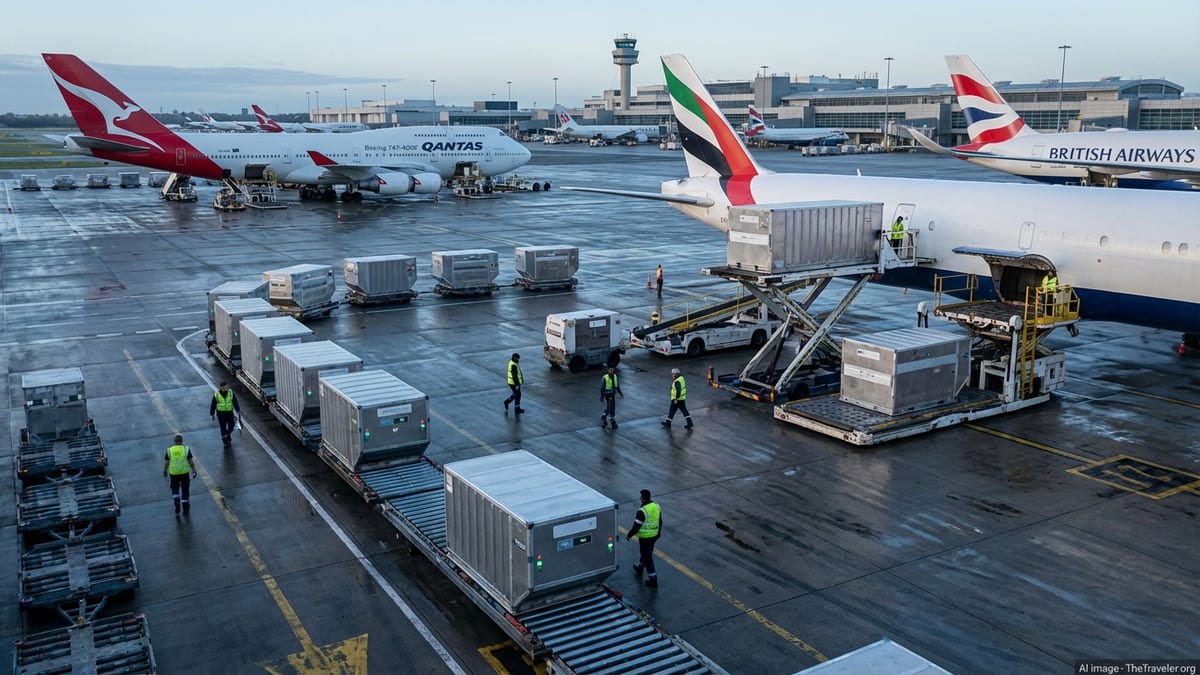
A Quiet Revolution in the Belly of the Plane
While passenger cabins grab the headlines, airlines are increasingly focused on what sits below deck. Cargo has become a strategic revenue pillar since the pandemic, and any innovation that can make freight lighter, faster and more predictable is drawing attention. ISG’s technology squarely targets that space, combining lighter container materials, smarter packing systems and embedded sensors to modernise a part of the business that has changed little in decades.
Executives at Qantas, Emirates, Air New Zealand, Singapore Airlines and British Airways, according to people familiar with their internal briefings, have been examining ISG’s concept because it tackles multiple pain points at once: fuel costs, climate targets, turnaround times and reliability for shippers. For airlines juggling tight schedules on complex international networks, incremental gains on each of those fronts can translate into millions of dollars in savings and a measurable reduction in emissions.
The excitement is not about a single gadget, but about a system that rethinks how cargo is built up at origin, loaded into unit load devices, monitored in transit and broken down at destination. In an era when carriers are digitising reservations, boarding and baggage, the hold has lagged behind. ISG’s pitch is that modern data and materials science can finally bring cargo up to speed.
Industry analysts note that the timing is critical. With new long-range aircraft arriving and international travel demand rebounding on key routes between Europe, the Middle East and the Asia-Pacific, airlines are under pressure to squeeze every efficiency they can out of their fleets. A leaner, smarter cargo operation is one of the few levers left that does not require a new aircraft order.
How ISG’s Shipping System Works
At the core of ISG’s offering is a redesigned unit load device and pallet system, using advanced lightweight alloys and composite panels to cut dead weight compared with traditional containers. Each kilogram removed from a container is one less kilogram that an aircraft has to lift on every sector, and over thousands of flights a year that adds up to significant fuel savings and lower carbon emissions.
The containers are built around modular, configurable interiors that allow freight to be packed more tightly without compromising safety or damage protection. Adjustable partitions and smart tie-down points mean odd-shaped e-commerce consignments, perishables and high-value electronics can share the same device while still meeting strict handling rules. In practice, that can reduce the number of half-empty containers flying on a route and free up belly space for extra paying cargo.
ISG couples the hardware with embedded tracking technology. Sensors monitor location, temperature, humidity and shock, feeding data into airline and shipper control towers in near real time. That level of visibility, long standard in express parcel networks, is still patchy in much of the general air freight market. By integrating tightly with airline cargo systems and third-party platforms, ISG aims to give operations teams a live picture of where every container sits in the chain, from warehouse to aircraft and back again.
Behind the scenes, algorithms use that data to optimise container pools. Instead of static allocations at each airport, containers circulate dynamically, with repair needs flagged early and idle assets repositioned before they become a bottleneck. For carriers that operate across multiple continents, better utilisation of unit load devices can reduce capital expenditure and ground handling costs.
Why Qantas and Emirates Are Leaning In
In Australia, Qantas has been steadily strengthening its freight business, investing in converted freighters and upgraded terminal facilities to handle growing export flows and trans-Pacific e-commerce. A lighter, smarter container fleet fits neatly into that strategy, particularly on long sectors like Sydney to Dallas or the non-stop Perth to London flights where every kilogram of weight matters. For Qantas, any technology that can trim fuel burn while freeing up space for high-yield cargo is attractive.
Emirates, for its part, runs one of the world’s largest widebody fleets through its Dubai hub, acting as a bridge between Asia, Europe, Africa and the Americas. Its SkyCargo arm already pushes the limits of precision handling for pharmaceuticals, perishables and luxury goods. ISG’s promise of better temperature control and live condition monitoring aligns with Emirates’ push to win more premium freight customers who demand tight control and verifiable data on each shipment.
Both carriers also sit in regions where regulators and investors are sharpening their focus on aviation emissions. Cutting container weight and improving load efficiency does not deliver the dramatic step change of a new engine or sustainable aviation fuel, but it does offer measurable, bankable progress that can be tracked and reported quickly. In a market where customers increasingly ask about the carbon footprint of shipments, those marginal gains can help secure major contracts.
There is also a competitive angle. If one global carrier demonstrates that lighter, sensor-enabled containers can reliably reduce delays and damage rates, rivals will be hard pressed to ignore the results. For network airlines that sell complex interline itineraries, compatibility and shared standards will become critical, and early adopters will help shape how those standards evolve.
Air New Zealand and Singapore Airlines Eye the Digital Upside
Air New Zealand and Singapore Airlines, meanwhile, are approaching ISG’s technology with an eye on broader digital transformation. Both carriers have been experimenting with new tools to analyse operational data, automate routine decisions and personalise services. Extending that thinking to cargo, where tracking has often relied on manual inputs and spreadsheets, is a logical next step.
For Air New Zealand, whose cargo business underpins many long thin routes across the Pacific and into Asia, the ability to predict exactly how much freight will move, and how quickly containers will turn around at each station, is crucial. Smarter unit load devices feeding reliable data into planning systems could help reduce ground times in Auckland and outstations, smoothing the flow of goods in a part of the world where weather and seasonal demand swings can be pronounced.
Singapore Airlines, operating from one of the world’s busiest and most efficient hubs, views automation and data integration as key to maintaining its edge. ISG’s system does more than simply report on container locations. By exposing rich operational data through modern interfaces, it can be plugged into the airline’s broader analytics stack, supporting everything from predictive maintenance of ground equipment to more accurate cargo revenue management.
Both carriers also serve a high proportion of digital-first freight forwarders and e-commerce platforms, which expect parcel-like visibility for even complex shipments. Being able to tell customers where their goods are in almost real time, and to prove that temperature and handling standards have been maintained, has become a differentiator. ISG’s embedded sensors and connectivity aim to make that level of transparency the default rather than the exception.
British Airways and the European Hub Perspective
British Airways, through its cargo operations, sits at the crossroads of transatlantic, European and Middle Eastern trade. Its parent group has been exploring deeper cargo partnerships and new digital tools to streamline freight through London and other hubs. From that vantage point, ISG’s technology is interesting less as a standalone product and more as a building block in a broader reconfiguration of how freight moves across the network.
European hubs face persistent congestion, tight slot controls and rising labour costs. Turnaround times are closely scrutinised, and delays in unloading or repositioning containers can quickly snowball through the daily schedule. Lighter, easier-to-handle devices, paired with better information about what is inside and where each unit is headed next, could give handlers more flexibility when operations go off plan.
There is also a strategic sustainability dimension. European regulators and institutional investors are pushing airlines to show concrete steps toward cleaner operations beyond headline fleet renewals. Initiatives such as replacing older containers, experimenting with new materials and rolling out live tracking can be implemented relatively quickly and scaled incrementally. That makes them attractive to carriers that need shorter-term wins while they wait for low-emission aircraft and fuels to mature.
For British Airways, another factor is interoperability with partner airlines across alliances and joint ventures. If multiple carriers adopt a common standard of smarter containers and data feeds, transferring freight across different metal becomes simpler and less error-prone. ISG’s pitch emphasises that its devices and systems can be certified and configured for use across a mix of fleets and handling agents, which is essential in Europe’s fragmented airport environment.
Cutting Fuel Burn and Emissions, One Kilogram at a Time
At first glance, shaving a few dozen kilograms off a container might not sound transformational. Yet on a fully loaded widebody making multiple long-haul sectors a day, the physics adds up quickly. Fuel burn rises roughly in line with weight, and over a year of operations those marginal savings can cut several hundred tonnes of fuel consumption per aircraft, according to engineers familiar with airline weight-reduction programmes.
ISG’s approach compounds that benefit by also improving load factors. Better packing and smarter allocation mean fewer underfilled containers and less wasted space in the hold. That lets airlines carry more revenue-generating freight on the same flight, helping offset rising fuel and labour costs. For routes where capacity is constrained by airport slots or overflight agreements, that extra efficiency can be more valuable than adding another frequency.
From a climate perspective, airlines are under growing pressure to show credible paths to net-zero goals. While sustainable aviation fuels and new aircraft technologies dominate the discussion, operational efficiencies remain a critical part of the puzzle. Lightweight containers, streamlined ground handling and data-driven optimisation will not solve aviation’s emissions challenge on their own, but they are among the few tools available today that can be deployed at scale without waiting for breakthroughs.
Several carriers have already publicised initiatives to modernise their unit load device fleets with lighter materials, reporting meaningful annual reductions in fuel use and emissions. ISG’s technology plugs into that same logic, with the added twist of richer data and smarter workflows wrapped around the hardware.
What It Means for Shippers and Travellers
For freight customers, the implications of airlines adopting ISG-style technology are concrete. Tighter packing and faster container turns can mean more available capacity during peak seasons, reducing the need to divert shipments onto slower sea or road options. Improved tracking and condition monitoring help shippers manage their own inventories, insure high-value cargo more accurately and respond faster when disruptions occur.
Reduced damage and loss rates, a potential outcome of better-designed containers and clearer handling instructions tied to each unit, can also ease longstanding frictions between airlines, forwarders and cargo owners. If every container effectively becomes a connected asset, with a clear digital history of who handled it, when and under what conditions, disputes over responsibility are likely to diminish.
Passengers may never see the containers under their feet, but they stand to benefit indirectly. More efficient cargo operations can support the economics of long-haul routes, particularly to smaller markets where freight revenue helps keep passenger services viable. Smoother turnarounds reduce the risk of knock-on delays that strand travellers, and progress on emissions goals can help ease regulatory and political pressure on aviation growth.
For destinations that rely heavily on air links to export perishables or high-tech goods, from New Zealand’s primary producers to manufacturers in Southeast Asia, every gain in reliability and capacity supports broader economic resilience. In that sense, seemingly technical decisions about container design and data standards feed directly into the appeal and affordability of international travel and trade.
Next Steps for Airlines and ISG
For now, the conversations between ISG and major carriers appear to be focused on pilots, proofs of concept and targeted deployments on select routes. Airlines are notoriously cautious about altering core operational equipment, and any new container or tracking system must pass rigorous safety, certification and interoperability checks before it can be used widely.
Qantas, Emirates, Air New Zealand, Singapore Airlines and British Airways each have distinct network shapes, fleets and handling partners, which means ISG will likely need to tailor implementations for each one. Early trials may focus on long-haul trunk routes or high-value verticals such as pharmaceuticals, where the benefits of better monitoring are clearest and the additional hardware costs can be more easily justified.
Industry observers say the real test will be whether the technology can scale beyond a few flagship corridors. That will require not only strong technical performance but also alignment across ground handlers, regulators and partner airlines who share containers and belly space. If ISG can demonstrate that its system improves efficiency without adding complexity at the ramp, adoption could accelerate quickly.
Regardless of the exact timeline, the level of interest from such a broad cross-section of global carriers suggests that the hold is finally catching up with the rest of the aircraft. As airlines race to modernise their operations and prove their sustainability credentials, innovations that quietly reshape the logistics under every passenger flight are moving out of the shadows and into strategic focus.