

More news on this day
Greece’s ports are heading into another record-breaking cruise season in 2025, with new deployment from major lines, expanded homeports and rising demand driving unprecedented passenger numbers across the Eastern Mediterranean.
Get the latest news straight to your inbox!
Record Passenger Volumes Crowd Greek Ports
Publicly available data show that Greece’s cruise sector has entered 2025 on the back of consecutive record years. Industry and hospitality reports indicate that around 7.9 million cruise passengers called at 51 Greek ports in 2024, a double-digit increase on 2023 and well above pre-pandemic levels. Early projections for 2025 point to further growth, suggesting national cruise traffic could surpass 8 million passengers if current booking trends hold.
The country’s largest passenger gateway, Piraeus, is central to this surge. Port and market bulletins for 2024 point to roughly 800 to 810 cruise ship calls and about 1.7 million cruise passengers, with a strong share embarking or disembarking there as their start and end point. Forward bookings for 2025 show even higher levels of scheduled calls, reinforcing Piraeus’s status as a principal hub for Eastern Mediterranean itineraries.
Secondary ports are also setting fresh records. Heraklion on Crete, for example, has reported all-time highs, with port authorities citing more than 400,000 cruise passengers and close to 200 ship calls in the most recent full year, growth of over 40 percent compared with 2023. Similar growth curves are reported for island destinations such as Mykonos and Santorini, which each handled well over one million cruise passengers in the latest seasons.
Together, these numbers help explain why cruise lines are devoting more capacity to Greek waters in 2025. For operators, Greece has become a reliable engine of demand in the Mediterranean, capable of filling large ships and supporting extended seasons beyond the traditional summer peak.
Big-Ship Capacity and New Homeports Reshape the Market
The surge in cruise visitors is not driven only by more ships, but by bigger and more efficiently deployed vessels. Cruise deployment databases for 2025 highlight significant capacity growth in the Eastern Mediterranean, with Greece benefitting from year-round and shoulder-season itineraries. New ships launched in 2024 and 2025, including energy-efficient vessels designed for European routes, are increasingly scheduled on circuits that include multiple Greek ports.
Major brands are deepening their presence through homeporting strategies. Royal Caribbean has announced two ships using Piraeus as a base for the 2025 season, operating series of weeklong itineraries that combine marquee Greek islands with ports in Turkey and Cyprus. Other global operators are following a similar pattern, turning Athens into a turnaround port rather than just a port of call, which increases passenger nights on shore and strengthens Greece’s aviation links.
MSC Cruises has confirmed that 2025 will be the first year it offers year-round deployment in Greece and the Eastern Mediterranean, with six ships either calling at or homeporting in Greek ports during the summer schedule. According to industry coverage, additional winter and shoulder-season sailings are planned, effectively shrinking the traditional off-season and spreading arrivals more evenly through the year.
These moves align with a wider Mediterranean trend. Cruise industry forums held in Greece in 2025 have pointed to at least 40 new ocean ships entering service globally over a three-year window, adding tens of thousands of berths. A notable share of that added capacity is earmarked for Eastern Mediterranean routes, where Greece’s port network, air connections and recognizable island brand give it a competitive edge in itinerary planning.
Beyond Santorini: Diversifying Destinations Under Pressure
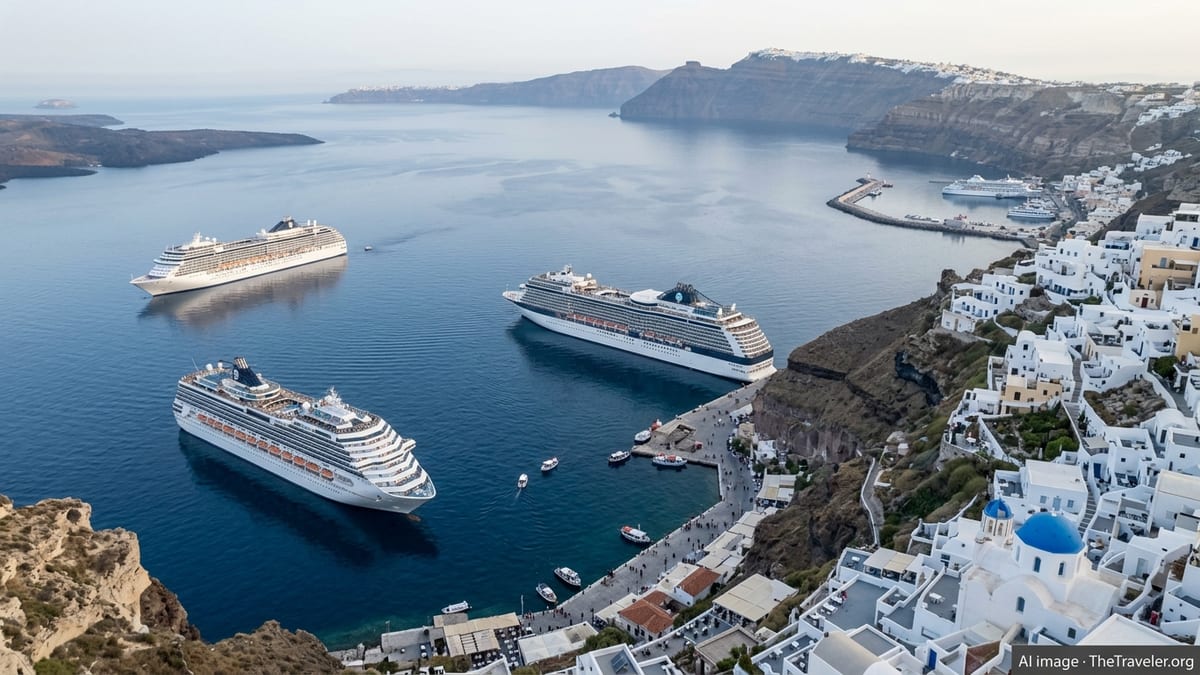
While record volumes underscore Greece’s popularity, they also expose the limits of its most famous islands. Santorini and Mykonos have regularly topped national rankings by cruise passenger volume, with recent estimates placing their annual cruise visitation in the range of 1.2 to 1.3 million passengers each. That intensity has raised concerns about congestion, infrastructure strain and the daily experience for both residents and visitors.
In response, authorities and port stakeholders have been experimenting with caps and scheduling tools. Recent seasons at Santorini have seen restrictions on simultaneous ship calls, with allocation systems used to spread arrivals across the week. According to specialist destination analysis, these measures have not reduced overall cruise demand for Greece but have instead encouraged a redistribution of calls to alternative ports including Crete, Rhodes, Chania and smaller island harbors.
The redistribution trend is visible in recent statistics. Heraklion has emerged as Greece’s leading cruise port by passenger volume in some tallies, while relative growth rates at secondary ports such as Chania and Agios Nikolaos have outpaced the national average. Industry observers describe this as a shift from a few overburdened icons to a more balanced portfolio of destinations that can absorb growth while offering varied shore experiences.
The policy environment is evolving as well. From mid 2025, Greece introduced a tiered “sustainable tourism” fee for cruise passengers, with higher charges at high-pressure islands like Santorini and Mykonos and lower rates at other ports. Early commentary suggests the levy is designed both to generate funds for local infrastructure and to nudge cruise lines toward a wider spread of destinations during peak months.
Pent-Up Demand, Air Links and Geo-Politics Fuel the Boom
The record-breaking trajectory of Greece’s cruise sector is also rooted in wider travel patterns. Tourism spending in Greece reached historic highs in 2024, and analysts attribute part of this to lingering post-pandemic demand for international travel combined with a preference for outdoor, coastal destinations. Cruises that weave together multiple islands in a single trip appear to meet travelers’ desire to “make up” for lost years of mobility.
Strong air connectivity supports this trend. Athens International Airport reported double-digit growth in passenger traffic in 2024 compared with 2023, reflecting expanded long-haul and intra-European capacity. For cruise lines, this makes turnarounds at Piraeus and other nearby ports more attractive, as passengers can more easily connect from the United States, the United Kingdom and major European hubs to start a voyage in Greece.
Regional dynamics are also playing a role. Industry forums held in Crete and Athens in 2025 have emphasized the growing importance of the Eastern Mediterranean as an alternative to some parts of the Middle East and other regions facing geopolitical instability. Greece’s membership in the European Union, its established maritime infrastructure and its dense network of islands allow cruise planners to design itineraries that feel both adventurous and relatively predictable from an operational standpoint.
Price trends have further supported demand. While cruise fares have risen in line with global inflation and strong bookings, consumer-facing reports and traveler discussions for 2025 indicate competitive pricing for Mediterranean sailings relative to land-based stays in peak summer. For many travelers, a week visiting several Greek islands by ship remains perceived value, especially when compared with high hotel and airfare costs in other European hotspots.
Green Rules and Infrastructure Upgrades Shape the Future
As more ships head to Greece in 2025, environmental and infrastructure questions are moving to the foreground. Global regulations on emissions, including new requirements on fuel quality and carbon intensity, are already influencing ship deployment decisions. Newer vessels sailing to Greek ports are being marketed with improved energy efficiency and cleaner propulsion systems, aligning with European Union climate objectives and local air quality goals.
Port investments are beginning to respond as well. Development plans for Piraeus and other major harbors include expanded cruise terminals, upgraded passenger facilities and, in the longer term, shore power capabilities that would allow ships to switch off engines while docked. Regional authorities and port organizations have used recent cruise industry conferences in Crete and Athens to promote Greece as a destination that can pair high volumes with modern, more sustainable infrastructure.
Even with these initiatives, the pace of growth presents challenges. Coastal towns and islands that are seeing double-digit increases in cruise arrivals each year must manage traffic flows, waste, water resources and housing pressures linked to tourism. Commentators note that the new sustainability fee for cruise passengers is only one tool, and that long-term planning will need to integrate transport, heritage protection and community priorities.
For now, however, the combination of strong global demand, aggressive deployment by major cruise lines and an expanding network of Greek ports has set the stage for another milestone year. If forecasts for 2025 prove accurate, Greece’s cruise numbers will not only break records but also confirm the country’s position as the flagship destination of the Eastern Mediterranean cruise boom.