

More news on this day
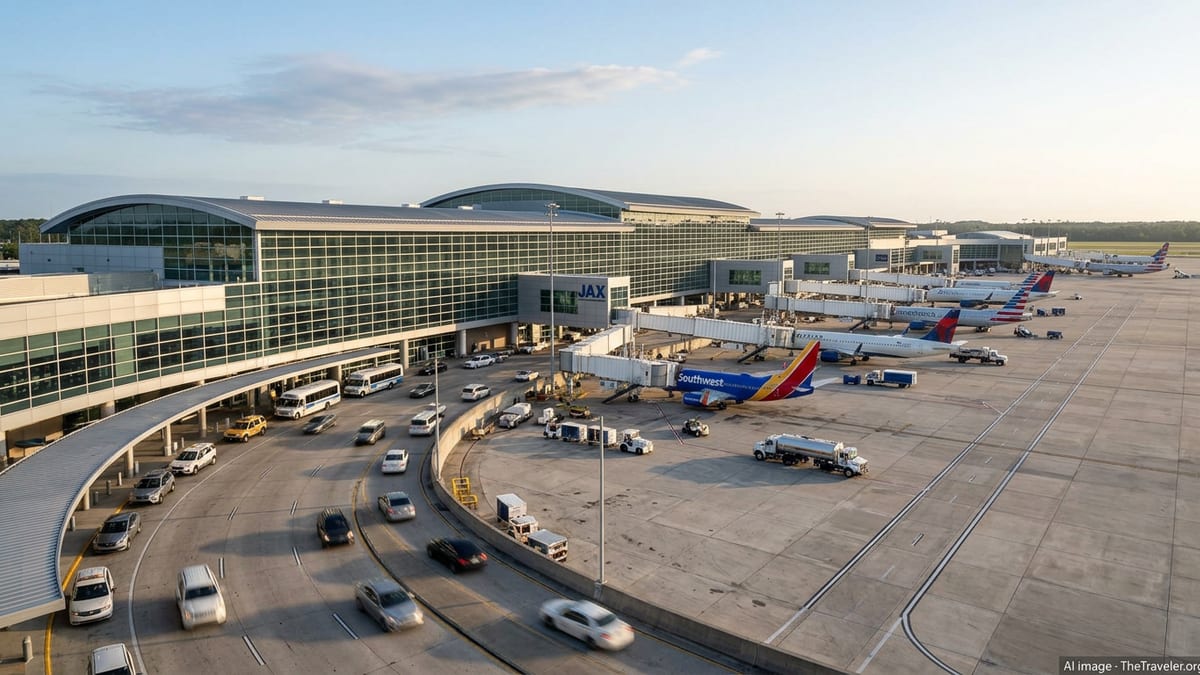
Jacksonville International Airport is rapidly transforming from a convenient regional facility into one of the most closely watched growth stories in U.S. air travel, as record passenger numbers, new routes and an ambitious terminal expansion position Northeast Florida as a rising tourism powerhouse.
Get the latest news straight to your inbox!
Record Passenger Growth in a Booming Tourism Market
Jacksonville International Airport has quietly set a series of traffic records that illustrate its new status on the U.S. tourism map. Publicly available data for the 2024 fiscal year show that the airport handled more than 7.6 million passengers, a historic high and an increase of nearly 5 percent over the previous year. That growth comes as Jacksonville’s broader visitor economy posts some of its strongest results on record.
Visit Jacksonville reporting for the most recent full year indicates that the city welcomed more than 8 million visitors, whose spending generated an economic impact estimated at about 7.4 billion dollars and supported tens of thousands of local jobs. Hotel occupancy has climbed, daily visitor spending has remained robust, and analysts point to a growing mix of leisure and business travelers choosing the region over more saturated Florida destinations.
Seen together, the airport’s passenger records and the city’s visitor numbers highlight a reinforcing trend. Airlines are adding capacity because seats are filling, and visitors are choosing Jacksonville in part because the air gateway is easier to reach and navigate than larger hubs. Aviation observers note that Jacksonville’s air traffic remains a fraction of the volumes seen at the biggest U.S. airports, but its growth rate signals a market with substantial upside.
Jacksonville’s demographic trajectory is amplifying the shift. Recent census updates show the city as Florida’s most populous, with strong net in-migration. That rising resident base adds year-round demand for air travel, helping sustain routes that also serve tourists drawn to beaches, riverfront attractions and major sporting events.
New Routes and Airlines Redrawing the Map
Much of Jacksonville International’s new influence in tourism stems from how the route map has evolved in just a few years. A growing roster of low-cost and hybrid carriers has entered the market, expanding nonstop options to mid-size and secondary cities that previously required connections through congested hubs.
Breeze Airways has built out a network linking Jacksonville with destinations such as Las Vegas and several Midwestern and East Coast cities, targeting leisure travelers seeking affordable point to point trips. Avelo Airlines has moved into the market as well, launching nonstop service between Jacksonville and Wilmington in the Philadelphia and Delaware Valley region, building on earlier flights to Southern New England through Tweed New Haven Airport.
Traditional U.S. carriers continue to offer core domestic connectivity, while international access has begun to broaden. Recent schedules have included nonstop flights to Toronto operated by Air Canada, underscoring Jacksonville’s shift from purely domestic gateway to a limited but growing international entry point for Canada based visitors heading to Northeast Florida.
For travelers, the effect is tangible. More nonstop options shorten travel times, expand the pool of origin cities feeding Jacksonville’s hotels and attractions, and make weekend beach trips or event based visits more feasible. For airlines, Jacksonville offers an opportunity to serve a growing metro area without the cost and congestion of Florida’s largest hubs, a combination that has encouraged experimentation with new seasonal and year round routes.
Concourse B Expansion Poised to Unlock Next-Stage Growth
The most visible symbol of Jacksonville International Airport’s tourism ambitions is rising on the airfield itself. Construction of a new Concourse B is well underway as part of a terminal expansion program valued in the hundreds of millions of dollars, backed by the Jacksonville Aviation Authority and designed by a team of national engineering and architecture firms.
Reports on the project describe a three level concourse with an initial six gates and the ability to expand to 10 as demand grows. The layout calls for lounges on the upper level, a broad mix of restaurants and concessions on the second level and gate areas extending into the middle and end of the structure. Recent coverage from local outlets notes that the shell of the concourse has been topped off, signaling a key milestone ahead of a planned opening later in the decade.
Beyond additional gates, the expansion is paired with changes to ground access, including redesigned rental car pickup and return areas intended to relieve congestion near the terminal. Improved security checkpoints and reconfigured parking are part of a broader modernization strategy aimed at keeping wait times low even as passenger volumes rise.
Aviation planners often point out that airports are advised to prepare for expansion once they reach roughly two thirds of terminal capacity. Jacksonville’s previous concourse configuration left limited slack during peak periods, and the new build out is widely seen as essential infrastructure if the airport is to sustain higher frequency service, attract new airlines and eventually accommodate more international flights.
Passenger Experience as a Competitive Advantage
While Jacksonville cannot match the size of major hubs, it is increasingly positioning the passenger experience itself as a reason visitors choose to fly there. The terminal’s compact layout and relatively short walking distances appeal to families and occasional travelers who may find larger airports daunting. Check in and security lines are typically shorter than in mega hubs, and recent design work has focused on intuitive wayfinding and open sightlines from curb to gate.
The airport has invested in amenities that align with Jacksonville’s identity. Art installations showcase local culture and history, and rotating exhibits highlight regional institutions and landmarks, connecting travelers to the city even before they leave the terminal. Dining and retail offerings have expanded, with a growing emphasis on regional flavors and recognizable local brands rather than a purely generic mix of national chains.
Outside the terminal, a cluster of hotels within a short shuttle ride provides additional convenience for late night arrivals, early departures and airline crew changes. Transportation links to downtown and the beaches, including rental cars, ride hailing and shuttle services, give visitors multiple options at various price points, an important factor for budget conscious travelers.
For many visitors, the contrast with more crowded Florida gateways is striking. Reports from business and leisure travelers frequently describe Jacksonville International as efficient and low stress, characteristics that can shape repeat visitation and word of mouth recommendations. In an era when airport bottlenecks can sour an entire trip, that perception is an increasingly valuable tourism asset.
A Gateway Aligned With Northeast Florida’s Tourism Future
Jacksonville’s emergence as a tourism destination is being driven not only by beaches and sunshine but by a steady stream of investments in public spaces and events, from the revitalized riverfront and reopened Friendship Fountain to large annual gatherings such as college football games, fairs and international cultural festivals. Jacksonville International Airport sits at the center of that story, functioning as both gateway and growth engine.
State level data show Florida setting all time tourism records in 2024, and Jacksonville is capturing a growing share of that momentum. As population growth, corporate relocations and infrastructure spending converge in Northeast Florida, the airport’s expanding route map and terminal capacity are expected to play a decisive role in where visitors choose to land.
Industry analysts note that Jacksonville’s strategy aligns with broader shifts in U.S. aviation, where mid size airports with room to grow are attracting low cost carriers and new international links. With record passenger numbers already in hand and a major concourse project taking shape, Jacksonville International is positioned to convert this period of rapid change into long term tourism gains, potentially redefining how travelers experience Florida beyond its most familiar gateways.