

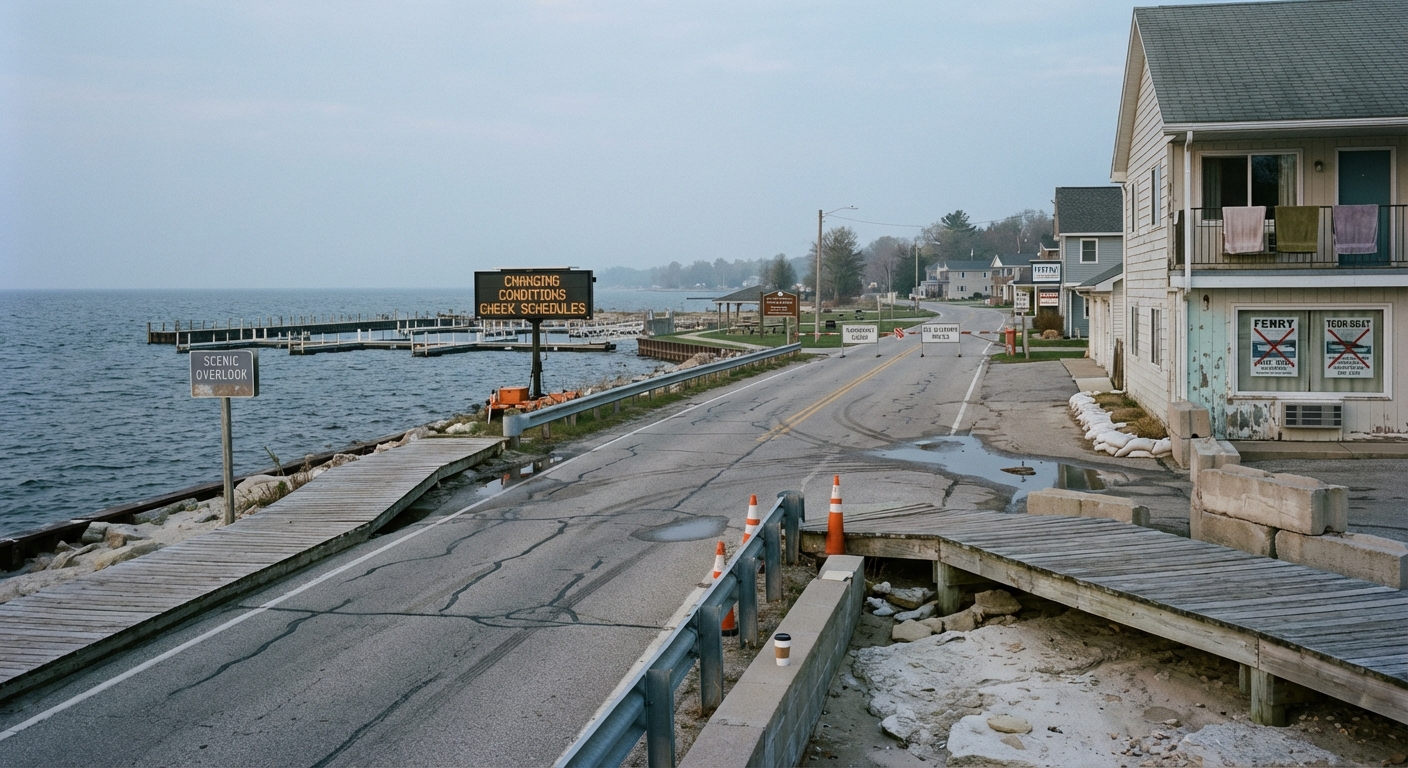
Alt text: "Overcast view of a quiet lakeside road, deserted motel, and altered shoreline."
A trip to the Great Lakes used to feel like a reliable escape. People arrived expecting cold, deep water, predictable breezes, and quiet drives that barely registered as “travel” compared with flying across a continent. Now the same journey can feel strangely unstable. The shoreline looks different from trip to trip, the air smells different, and the routes that once felt empty are suddenly clogged or unexpectedly quiet.
In many lake towns, visitors arrive with a memory of how things used to work and collide with how things work now. Ferry schedules feel looser around the edges. Park access can open and close with little warning. Border crossings that once meant a quick chat and a stamp can turn into a slow shuffle of cars inching forward. The result is a kind of low-level uncertainty that lingers over what was once an easy, almost automatic getaway.
What makes this feel current is the way these frictions no longer appear as rare exceptions. Travelers describe an overall sense that the Great Lakes region has become less predictable, even when the skies are clear and the highway signs look reassuringly familiar. The instability rarely explodes into dramatic scenes. Instead it accumulates in delays, diversions, and subtle changes that add up over the course of a trip.
One of the biggest shifts is in the water itself. Levels in parts of the region now swing more sharply than many visitors remember from earlier years. In some places, boardwalks that once seemed comfortably above the waves now sit closer to the water, while in other stretches marinas and docks feel oddly far from the shoreline. For travelers, it translates into boat tours that change routes, waterfront paths that dead end at temporary barricades, and beaches that seem to expand or disappear between visits.
On paper, these are described as natural variations that engineers and planners are working to manage. The language is measured, full of references to long cycles and infrastructure resilience. Yet from the traveler’s perspective, the effect is more intimate. A favorite lakeside picnic spot becomes inaccessible without explanation. A small harbor that once felt sheltered suddenly closes to larger boats for “safety reasons,” with little detail on what has actually changed.
Weather has become another quiet wildcard for Great Lakes travel. Conditions can now pivot quickly from tranquil to disruptive, not only along the coasts but deep into the interior routes that feed the region. Drivers planning simple half-day journeys sometimes encounter visibility that deteriorates without much warning, or heat that feels more like a southern city than a northern shoreline. They may not think of the trip as “weather-risky,” but their itinerary increasingly behaves as if it is.
When disruptions occur, official explanations often emphasize that systems are functioning as intended, just under stress. A cruise or ferry rerouting is framed as a cautious adjustment. A string of highway slowdowns is presented as normal congestion during busy periods. Border bottlenecks are explained as the necessary outcome of careful checks. Each statement sounds reasonable, yet the combined effect can leave visitors feeling that travel has become a moving target.
At the same time, cross-border patterns in the wider region have been shifting. Communities around the lakes that once depended on steady two-way flows of visitors now report softer, less predictable demand. Some stretches of highway and small airports feel underused compared with their built capacity, while specific corridors suddenly intensify as travelers bunch around what they perceive as the least complicated options. For people planning a quick cross-border shopping run or a lakeside weekend, the old assumptions about how busy a route will be no longer hold.
The messaging around these changes tends to stress adaptability. Travelers are reassured that alternate routes exist, that schedules are “dynamic,” that local businesses are “pivoting” and “reimagining” experiences. Behind those smooth phrases, guests often encounter shortened operating hours, trimmed services, and staff juggling multiple roles. The region still welcomes visitors, but the ease that once defined a Great Lakes trip has begun to feel like something that must be constructed day by day rather than taken for granted.
For some visitors, the first real sign that something is different comes from the small details. Waterfront hotels talk more about erosion control than new amenities. Tour guides mention changing waterlines almost in passing. Campgrounds and coastal parks lean heavily on temporary signage, moving entrances, and improvised parking patterns. None of this always ruins a trip, but it shifts the emotional tone from carefree to cautiously observant.
There is also a subtle psychological gap between the way the region is promoted and how it now behaves. Promotional images still lean on timeless scenes of still water, sturdy piers, and relaxed crowds. The lived reality is more conditional. Swimming areas open and close based on shifting criteria. Local businesses weigh fluctuating visitor numbers against higher costs, leading to abrupt decisions about whether to stay open on marginal days. Travelers who arrive expecting a steady rhythm instead encounter a region that feels like it is constantly negotiating with its own conditions.
Air and rail connections to the Great Lakes add another layer of fragility. Routes that once felt surplus to demand have quietly thinned out in some directions while crowding in others. Some visitors notice fewer direct options to small cities around the lakes and more emphasis on funneling everyone through a handful of larger hubs. This concentration can amplify any disruption, turning a modest delay into a chain reaction that reaches deep into otherwise quiet resort towns and islands.
Locally, many communities around the Great Lakes seem to be rethinking what kind of visitor volume they can realistically count on. Some lakeside districts that were built around steady seasonal peaks now experience pulses that are harder to predict. Streets swing between feeling overrun and oddly empty. Guests arrive expecting a certain buzz and instead find a town that appears to be holding its breath, waiting to see who will actually show up.
For travelers, the practical result is a widening gap between what a trip is expected to be when it is planned and what it turns into once it is underway. It is not just about whether a specific ferry sails or a particular trail is open. It is the cumulative sense that familiar reference points around the Great Lakes are drifting. Routes, routines, and even the shape of the shoreline stand a little less still.
That lingering uncertainty is what now defines travel in the region. Journeys that once felt comfortably ordinary have taken on a more contingent quality, shaped by shifting water, uneven visitor flows, and stressed infrastructure. The Great Lakes still draw people in, but the experience of reaching and moving through them increasingly reminds travelers that even seemingly solid places can feel unsettled, and that this unsettledness is becoming part of the trip itself.