

More news on this day
Across Greece, Costa Rica, France, Malaysia and Mexico, a growing number of retirees are quietly testing a radical idea: that committing to long-term travel, rather than a single retirement destination, may be the most reliable way to secure happiness, adventure and better value from their later years.
Get the latest news straight to your inbox!
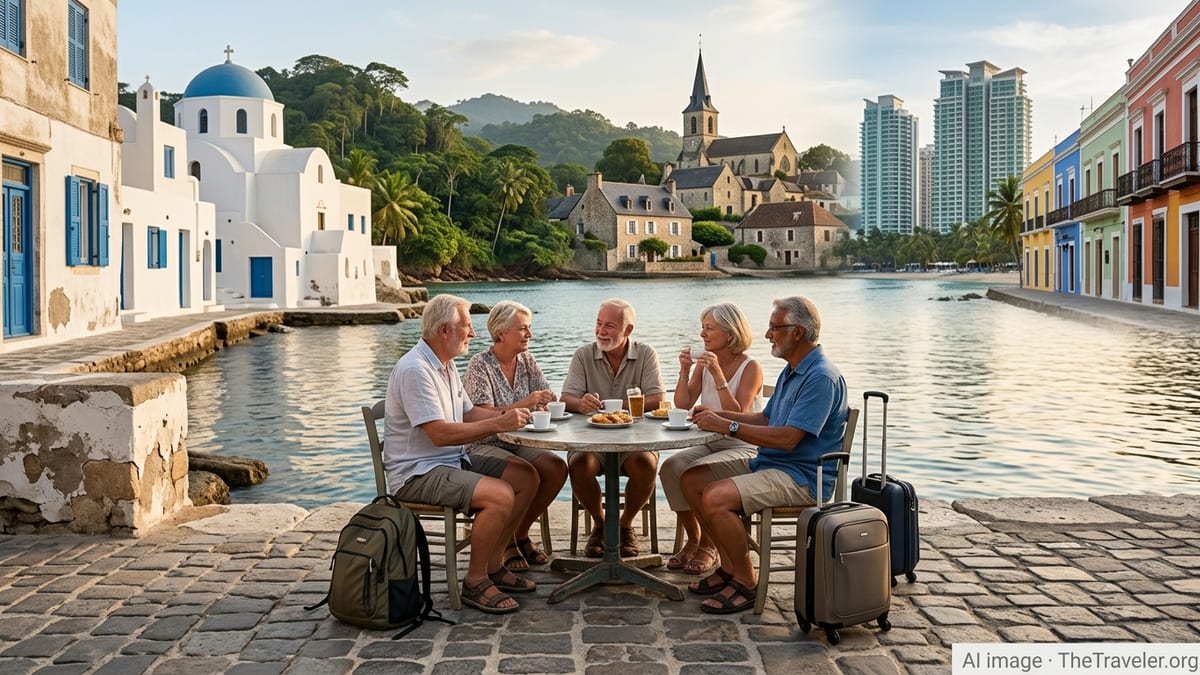
Long-Term Travel Moves From Fantasy To Financial Strategy
Recent travel and lifestyle research points to a decisive shift away from two-week vacations toward extended, slower stays abroad, as remote work and flexible pensions make cross-border lives more realistic for older travelers. Analysis from payment and tourism data providers highlights a clear rise in longer stays globally since the pandemic, with “slow travel” and digital nomad patterns spilling into the retirement demographic as well.
For retirees, the appeal is partly economic. Publicly available comparisons of living costs show that many destinations in Southern Europe, Latin America and Southeast Asia undercut major U.S. and Western European cities on housing, food, transport and private healthcare. Reports on global retirement trends in 2025 and 2026 consistently rank countries such as Mexico, Costa Rica and Malaysia among the most cost-effective options for stretching fixed incomes.
Industry surveys suggest that retirees are increasingly piecing together multi-country lifestyles rather than relocating once. This might mean spending spring in Greece, the rainy season in Costa Rica’s highlands, summer in the French countryside, and winter in Malaysia or Mexico, taking advantage of regional visa schemes and seasonal rental markets. In effect, long-term travel is evolving into a structured retirement plan rather than a one-off adventure.
Greece: Tax Perks, Seaside Living And A Gateway To Europe
Greece has emerged as a powerful anchor in this new retirement-on-the-move model, combining Mediterranean scenery with targeted incentives for foreign residents. Publicly available information on Greek policy shows that the country offers a flat 7 percent tax rate on global income for eligible foreign retirees who transfer their tax residence, alongside a residency-by-investment “golden visa” that grants long-term rights to stay for those purchasing property above set thresholds.
In parallel, Greece has introduced digital nomad and long-term visas aimed at remote workers and lifestyle migrants, with provisions that allow extended stays for people able to support themselves from abroad. Data cited in recent investment and real estate coverage indicates that foreign property purchases have surged since 2020, with American and other international buyers playing a growing role in coastal markets and historic urban centers.
For retirees interested in long-term travel rather than permanent settlement, Greece functions as a summer hub and Schengen gateway. With good air links to the rest of Europe, many long-stay visitors base themselves in cities such as Athens or Thessaloniki, or on islands with robust off-season services, then move on to other regions for part of the year. The combination of reasonable rents outside peak tourist months, favorable tax treatment for qualifying pensioners and access to European healthcare systems has made Greece a template for travel-based retirement planning.
Costa Rica And Mexico: Affordable “Pura Vida” On The Move
In the Americas, Costa Rica and Mexico remain central pillars of long-term retirement travel, helped by geographic proximity to the United States and Canada. Costa Rica continues to promote its Pensionado residence category for retirees with verifiable monthly income, allowing extended stays and re-entry while maintaining access to the country’s national health system for those who enroll and contribute. Lifestyle coverage often cites Costa Rica’s safety perceptions, biodiversity and “pura vida” ethos as key quality-of-life draws for older travelers.
Mexico, meanwhile, has solidified its position as one of the world’s largest hubs for foreign retirees. Global retirement indexes and financial rankings place Mexico near the top for affordability and lifestyle, with destination reports pointing to long-established communities around Lake Chapala, San Miguel de Allende, Puerto Vallarta, Mérida and parts of the Baja Peninsula. Analyses in retirement and personal finance outlets suggest that a couple can often live comfortably on budgets far below those required in many U.S. coastal cities, especially outside the most tourist-driven neighborhoods.
Crucially for long-term travelers, both Costa Rica and Mexico allow retirees to move in and out seasonally, combining stays with trips further afield. Frequent flight connections from Mexican hubs like Mexico City and Cancún, along with Costa Rica’s well-served San José and Liberia airports, make it straightforward to pivot between Central America, North America and onwards to Europe. This connectivity enables a flexible, country-hopping approach where retirees spend several months at a time in each place rather than committing to a single base.
France: Culture-Rich Long Stays Amid Complex Rules
France continues to attract older international travelers who view retirement as an opportunity for deep cultural immersion. Tourism statistics published in early 2026 show that the country recorded another strong year in 2025, with growth driven not only by short-term visitors but also by extended-stay guests in regions such as Nouvelle-Aquitaine, Occitanie and Provence. French tourism and regional economic reports highlight growing interest in long-stay camping, rural rentals and off-season city breaks.
For non-EU retirees, however, the legal landscape is more complex. Public guidance and specialist visa resources explain that long-stay visas and temporary residence permits remain tightly regulated, with distinct categories for non-working individuals, spouses and economically self-sufficient residents. Published coverage in French and international media has recently focused on debates around tax and social security treatment for foreign retirees, underscoring that France remains attractive but administratively demanding for those hoping to live there full-time.
Within a long-term travel strategy, France often functions as a seasonal stop rather than a permanent home. Retirees may spend up to several months each year in smaller towns, wine regions or along the Atlantic coast before rotating back to lower-cost destinations. Budget analyses note that while French healthcare is comparatively affordable and comprehensive, housing and day-to-day expenses in major cities can be significantly higher than in Mexico, Malaysia or parts of Greece, pushing many to treat France as a cultural highlight within a broader, multi-country plan.
Malaysia: A Revamped “Second Home” Hub In Southeast Asia
On the other side of the world, Malaysia has been repositioning itself as a structured base for globally mobile retirees. The Malaysia My Second Home (MM2H) program, long known among expatriates, underwent a major overhaul beginning in 2024, with new tiers and financial thresholds designed to attract wealthier long-stay residents. Economic data released by Malaysian authorities and analyzed by residency-industry outlets show that the updated program generated hundreds of millions of dollars in deposits, property purchases and local spending through 2025.
Detailed guidance from relocation consultancies and legal firms indicates that the new MM2H framework includes different categories with varying minimum income, fixed deposit and real estate requirements, as well as multi-year renewable passes that allow holders to reside in Malaysia for substantial portions of each year. While some commentators argue that higher thresholds risk pricing out traditional middle-income retirees, the program continues to appeal to those able to meet the criteria and seeking a stable, English-speaking base in Southeast Asia.
For long-term travelers, Malaysia’s value lies in its connectivity and relative affordability once on the ground. Cost-of-living comparisons frequently point to Kuala Lumpur, Penang and parts of Borneo as offering lower housing and service costs than many Western cities, while maintaining strong healthcare systems and international airports. Retirees using Malaysia as a home base can move seasonally to nearby destinations such as Thailand, Indonesia or Vietnam, effectively extending their long-term travel circuit across multiple countries while maintaining a secure foothold.
From Single Destination To Global Circuit
Taken together, Greece, Costa Rica, France, Malaysia and Mexico illustrate how retirement is gradually decoupling from the idea of a fixed address. Each country offers different combinations of visa pathways, healthcare options, tax treatment and cost structures, and publicly available trend data shows that older travelers are increasingly willing to combine them into a personal global circuit.
Financial planners and lifestyle analysts note that, for some retirees, this approach can reduce overall living costs while unlocking a level of cultural variety that traditional retirement rarely matches. It also introduces complexity, from navigating shifting visa rules to managing cross-border tax obligations and securing health coverage that works across regions. Yet for a growing segment of retirees, these challenges are viewed as manageable trade-offs for the chance to treat the world itself as a long-term home.
As governments refine residence programs and tourism boards court longer-stay visitors, the idea of long-term travel as a retirement plan is moving from niche experiment to mainstream option. For those able to stay flexible and informed, the emerging retirement map is less a final destination and more an evolving itinerary stretching from the Aegean to the tropics of Central America and the cultural crossroads of Asia.