

More news on this day
Long overshadowed by Paris and Venice, Madrid is quietly emerging as one of Europe’s most compelling cities for romance, blending late-night energy, intimate green spaces and a flourishing cultural scene that increasingly targets couples and city-break travelers.
Get the latest news straight to your inbox!
Award-Winning City Break With Romantic Credentials
Recent rankings suggest Madrid can no longer be described as a well-kept secret. In February 2026, the city was named the top European destination for 2026 by the European Best Destinations organization, after more than a million travelers cast votes from around the world. Coverage of the award highlights a mix of culture, walkability and nightlife that appeals strongly to couples looking for a city break with ambience as well as attractions.
Madrid’s momentum has been building. Tourism analysis compiled in 2024 and 2025 notes the Spanish capital’s consistent appearance near the top of lists of best European cities and top city-break destinations, including high placements in city branding and travel industry indices. A separate couples-focused report from an online travel company in 2024 found Madrid among the most-booked city-break destinations for partners, underscoring how the city is increasingly marketed and booked as a romantic escape rather than solely a cultural or business stopover.
Research into holiday romance trends has also put Madrid in the spotlight. A comparative study of European cities published in 2025 by several outlets, using data on nightlife, inclusivity, sunset conditions and the size of the single population, ranked Madrid as Europe’s leading destination for a holiday romance. The analysis emphasized the capital’s strong nightlife scores and welcoming LGBTQ+ environment, elements that translate directly into an atmosphere where couples and solo travelers alike can connect in relaxed, social settings.
Supporting this reputational surge, Madrid’s tourism statistics show strong visitor numbers and record daily spending in 2024, indicating that travelers are not only arriving in greater volumes but are also staying longer and investing more in experiences such as dining, culture and nightlife. For couples, that translates into a wider range of romantic itineraries, from tasting menus to private tours, that did not exist at the same scale a decade ago.
Golden-Hour Cityscapes and After-Dark Energy
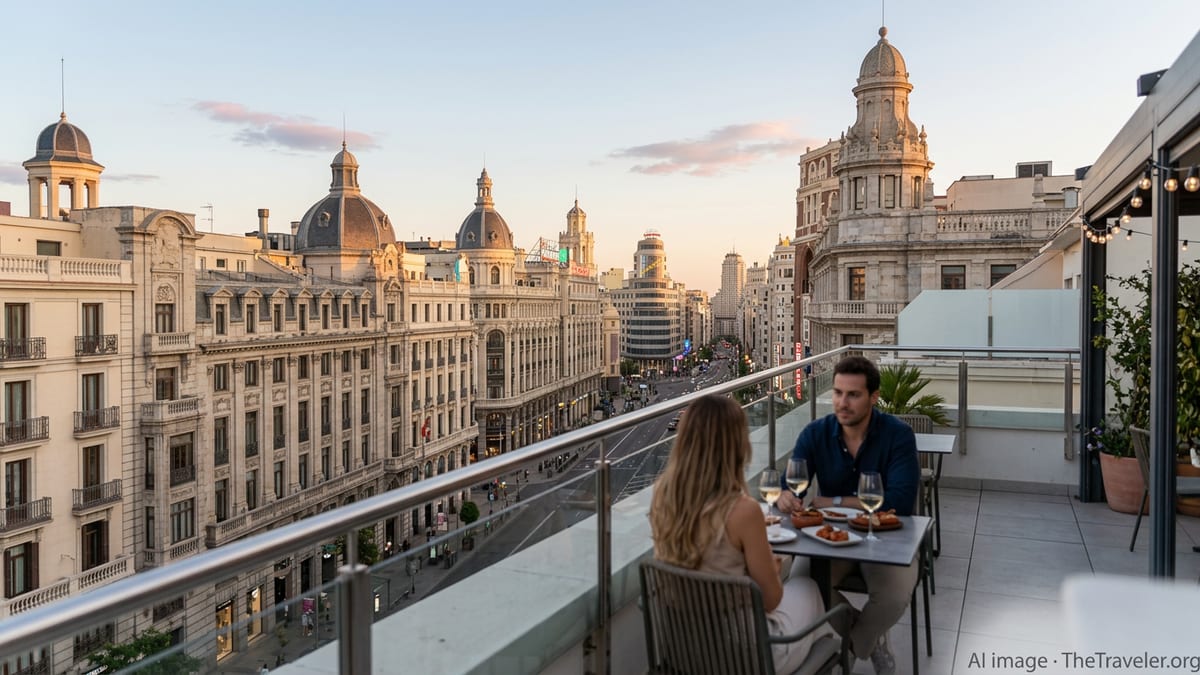
Much of Madrid’s romantic appeal is tied to its distinctive daily rhythm. With more than 3,000 hours of sunshine a year, according to promotional and municipal data frequently cited in travel coverage, the city delivers long golden evenings that stretch naturally into late-night dinners and bar-hopping. Analysts who examined European cities for holiday romance ratings gave Madrid notably high marks for sunset visibility, pointing to its clear skies and vantage points across the city’s hills and terraces.
Couples gravitate toward spots such as the Temple of Debod, an elevated park and historic monument that travel writers routinely identify as one of Madrid’s most atmospheric sunset viewpoints. Nearby, rooftop terraces along Gran Vía and in neighborhoods like Chueca and La Latina offer skyline views where domes, Art Deco facades and new glass towers catch the changing light. Editorial coverage by travel and lifestyle outlets consistently frames these rooftops as some of Europe’s most appealing places for a drink at dusk, especially in spring and autumn.
As night falls, Madrid’s late dining culture adds another layer. Restaurants typically fill after 9 p.m., and the city’s reputation for tapas-hopping turns dinner into a slow-moving date through different bars and plazas. Guides to romantic European breaks frequently highlight the way Madrid’s streets remain lively well past midnight, yet feel oriented around conversation, food and music rather than only high-intensity nightlife.
For visitors planning a special occasion, the timing is favorable. Industry reports show a surge in music tourism and major events scheduled in Madrid for 2026, which is expected to bring headline concerts and cultural festivals to the city. That calendar gives couples the option to anchor a romantic weekend around a performance or event, then extend their stay with quieter evenings in traditional taverns or wine bars.
Art, Flamenco and the “Landscape of Light”
Madrid’s cultural core may not sound overtly romantic on paper, but in practice it provides a powerful backdrop for couples. The city’s central museum axis, known as the “Landscape of Light,” achieved UNESCO World Heritage status in recent years and has been widely profiled as one of Europe’s most concentrated cultural corridors. It links the Prado, Reina Sofía and Thyssen-Bornemisza museums with landscaped boulevards and formal gardens, creating a setting where a day of gallery-hopping naturally blends into a stroll through tree-lined avenues.
Travel features focused on city-break itineraries often recommend this area as a base for romantic stays, in part because of its walkability and proximity to Retiro Park. Exhibition programming at the major museums, including blockbuster shows and evening openings, further supports couples who want to pair culture with dining reservations, especially as Madrid’s culinary scene has gained international recognition.
Flamenco, meanwhile, supplies the passion many visitors associate with Spain. Madrid is a historic center for tablaos, the intimate venues where live flamenco is performed, and coverage from culture and lifestyle outlets describes an ongoing resurgence in small, high-quality spaces. For couples, an evening in a traditional tablao often functions as a centerpiece experience: the combination of close-up music, dance and late-night timing sets a tone that many other European capitals struggle to match.
Outside the traditional core, creative districts such as Carabanchel have begun appearing in city rankings and destination marketing as symbols of Madrid’s contemporary edge. Once a largely industrial zone, the area now hosts galleries, design studios and street art. For travelers, this mix of classic and cutting-edge culture invites longer stays and repeat visits, allowing couples to structure different trips around museums on one occasion and emerging art spaces on another.
Parks, Plazas and Slow Moments for Two
Despite its size, Madrid offers a range of green and urban spaces that are well suited to quieter romantic moments. Tourism data compiled for 2024 shows that Retiro Park remains one of the capital’s most visited attractions, drawing nearly a tenth of all visitors. The park’s boating lake, rose garden and shaded paths are regularly featured in guides to romantic Madrid itineraries, often alongside recommendations for picnics or rowboat rentals.
Beyond Retiro, neighborhoods like La Latina, Malasaña and Las Letras provide smaller-scale charm. Published city-break rankings and tour operator reports note that Madrid’s historic center remains relatively compact and walkable, allowing couples to design days without heavy reliance on transport. Narrow streets lined with independent boutiques, cafés and wine bars encourage aimless wandering, which many travel writers identify as one of Madrid’s most underrated romantic assets.
Public squares, or plazas, play a central role in this experience. From the grand scale of Plaza Mayor to more intimate corners such as Plaza de la Paja or Plaza de Santa Ana, these spaces function as open-air living rooms. Even in cooler months, outdoor heaters and canopies keep terraces active, offering spots for early-evening vermouths or late-night digestifs that extend conversations and people-watching.
Couples watching budgets may find additional appeal in Madrid’s relative affordability compared with other major Western European capitals. A pre-pandemic ranking of romantic city breaks found Madrid among the continent’s better-value options for accommodation and dining, and more recent analyses of European travel pricing still tend to place the Spanish capital below cities such as Paris and Amsterdam on average daily costs. That makes it easier to opt for extra nights, upgraded hotel rooms or special-occasion meals without exceeding typical city-break budgets.
Europe’s Romance Capital in Waiting
Despite mounting accolades, Madrid often remains absent from the top tier of classic “romantic city” shortlists dominated by Paris, Venice and Prague. Some recent travel commentary has framed this as an advantage: expectations are lower, crowds are proportionally smaller at key romantic sites, and visitors are more likely to share terraces and viewpoints with locals than with tour groups.
The city’s growing presence in rankings of best European destinations, most attractive cities and top holiday romance spots suggests that this perception may soon shift. In 2025, industry reports placed Madrid near the top of European city lists for both overall appeal and couple-oriented travel, while hotel investment analyses ranked the Spanish capital among the continent’s leading markets for new hospitality projects. Those factors point to an expanding range of design-led hotels, rooftop pools and wellness-focused properties tailored to weekend escapes.
Yet what many observers identify as Madrid’s strongest romantic asset is harder to quantify: its atmosphere. Publicly available descriptions from travel journalists and tourism analysts repeatedly emphasize the city’s welcoming character, from its relaxed café culture to a nightlife scene that feels social rather than exclusive. For couples, that combination of warmth, energy and relative affordability positions Madrid not just as an alternative to Europe’s traditional capitals of love, but as a destination that may soon redefine what a romantic city break looks like.