

I did not expect the tiny airport at Svolvær to feel like a backstage door to a global phenomenon. Yet as I wheeled my carry-on past hikers in neon shells, tripod-toting photographers and a French family debating the Northern Lights in hushed excitement, it was obvious: the Lofoten Islands, a ragged little chain above the Arctic Circle, are no longer a secret. This tiny destination is suddenly on everyone’s radar, and after a week of tasting stockfish, dodging camper vans and watching midnight light pour over jagged peaks, I understand exactly why.
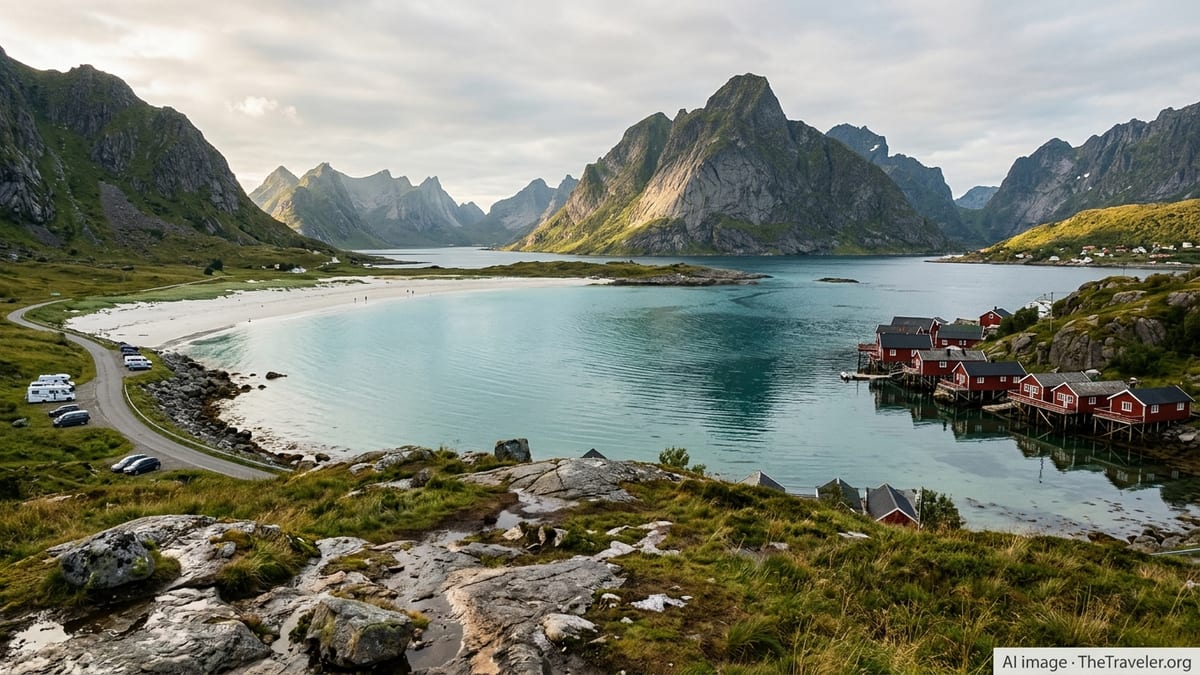
The Moment Lofoten Went From Secret to Screensaver
The first time I heard the word “Lofoten” was not from a guidebook but from an algorithm. A friend sent me a social clip of someone running up a staircase of stone steps to a knife-edge ridge above teal fjords. It was Reinebringen, a 600-meter summit that has quietly become one of Europe’s most shared viewpoints, helped along by nearly 2,000 purpose-built stone steps and a stream of viral posts. Local media in Norway have reported that visits to Reinebringen multiplied several times in just a few years, to well over one hundred thousand hikers each summer, a staggering figure when you consider that the entire Lofoten archipelago is home to only around 25,000 people.
At the same time, Northern Norway as a whole has been breaking its own records. Regional tourism boards reported more than two million overnight stays across the north in the summer of 2025 alone, with Lofoten posting some of the strongest growth in guest nights. Hotels that once worried about filling rooms outside of July and August now talk about “year-round season.” When I asked the receptionist at a small harbor hotel in Henningsvær about occupancy, she laughed and said that even midweek in October, they are now often full with Germans chasing the aurora and Americans on “coolcation” itineraries that pair Lofoten with Tromsø or the Luleå archipelago in Sweden.
The numbers tell part of the story, but you really feel the boom in smaller, everyday ways. On my first night, a local bartender told me he now keeps his bar open until midnight even in shoulder seasons because hikers come off the mountain late, headlamps still around their necks, looking for a beer and a bowl of fish soup. A decade ago, he said, you would have struggled to find anywhere open after ten on a Tuesday in March.
All of this has happened while places further south wrestle with overtourism and heat waves. As Mediterranean summers get hotter, industry reports show a clear shift toward “coolcations” in countries like Norway and Iceland, with some luxury networks noting double-digit percentage growth in bookings to these cooler climates. Lofoten, with its drama-per-square-meter and relatively limited beds, was almost destined to be swept up in that wave.
Arriving at the Edge of the Map
Getting to Lofoten still feels like flying to the edge of the map, even if the route has become far more popular. I started in Oslo, then took a morning flight north to Bodø, a compact coastal city that has become one of the main jumping-off points to the islands. From there, I boarded a small Widerøe propeller plane to Svolvær. The 25-minute hop felt more like a scenic flight than a simple transfer, with the pilot banking low over dark water flecked with whitecaps and rows of mountains rising straight from the sea.
You can also arrive the classic way: by ferry. The overnight coastal ship from Bergen still calls at Stamsund and Svolvær, and in summer a car ferry shuttles between Bodø and Moskenes, near the picture-book village of Reine. On board, I met a Dutch couple who had decided to bring their electric camper van, calculating that even with Norway’s famously high fuel and food prices, they would save compared with hotel stays. They had pre-booked campsites along the chain, paying the equivalent of around 40 to 60 dollars per night for a powered site with showers.
Costs in Lofoten can surprise first-time visitors. A basic but comfortable double room in a rorbuer, the traditional red wooden fisherman’s cabins that line the harbors, often runs between 180 and 280 dollars a night in summer, depending on the village and view. A restaurant main course of Arctic cod or stockfish might be 30 to 45 dollars. It is not a cheap destination, but there are ways to soften the impact: self-catering cabins booked outside of peak school holidays, supermarket picnics, and traveling in the shoulder months when car rental rates and room prices drop.
Arriving in Svolvær, I picked up a compact rental car and quickly discovered why almost everyone you speak to recommends having your own wheels. Public buses do connect the main villages, but they are infrequent, especially on weekends, and tours fill up days in advance in high season. With a car, you can pull over at an unsigned lay-by because the light has turned the sea to mercury, or veer down a side road when you spot a cluster of colorful houses clinging to a rocky bay.
First Impressions: A String of Villages and a Sea of Cameras
Lofoten is not one place but many, stitched together by one improbably scenic road, the E10. Driving west from Svolvær on my first afternoon, I passed cod-drying racks standing empty for the summer, harbors lined with sled-like fishing boats, and football pitches that seemed to have been flung onto scraps of flat land wherever the mountains briefly relented. At each pullout, there were rental cars with unfamiliar plates, camper vans from Germany and France, and the occasional tour bus disgorging passengers wrapped in down jackets and holding identical paper coffee cups.
Henningsvær, sometimes called the “Venice of Lofoten,” was my first real stop. Once a gritty fishing harbor, the village has leaned into its new role as an Instagram darling. On a Tuesday in late September, artists’ studios displayed minimalist ceramics and landscape prints priced for an international audience, and the local bakery served cardamom buns alongside oat-milk lattes. A hand-lettered sign outside one shop reminded visitors not to block narrow lanes with parked cars and asked, politely but firmly, that drones not be flown directly over people’s homes.
Further west, the tiny hamlet of Å, literally the last letter of the Norwegian alphabet and the last stop on the road, felt like the Lofoten of travel posters. Turf-roofed houses tumbled down to a small harbor, and the scent of stockfish hung faintly in the air. Yet even here, in a place that once felt like the end of the world, there was a queue at the only open café, and a sign in English and German explaining that local residents have priority for the limited parking.
It would be easy to complain that Lofoten is “too discovered” now, but the reality is more nuanced. Yes, there are moments when the drone of actual drones breaks the spell, or when the trailhead at Reinebringen feels more like a city park than a remote Arctic climb. But walk ten minutes beyond the viewpoints you see on your social feed, and the crowds thin dramatically. On a short evening hike near Leknes, I shared an entire ridge of mossy rock and views toward the Vestfjorden with just two local teenagers and their dog.
The Outdoor Playground Everyone Wants a Ticket To
What makes Lofoten irresistible, even to skeptics of hyped destinations, is how quickly you can go from airport arrival to genuine wilderness. Within a few hours of landing, I found myself zipped into a floatation suit, boarding a rigid inflatable boat for a safari to see sea eagles and white sand beaches that looked like they belonged in the Caribbean, only with snow-dusted peaks as a backdrop. The guide, a local in his thirties who had worked both in fishing and tourism, explained that tours like this have exploded in popularity. In high season, his small company runs several trips a day, each one full, at a cost of roughly 120 to 150 dollars per person.
Hiking is the other big draw, and also the flashpoint of many of Lofoten’s growing pains. Iconic routes such as Reinebringen, Ryten and Kvalvika Beach now see hundreds of people on busy days, which is why local authorities and volunteer groups have invested heavily in stone steps, signage, and even staffed parking lots where attendants explain trail etiquette and check that people are properly equipped. On a windy day, a ranger at the trailhead gently but firmly turned away a couple wearing smooth-soled sneakers and carrying no water, suggesting a lower, safer walk instead.
If your idea of adventure involves fewer people and gentler gradients, there are still plenty of options. Sea kayaking has gone from niche activity to near-essential experience, with half-day guided paddles around sheltered bays starting at around 90 to 110 dollars per person, all equipment included. On one calm morning outside Svolvær, I joined a small group that paddled between skerries where cormorants dried their wings, the only sounds the drip of paddles and the distant thrum of a fishing boat.
Winter, too, has come into its own. Tourism data from Destination Lofoten show that guest nights in the cold months have grown dramatically in just a few years, as visitors realize that this is not only a summer destination. From December to March, you are as likely to meet people in insulated suits and balaclavas scanning the sky for aurora as you are to see hikers. Tour operators now sell multi-day packages that combine snowshoe hikes, photography workshops, and evenings in glass-roofed cabins or converted lighthouses, at prices that rival luxury ski resorts in the Alps.
The Cost of Being Suddenly Famous
The boom has not come without strain. As Northern Norway set new tourism records, local mayors and residents began speaking more openly about the downsides. In Lofoten, house prices have risen sharply, driven in part by the growth of short-term rentals. In one small municipality, local estimates suggested that the number of overnight stays more than doubled between 2023 and 2025, outpacing the capacity of roads and basic services. Villages with only a few thousand residents now host tens of thousands of overnight guests each summer month.
You notice the pressure most acutely around basic infrastructure. Parking lots at popular beaches and trailheads overflow on sunny days, leading to creative, and sometimes dangerous, roadside parking. Public toilets are often stretched beyond their limits, which has led to ugly headlines in the national press about waste left in nature. A café owner in Reine told me she now budgets extra for private waste collection in July and August, because municipal services cannot keep up with the volume of trash from takeaway cups and sandwich wrappers.
Local authorities are not standing still. In 2025, the Norwegian government approved a framework that allows municipalities to introduce a tourism levy on accommodation, with the goal of channeling some of the money back into trails, toilets and public transport. Lofoten’s councils have also worked with regional tourism boards on campaigns that encourage visitors to travel outside peak weeks, to stay longer and to explore less-visited corners of the archipelago instead of concentrating on the same three or four stops.
There is a cultural cost to manage as well. Several islanders I spoke to worried about Lofoten becoming a kind of Arctic theme park, its fishing culture reduced to a backdrop for selfies. At the same time, many acknowledged that tourism has helped keep younger people from moving away by creating year-round jobs in guiding, hospitality and creative industries. The balance between prosperity and preservation plays out in small decisions: a former fish warehouse converted into a design hotel instead of luxury apartments, or a family choosing to keep their rorbuer rental open only part of the year so they can still use it themselves.
Finding Quiet in a Popular Place
For all the headlines and statistics, what stays with me from Lofoten are the quieter moments that still feel almost impossibly intimate, proof that even suddenly famous places have corners that tourism has not yet frayed. One evening near the village of Vikten, I pulled off at an unsigned gravel track that led down to a crescent of black sand. There were no tour buses, no gift shops, just a single dog walker and the rhythmic crash of waves. The late-summer light turned the wet stones at the tide line silver as the sun slipped behind a serrated skyline of mountains.
In the historic fishing village of Nusfjord, I visited outside the busiest hours, arriving late in the afternoon as day-trippers drove away. The entrance fee that had frustrated some visitors on review sites suddenly made sense: the money helps fund restoration of creaking wooden piers, yellow and red rorbuer, and the old smokehouse. A local guide explained that without a mix of income from tourism and fishing, many of these buildings would have been lost.
I also found that local-run experiences tended to be both more thoughtful and less crowded. In Kabelvåg, I joined a small cooking workshop in a former fish factory, learning to prepare bacalao from locally dried cod. There were only six of us around the table, and the conversation ranged from Norwegian school traditions to debates about how high the proposed tourism tax should be. The cost, around 150 dollars including dinner, felt fair for an evening that gave as much cultural context as culinary instruction.
The real key to enjoying Lofoten now is timing and patience. Visit in late May, September or even early March rather than the peak of July. Book smaller, family-run rorbuer instead of only chasing the most photographed cabins. Accept that you will share some viewpoints with others, then deliberately carve out mornings or evenings to wander unnamed beaches or low ridges where you can hear your own footsteps again.
The Takeaway
Standing on a headland above Haukland Beach on my last morning, I watched the weather change in real time. Sunlight tore through fast-moving clouds, turning sections of sea from slate to electric turquoise in seconds. Below me, a handful of tiny figures walked the curve of white sand, dwarfed by surrounding peaks. Somewhere behind me on the road, a line of rental cars inched into the parking lot, the next wave of visitors spilling out with cameras and coffee cups.
Lofoten’s rise from niche climbing destination and fishing hub to global travel crush is a case study in how quickly a tiny place can go viral, especially when climate shifts push travelers toward cooler, wilder corners of the map. It is also a reminder that popularity is not automatically a problem, as long as growth is matched with respect, infrastructure and a willingness to say “enough” when the limits of the landscape are reached.
If you come now, you will find some crowds and higher prices, yes. But you will also find an Arctic archipelago still largely itself: fishermen hanging cod on wooden racks each winter, children playing soccer on floodlit pitches under the aurora, and locals who, more often than not, are happy to share their home as long as you tread lightly. This tiny destination is suddenly on everyone’s radar. Go, if you can, but go with the humility of a guest at the edge of the world.
FAQ
Q1. Where exactly are the Lofoten Islands located?
Lofoten is an archipelago in Northern Norway, above the Arctic Circle, stretching out into the Norwegian Sea southwest of the city of Tromsø.
Q2. How do you get to Lofoten from the United States?
Most travelers fly to Oslo, then connect via Bodø or Tromsø to small airports like Svolvær or Leknes, or take a ferry from Bodø to Moskenes with a rental car.
Q3. Is Lofoten very expensive to visit?
Yes, by most standards. Expect hotel or cabin rates often between 180 and 280 dollars per night in high season and restaurant mains around 30 to 45 dollars.
Q4. When is the best time of year to go?
For hiking and midnight sun, late May to early August is ideal. For Northern Lights and snow activities, plan between November and March, avoiding peak holidays.
Q5. Do I need to rent a car in Lofoten?
It is highly recommended. Buses exist but are limited, and many trailheads, beaches and viewpoints are difficult to reach on public transport schedules alone.
Q6. Are there still quiet places even though it is popular now?
Yes. If you avoid the most famous hikes at peak times, travel in shoulder seasons, and explore side roads and lesser-known villages, you can still find plenty of solitude.
Q7. Is it safe to hike without a guide?
In good weather on well-marked trails, confident hikers can go independently, but conditions change quickly. Always check local forecasts, carry proper gear and choose routes suited to your experience.
Q8. How is tourism affecting local life in Lofoten?
Tourism brings jobs and income but also pushes up housing costs, strains infrastructure and can feel overwhelming in small villages during summer if not carefully managed.
Q9. What should visitors do to travel responsibly there?
Stick to marked trails, respect private property, pack out all trash, use toilets where provided, keep noise and drone use low, and support local businesses rather than only global chains.
Q10. How far in advance should I book accommodation?
For July and early August, booking several months in advance is wise. In shoulder seasons you have more flexibility, but popular rorbuer still fill up quickly.