

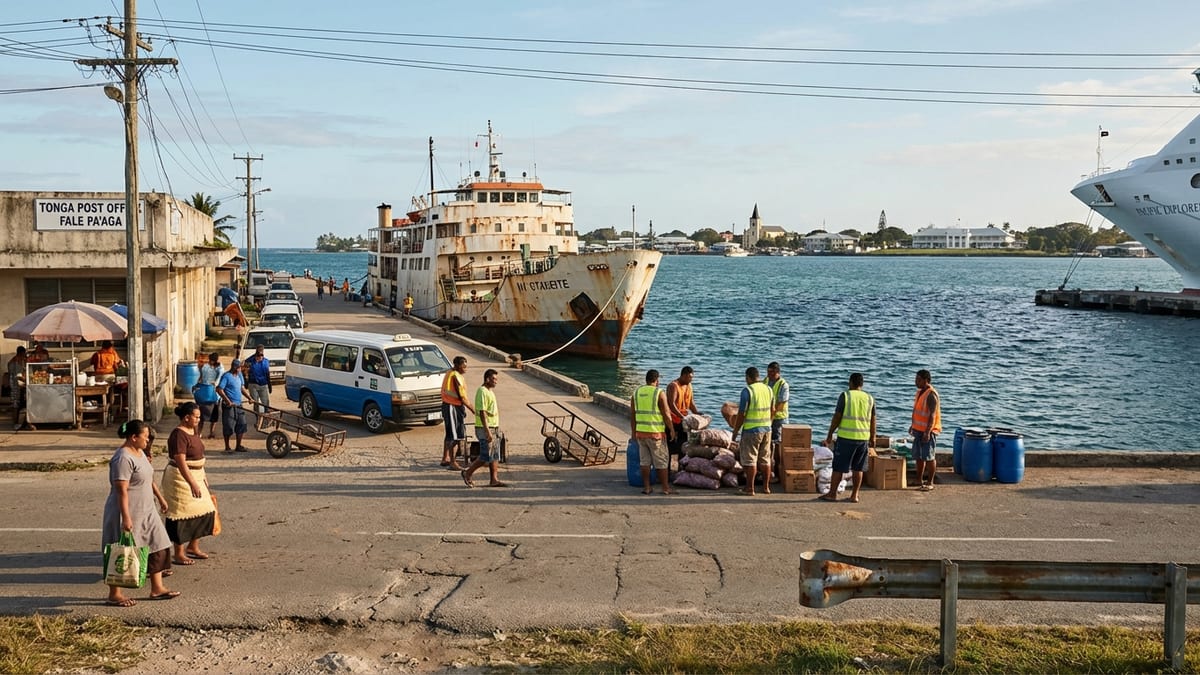
You feel it first in your shoulders. In Nukuʻalofa, they seem to drop a little lower than they do in the resort towns of the Pacific. There is no choreographed fire-dancing troupe waiting in a beachfront amphitheater, no gated compound separating you from local life. Instead, Tonga’s capital opens itself in quieter ways: through the murmur of kava circles, the hum of Talamahu Market, the slow sweep of the waterfront where rusting inter-island ferries share space with shiny cruise tenders. This is a capital that has not been rebuilt around visitor fantasy. It is one that still revolves, unapologetically, around its own people.
A Working Capital, Not a Stage-Set Resort
Many Pacific capitals have, over the last two decades, recast their waterfronts into highly curated leisure strips. Think of broad promenades edged with branded hotels, manicured lawns, and piers built primarily for visitors. Nukuʻalofa has a waterfront and a growing cruise presence, but its core identity remains stubbornly workaday. At Vuna Wharf, where visiting ships berth, passengers step into a landscape that still smells of salt, diesel, and market food rather than vanilla-scented lobby air conditioning.
The central streets around Taufaʻahau Road and Vuna Road are lined with banks, low-slung office buildings, Chinese-owned variety shops, and informal food stalls. Talamahu Market sits at the heart of this grid as a true municipal market rather than a themed craft plaza. Baskets of taro, manioke, and yams share space with secondhand clothes and mobile-phone accessories. The feeling is that of a functioning capital city that happens to receive visitors, not a resort enclave doing an impression of one.
Even as Tonga’s tourism sector rebounds and grows, with international arrivals climbing again and cruise calls scheduled throughout 2025 and beyond, Nukuʻalofa has not been transformed into a sanitized visitor bubble. The road surfaces can be patchy. Roosters wander through town. Taxis compete for cruise-ship passengers but just as often shuttle locals between errands. Everyday life is visible, and tourists fit into that reality instead of the other way round.
This difference is subtle, but it shapes your experience from the moment you step ashore. There is less hand-holding and fewer packaged diversions. The city asks you to walk, watch, and wander. You are a guest in a real place, not the main character in its story.
Monarchy, Mission Bells, and a Deeply Tongan Urban Rhythm
Nukuʻalofa is one of the few Pacific capitals where a reigning monarch’s presence is not just ceremonial but structurally woven into the city. The Royal Palace, a white wooden landmark facing the harbor, is not an Old World-style museum. It is an active seat of the Tongan crown, framed by royal tombs, churches, and government ministries. This living monarchy shifts the city’s energy away from purely commercial or touristic imperatives and toward a kind of dignified continuity.
The skyline is low and interrupted more by church steeples than hotel towers. Sunday, in particular, reshapes the entire rhythm of town. By law and custom, Sunday in Tonga is a day of rest and worship. Shops shutter, government offices are closed, buses stop running, and the city’s modest traffic evaporates. Instead of beach bars offering happy-hour deals, you hear choirs lifting through open church windows and see families in formal taʻovala mats walking along quiet streets.
For visitors, this can be jarring if your mental image of a Pacific capital involves infinity pools and seven-day-a-week entertainment schedules. In Nukuʻalofa, you plan your outings around church times, family lunches, and the practical reality that very little is open on Sunday beyond some hotels and a handful of eateries. The city’s pulse is set more by the monarchy’s ceremonial calendar and the church bells than by cruise arrivals or flight timetables.
This religious and royal overlay gives Nukuʻalofa a particular gravity that contrasts sharply with the breezy hedonism of resort hubs. Even casual walks bring you past royal burial grounds and government buildings, reminding you that this is a capital of a sovereign kingdom rather than a purpose-built playground. It is a place where tradition holds equal billing with tourism in shaping public space.
Talamahu Market and the Honest Heart of the City
If you want to understand why Nukuʻalofa feels different from resort-style Pacific capitals, start at Talamahu Market. Located just off Salote Road in the city center, this covered market is the place where Tonga comes to trade, talk, and stock up. It is not polished for the camera. Concrete pillars, simple stalls, and the constant movement of shoppers set the tone. On the ground floor, neat pyramids of bananas and piles of taro roots compete for space with bundles of leafy greens and woven baskets overflowing with seasonal fruit.
Upstairs, a different kind of economy unfolds. Here, local artisans sell tapa cloth, intricately woven pandanus mats, carved wooden bowls, and jewelry. There are rugby jerseys, printed island dresses, and the woven belts and mats that still hold deep social significance in Tongan life. Prices tend to be more grounded than in tourist boutiques, and the people behind the tables are often the same ones who harvested, carved, or stitched what they are selling.
Unlike the sanitized “cultural markets” set inside resort compounds elsewhere, Talamahu is first and foremost a local market. Cruise passengers and independent travelers pass through, but the design and atmosphere have not been reengineered around them. There is little in the way of overt sales theatrics. Vendors chat among themselves, children weave through the aisles, and shoppers fill canvas bags with vegetables for dinner. Even when a large cruise ship like Pacific Adventure brings thousands of tourists into town for the day, the market absorbs the influx rather than transforming its character.
That stubborn authenticity can be confronting if you are used to resort shopping villages where every shelf is curated for visitor expectations. In Nukuʻalofa, you are stepping into someone else’s grocery run and livelihood. It feels less like a retail experience and more like a glimpse of the city’s everyday economic engine, humming along whether you are there or not.
Faikava Nights and a Social Life That Does Not Orbit Tourists
After dark, many Pacific destinations pivot toward visitor entertainment: bar bands, fire shows, and themed buffets staged with an eye to online reviews. Nukuʻalofa after sunset is livelier than its sleepy reputation suggests, but its social life still centers on Tongans themselves. One of the most distinctive traditions is faikava, or the kava circle, where friends, relatives, and club members gather to drink kava, talk, and sing late into the night.
In the capital, kava clubs known as kalapu operate in yards, village halls, and informal venues tucked behind streets. Their names may reflect districts, churches, or shared interests. Inside, men sit cross-legged on mats, passing a shared kava bowl in a carefully ordered sequence while guitars and hymn-like harmonies rise between rounds. Historically, these gatherings helped farmers and fishermen unwind after work. In urban Nukuʻalofa, they have evolved into powerful social hubs that support community projects, fundraisers, and mutual aid.
Crucially, faikava is not a performance for tourists. Some visitors may be invited to observe or join by local friends or guides, but the tradition has not been packaged into a nightly “show” circuit in the way that dance or fire-knife performances have been in more commercialized Pacific settings. The kava bowl in Nukuʻalofa belongs to the people sitting around it, not to a hotel entertainment schedule.
This carries over into the city’s bars and eateries. There are places where foreigners and locals mingle over beer or soft drinks, and a modest nightlife scene does exist. Yet the feeling is that you are stepping into a Tongan evening, not one designed in a marketing department. The music, from old island ballads to contemporary Pacific pop, caters to local taste first. As a traveler, you are welcome, but you are not the target audience.
Cruise Ships at the Wharf, Not Resorts on the Reef
One of the reasons Nukuʻalofa has been able to preserve its low-key character is the way tourism arrives. Tonga’s overall visitor numbers remain modest compared with regional heavyweights, and a significant share of those visitors now come by sea. In 2024 more than a dozen international cruise ships called into Tongan ports, with Nukuʻalofa acting as a key gateway. In early 2025, local media reported that Tonga expected around 30 cruise ship visits during the year, and some months have seen as many as six ships in just a few weeks.
When a large vessel docks at Vuna Wharf, thousands of passengers step out into town. Taxis line up, tour buses head to beaches and blowholes, and handicraft stalls appear along the waterfront. Yet these surges are temporary. When the ship pulls away in the evening, Nukuʻalofa returns quickly to its baseline rhythm. There are no massive resort complexes locking up prime coastlines for exclusive use. Instead, day tours distribute visitors across the main island of Tongatapu: to historical sites like Haʻamonga ʻa Maui, to the Mapuʻa ʻa Vaea blowholes, to village homestays and small beach fales.
This cruise-centric pattern has its tradeoffs. Economically, Tonga benefits not only from port and wharfage fees but also from the income that flows to guides, taxi drivers, and market vendors. At the same time, cruise visitors are usually day-trippers who spend less per person in the country than long-stay resort guests might. The upside for Nukuʻalofa’s character is that the pressure to build large-scale resort infrastructure in the city itself has been muted. Hotels are generally modest, locally owned or small-scale, and integrated into the existing urban fabric rather than walling off new beachfront districts.
For travelers who do stay in town, this means your base is likely to be a mid-rise guesthouse, a small hotel, or a boutique property rather than a branded resort village. You may wake to the sound of church bells or traffic instead of curated bird song played through hidden speakers. And when you walk out the door, you are immediately in the city, sharing sidewalks and services with residents, not riding a shuttle across a controlled resort boundary.
Slow Travel in a Capital That Still Does Things on Island Time
Resort-style capitals are often defined by their frictionless efficiency. Check-in is automated, transfers are pre-arranged, and activities are slotted into neat, hour-by-hour itineraries. In Nukuʻalofa, travel still unfolds at human speed. There is an airport out at Fuaʻamotu and a growing number of regional flights, but on the ground the city operates according to island time and Tongan priorities.
Public transport is informal, relying on locally run minivans and buses that start and stop according to passenger demand and daily routines. Walking remains the most reliable way to get around the compact center, and many visitors rent bicycles to cruise between the waterfront, markets, and outlying villages. Directions are given using landmarks and family names, not GPS coordinates and branded signage.
This can be disorienting if you are used to a resort environment where every movement is stage-managed. Schedules may shift without explanation. A cafe that was open yesterday might be closed for a funeral, a church function, or simply because the owner needed to be elsewhere. On the other hand, this lack of rigid structure is precisely what allows for encounters you cannot script: an impromptu invitation to share food, a conversation at a roadside stall, a chance to join a village rugby practice or church youth event.
For travelers willing to accept uncertainty, Nukuʻalofa rewards slowness. Sitting on a bench along the harbor, watching a local inter-island ferry unload cargo next to a visiting cruise ship, you begin to see the layers. This is a capital negotiating global tourism on its own terms, absorbing outside influences without reprogramming its internal clock. It is less about ticking off attractions and more about learning how the day is structured when commerce, community, and custom share the same small stage.
Everyday Hospitality Instead of Scripted Service
One of the clearest distinctions between Nukuʻalofa and resort-style capitals lies in how you experience hospitality. In high-end Pacific resorts, service is often meticulously trained to international standards, with staff coached to anticipate needs, use guest names, and perform a certain brand of cheerful attentiveness. In Tonga’s capital, the warmth you encounter is more ad hoc, grounded in family networks, church ties, and a cultural emphasis on respect and generosity.
Staff in small hotels or guesthouses may not follow a global hospitality script, but they may remember how you like your coffee, introduce you to relatives, or help track down a distant cousin you did not know you had. Restaurant service can be unhurried, yet if you show genuine interest in the food, someone might emerge from the kitchen to explain a dish, share a recipe, or recommend a village where you can see it prepared in a traditional earth oven.
This everyday hospitality extends into public space. Strangers will greet you with “Mālō e lelei,” particularly outside the most tourist-saturated blocks. Children may shout hello and ask where you are from. People will notice where you sit at church and might invite you home for lunch or to community events. These interactions are not part of a resort’s programmed cultural calendar. They happen because Tonga is still a place where social ties are thick and visitors are folded into those ties when they show humility and interest.
The flip side is that there is less insulation if things go wrong. There may be no concierge to “fix” every inconvenience, and miscommunications can arise in a city where multiple languages and cultural frames intersect. But for many travelers, this unscripted, sometimes imperfect hospitality is what makes Nukuʻalofa feel profoundly human, far removed from the polished universality of resort service.
The Takeaway
On paper, Nukuʻalofa has many of the ingredients that could push it toward a resort-style future. Tourism arrivals are growing again, cruise ships call in increasing numbers, and investment agencies actively court new tourism infrastructure. Yet walk its streets today and you find a capital that has resisted becoming a stage set. It remains a place of markets and ministries, churches and kava clubs, royal ceremonies and weekday errands.
That difference shows up in practical ways: a waterfront where cargo and cruise coexist, a Sunday when commerce yields to worship, a nightlife more focused on kava bowls than cocktail menus. It also manifests in subtler feelings: the sense that the city is oriented toward its own citizens rather than endlessly mirroring visitor expectations. Travelers looking for uninterrupted beach time and all-inclusive predictability may be surprised, even frustrated. Those seeking a more grounded encounter with the contemporary Pacific are likely to find Nukuʻalofa deeply compelling.
To experience the city well is to accept that you are an observer of a living Tongan capital first and a customer second. Markets will be busy whether or not you show up. Choirs will fill the air on Sunday even if no visitor is listening. Kava will be mixed late into the night in yards you may never see. Nukuʻalofa’s gift is that it allows you to slip, however briefly, into this ongoing story without rewriting the script. In an era of increasingly standardized tropical getaways, that feels quietly radical.
FAQ
Q1. Is Nukuʻalofa a good destination if I am used to resort-style Pacific holidays?
Nukuʻalofa can be a rewarding contrast if you are open to a less packaged experience. There are comfortable places to stay and day trips to beaches and outer islands, but the city itself feels more like a lived-in town than a resort zone. Expect fewer amenities aimed solely at tourists and more everyday encounters with local life.
Q2. Will I find big beachfront resorts in or near Nukuʻalofa?
Large international resorts are limited around the capital. Accommodation tends to be small hotels, guesthouses, and boutique properties, some with ocean views but on a much smaller scale than resort complexes in places like Fiji or Tahiti. For classic beach stays, many travelers base in Nukuʻalofa and take day trips or short stays on nearby islands.
Q3. How does Sunday in Nukuʻalofa affect travelers?
Sunday is a strict rest and worship day in Tonga. Most shops, markets, and local transport services close, and the city becomes very quiet. Visitors should plan ahead by arranging meals at hotels that stay open and using the day to attend church, rest, or enjoy low-key activities rather than shopping or touring.
Q4. Is it easy to walk around and explore the city independently?
Yes. Nukuʻalofa’s center is compact and generally walkable, with key sites like Talamahu Market, churches, the waterfront, and many eateries within a short stroll of each other. Sidewalks can be uneven and traffic somewhat chaotic at times, but most visitors find walking one of the best ways to get a feel for the city.
Q5. Can tourists visit kava circles in Nukuʻalofa?
While kava clubs are primarily local social spaces, some tours and guides can arrange introductions, and visitors with local friends may be invited to attend. It is important to remember that faikava is not a show. Dress modestly, follow guidance on etiquette, and approach the experience with respect rather than as entertainment.
Q6. What should I expect at Talamahu Market as a visitor?
Expect a busy, authentic local market with fresh produce on the ground floor and handicrafts, clothing, and souvenirs upstairs. It can be crowded, especially on Saturday mornings, and facilities are basic. Prices are usually fixed and fair, and bargaining is not a big part of the culture. It is as much a place to observe daily life as it is to shop.
Q7. How significant are cruise ships to the feel of the city?
On days when a large cruise ship is in port, Nukuʻalofa is noticeably busier, especially around the waterfront and main market. Extra stalls and tour operators appear to meet demand. Once the ship departs, the city quickly returns to its quieter baseline. The temporary crowds do not fundamentally change the city’s character but can affect the atmosphere for a few hours.
Q8. Is Nukuʻalofa safe for independent travelers?
Most travelers experience Nukuʻalofa as friendly and relatively safe, especially compared with larger urban centers elsewhere. Normal common-sense precautions apply: watch your belongings in crowded areas, avoid walking alone late at night in poorly lit places, and respect local customs. The strongest risks tend to be from traffic, stray dogs in some areas, and the tropical sun rather than crime.
Q9. How does the cost of visiting Nukuʻalofa compare to resort destinations?
Day-to-day expenses such as local food, simple accommodation, and market purchases are often lower than in heavily developed resort destinations. High-end experiences are fewer, but mid-range travelers can find good value. Imported goods and specialized tours can be more expensive due to Tonga’s remoteness, so budgets should allow for some higher costs in those areas.
Q10. Who will appreciate Nukuʻalofa most as a destination?
Nukuʻalofa tends to appeal to travelers interested in culture, community, and the contemporary Pacific more than those seeking polished resort luxury. If you enjoy markets, conversations with locals, learning about monarchy and church life, and taking things at a slower pace, you are likely to find the capital deeply engaging. If your priority is all-inclusive convenience and curated entertainment, it may feel too low-key.