

More news on this day
As Morocco accelerates its tourism ambitions toward 2030, the country’s capital, Rabat, is stepping into the spotlight, with new cultural titles, riverfront landmarks, and major sporting legacies converging to make 2026 a pivotal year for the Atlantic-facing city.
Get the latest news straight to your inbox!
A Capital Riding Morocco’s Tourism Wave
Publicly available data on Morocco’s tourism roadmap shows an aggressive push to attract up to 26 million visitors by 2030, with a 2023 to 2026 strategy focused on new products, stronger branding, and expanded capacity. Within this national drive, Rabat is emerging as a flagship urban showcase, pairing political stability with a growing portfolio of culture, sport, and business events that increasingly anchor international itineraries.
Recent analysis from industry and multilateral tourism bodies highlights Morocco’s rise as Africa’s most visited destination, crediting a mix of infrastructure investment, event hosting, and diversified tourism offerings. Rabat’s role as the political and institutional heart of the country, combined with its coastal setting and historic medina, places it at the intersection of this growth, giving the city a platform to convert policy ambitions into visible visitor experiences by 2026.
The city’s evolution is also tied to Morocco’s wider global visibility, from high-profile football performances to the country’s selection as co-host of the 2030 FIFA World Cup. For travelers, that means Rabat is no longer just an administrative stop between Casablanca and the imperial cities of Fez and Marrakech; it is being reframed as a stand-alone destination where national strategies are most clearly felt on the ground.
UNESCO World Book Capital 2026 and a Cultural Calendar in Motion
In October 2025, UNESCO named Rabat as World Book Capital for 2026, citing the city’s role as a cultural crossroads where literature and the arts intersect with education and public space. The designation brings with it a full year of themed programming, from reading initiatives to public events, aimed at making books more visible in everyday urban life and strengthening Rabat’s profile as a knowledge hub.
Local cultural planning indicates that the long-running Rabat International Book Fair, known by its French acronym SIEL, is set to be a central pillar of this title year. The 31st edition, scheduled from late April to early May 2026, is expected to expand its usual mix of publishers, debates, and author encounters, while drawing additional international attention because of the World Book Capital status.
Rabat’s literary moment is layered onto an already dense events calendar. The Mawazine music festival, historically described in international coverage as one of Africa’s largest music events, is slated to continue after its 2025 edition returns the capital to the global festival map. Together, these recurring fixtures are turning 2026 into a year when visitors can align travel with book-focused programs, open-air concerts, and cross-cultural exchanges concentrated within a relatively compact urban footprint.
Waterfront Icons and a Reinvented Urban Skyline
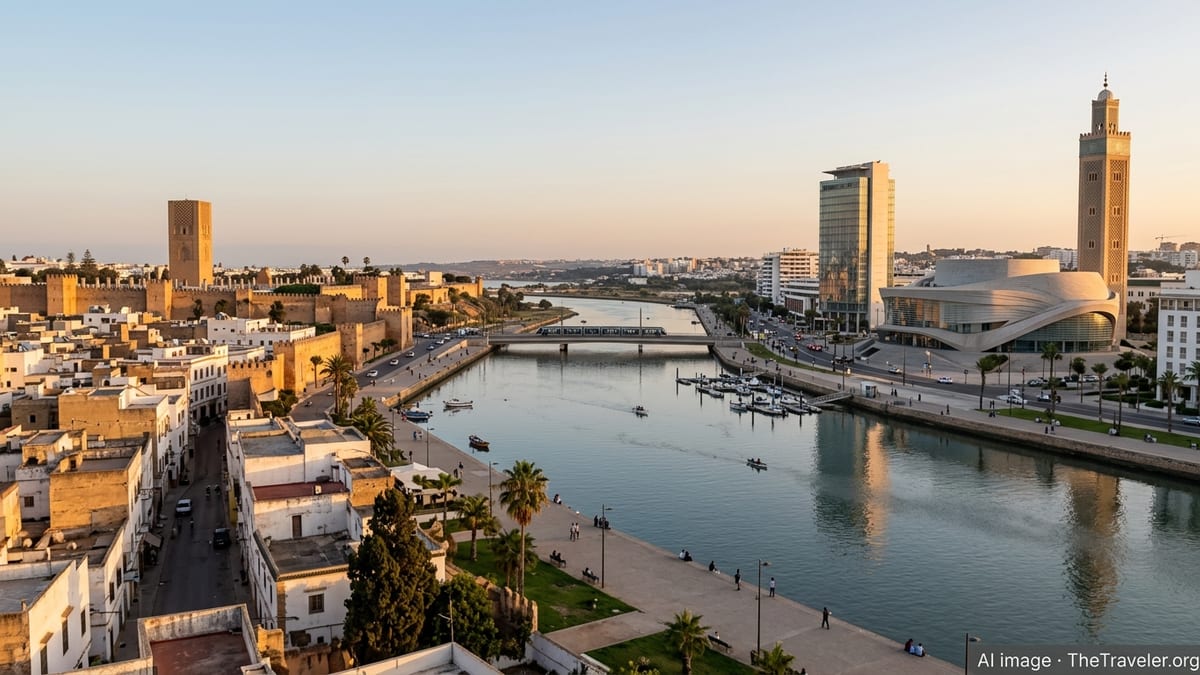
One of the clearest signs of Rabat’s transformation is along the Bouregreg River, the estuary that separates Rabat from its twin city of Salé. Urban development studies and regional investment documents describe the Bouregreg Valley as a new cultural district, featuring the Grand Théâtre de Rabat, a bold, flowing complex designed by the late architect Zaha Hadid, alongside landscaped promenades, a modern tramway, and a growing marina.
The Grand Théâtre, with its sculpted concrete shell and sweeping terrace facing the river, has been positioned as a future landmark able to host major concerts, opera, and conferences. Nearby, the Mohammed VI Tower in Salé, often cited as one of Africa’s tallest towers, has become a focal point of the skyline, designed with mixed uses including offices, hospitality, and public viewing spaces overlooking the Atlantic and the old city.
Together, these projects are changing the visual identity of Morocco’s capital region, juxtaposing minarets and fortified walls with high-rise silhouettes and contemporary cultural venues. For visitors arriving in 2026, the Bouregreg waterfront offers a concentrated snapshot of Rabat’s new direction: tram lines gliding past riverfront cafés, pedestrian bridges framing the Hassan Tower in the distance, and a skyline that signals both heritage and future ambition.
Urban planners and regional investment agencies highlight these schemes as part of a wider “City of Light” vision, aimed at positioning Rabat among the leading Mediterranean capitals. The result is an urban landscape where evening strolls along the river, boat trips, and theatre performances sit comfortably alongside visits to the medina and Chellah necropolis, expanding what a short city break can include.
Stadiums, Sporting Legacy, and the Post‑AFCON Effect
Rabat’s sporting infrastructure underwent a significant upgrade in the run-up to Morocco’s hosting of the 2025 Africa Cup of Nations, whose final was played in January 2026 at the renovated Prince Moulay Abdellah complex. Tournament documentation and subsequent media coverage describe extensive works to raise the stadium to modern standards, lifting capacity to around 68,000 spectators and integrating new access and hospitality facilities.
An additional Olympic stadium and related training facilities in the capital region have been developed as part of a broader program to prepare for major tournaments, including the 2030 FIFA World Cup. Investment figures reported in international media point to several billion dirhams allocated nationally for stadium modernization between 2023 and 2025, with Rabat featuring prominently in that portfolio.
For travelers, this infrastructure serves more than elite events. Expanded transport links, improved signage, and upgraded public spaces around stadiums tend to leave a lasting legacy for domestic leagues, concerts, and community activities. By 2026, Rabat is expected to capitalize on the post‑AFCON momentum to attract regional sports competitions, fan tourism, and mixed-use events that combine football, music, and festivals in large-scale venues.
These developments feed directly into Morocco’s tourism strategies, which increasingly market the country as a hub for major event experiences. With Rabat hosting national team matches, club fixtures, and potentially World Cup-related activities later in the decade, sports fans mapping future trips to North Africa are likely to see the capital as a natural base.
Creative Industries, Green Reputation, and the City’s Next Chapter
Beyond books and stadiums, Rabat is also being woven into Morocco’s push to grow creative and digital industries. International news coverage has highlighted plans for a dedicated “Rabat Gaming City,” part of a national initiative to expand the video game sector, train young developers, and attract global studios. Separately, a large-scale film city project announced for the outskirts of Rabat aims to capture more of the booming screen production business that has traditionally clustered around cities like Ouarzazate.
These projects complement the capital’s existing cultural infrastructure, from galleries and national museums to performance spaces tied to the city’s universities and diplomatic community. As they mature, they are expected to bring a different kind of visitor to Rabat: industry professionals, festival delegates, and students who blend business, study, and leisure, extending stays and diversifying the local tourism economy.
Rabat is also frequently cited in regional documentation as one of Morocco’s greener major cities, with significant tree cover, coastal breezes, and a tram network that links key districts without relying solely on private cars. For travelers planning 2026 trips, that translates into a relatively low-stress urban environment where many attractions, from the medina to the new waterfront, can be explored using public transport or on foot.
As Morocco refines its 2026 to 2030 tourism strategy, consultations launched by the national tourism office signal that cities like Rabat will be central to the next phase of growth. With a calendar anchored by UNESCO’s World Book Capital program, a refreshed stadium legacy, and an increasingly distinctive skyline, the Moroccan capital is moving from background player to leading character in the country’s travel story.