

Germany processes several hundred thousand visa applications every year, ranging from short-stay Schengen visas to long-stay national visas for work, study, and family reunification. While approval rates are generally high, a significant minority of applicants receive a refusal, which can delay or derail relocation plans and trigger additional costs and scrutiny on subsequent applications. Understanding the structural reasons behind German visa refusals is therefore critical for anyone evaluating whether relocation to Germany is practically feasible.
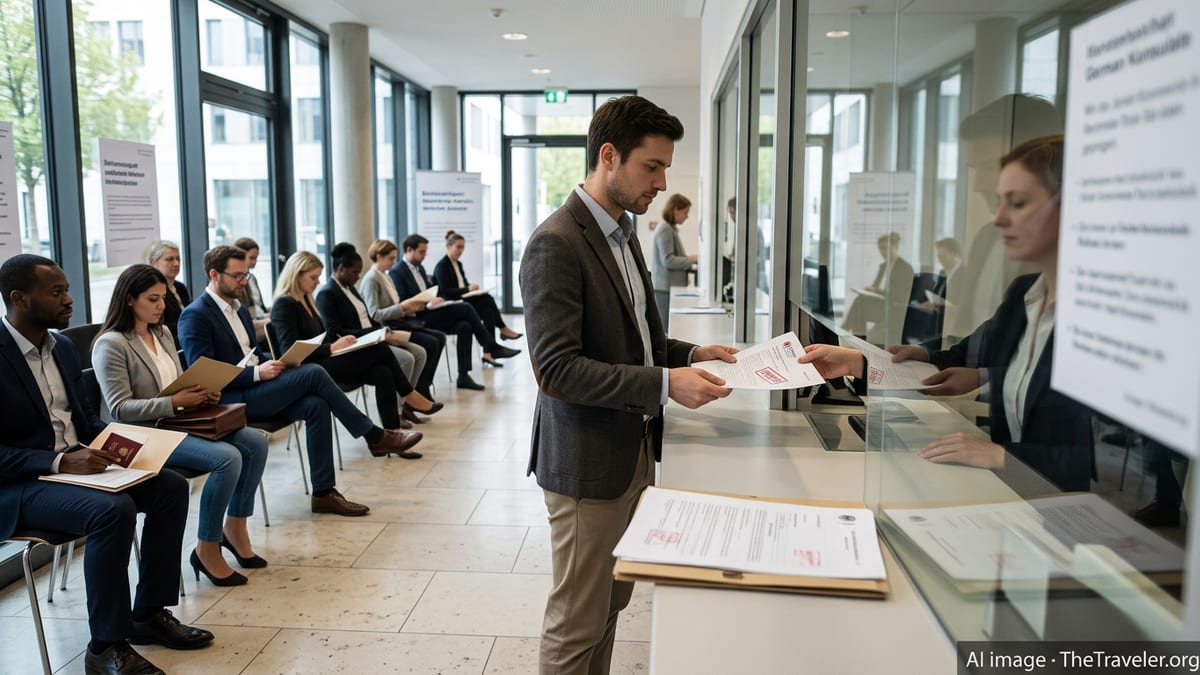
Context: How Often Germany Visa Applications Are Refused
Germany is consistently among the top Schengen states by volume of visa applications, and it also ranks high in the absolute number of refusals simply because of this scale. Across the Schengen Area, more than 1.7 million short-stay visa applications were refused in 2024, and France, Spain, and Germany together accounted for a substantial share of those negative decisions. While country-specific refusal rates fluctuate from year to year and vary by applicant nationality, it is clear that German consulates are applying Schengen and national visa rules with increasing scrutiny compared with pre‑pandemic years.
For context, many Schengen states report aggregate refusal rates in the high single digits to low double digits for short-stay visas, depending on the applicant’s country of residence. For German missions, refusal rates for some nationalities and some visa categories are significantly above that average, while others experience much lower rates. This uneven pattern means that an individual relocation plan may face quite different risk levels compared with the overall statistics often quoted in public debate.
It is also important to distinguish between Schengen visas, which cover stays of up to 90 days in any 180‑day period, and German national visas, which are a prerequisite for long-term residence permits for work, study, or family reasons. The formal grounds for refusal overlap but are not identical. Schengen refusals focus more on the credibility of short-term travel and the risk of overstay, while national visa refusals are more tightly linked to qualification recognition, financial sufficiency, and integration prospects in Germany.
From a relocation-planning perspective, the key takeaway from these figures is not that Germany is unusually restrictive, but that the system relies heavily on documentary proof and risk assessment. Applications that are incomplete, inconsistent, or poorly aligned with statutory criteria face a materially higher probability of refusal, even when the applicant’s underlying situation might qualify in principle.
Formal and Procedural Grounds for Refusal
A significant share of German visa refusals are based on formal or procedural issues rather than on a negative judgment about the applicant’s overall profile. Common grounds include incomplete application forms, missing or non-compliant documents, and failures to respect submission procedures or deadlines. For example, consulates routinely refuse applications where mandatory documents such as passport copies, biometric photos, or standardized declarations are absent or incorrectly formatted, because the legal framework obliges them to base decisions on a complete file.
Incorrect or inconsistent information is another major trigger. Even minor discrepancies between application forms, employment contracts, bank statements, and travel reservations can raise doubts about reliability. In the Schengen context, such doubts may lead to a refusal under standardized codes referring to “information submitted regarding the justification for the purpose and conditions of the intended stay not reliable” or “doubts as to the authenticity of the supporting documents.” For national visas, inconsistencies can suggest an attempt to circumvent labour market controls or residence regulations.
German consulates also apply strict rules regarding application channels and timing. Many missions outsource submission to external service providers, and appointments are allocated in fixed windows before the intended travel or start date. Late submissions, failure to appear for biometric capture, or attempts to lodge applications in a country where the applicant does not have legal residence can all result in a refusal or non-acceptance. From an operational standpoint, this allows consulates to manage heavy demand, but from the applicant’s perspective it increases the risk that logistical missteps will translate directly into a negative outcome.
These formal factors do not necessarily indicate that German authorities consider the individual a risk or unsuitable migrant. They do, however, illustrate that the visa process is document-driven and intolerant of errors. For relocation planners, this means that process management and file completeness are not administrative details but core risk variables that can materially influence whether a relocation plan proceeds on schedule.
Financial Insufficiency and Questionable Funding
Financial capacity is a central element in the assessment of both Schengen and national visa applications to Germany. For short-stay visas, consulates examine whether an applicant can credibly cover the cost of travel, accommodation, and daily living during the stay, often using indicative per‑day benchmarks that align with minimum subsistence levels in Germany. If bank statements show limited balances, irregular deposits, or recent lump-sum transfers that appear to be arranged solely for visa purposes, the application is at high risk of refusal on the basis that the means of subsistence are insufficient or not reliably proven.
For long-stay national visas, the thresholds are higher and more codified. Students are typically expected to demonstrate access to funds broadly aligned with the annual amount set for blocked accounts used by international students, while workers must present binding employment contracts that meet minimum salary levels and social-security requirements for the relevant permit type. Where income is below these benchmarks, or where employment contracts appear incomplete or vague, German missions may conclude that the stay will not be financially sustainable and refuse the visa accordingly.
Another area of concern for German authorities is the origin and traceability of funds. Large unexplained cash deposits, reliance on non-verifiable sponsors, or use of financial documents from institutions that are not widely recognized can prompt doubts about the legitimacy of the funding. In such cases, the refusal is less about the raw amount and more about risk management in relation to money laundering, undeclared employment, or future reliance on public assistance in Germany. These considerations are especially prominent in applications from regions where document fraud or informal financial practices are perceived as higher risk.
From a relocation feasibility perspective, financial refusals highlight the importance of long-term, transparent financial planning. Applicants whose funding structure relies on last‑minute transfers, informal sponsorship arrangements, or short-term loans specifically taken to inflate account balances are systematically more exposed to negative decisions, even if they intend to support themselves through future earnings once in Germany.
Unclear Purpose of Stay and Overstay Concerns
Across the Schengen Area, one of the most frequently cited reasons for visa refusal is that the purpose and conditions of the intended stay are not sufficiently justified. German consulates apply this standard rigorously. Short-stay applicants are expected to present a coherent travel plan, matching accommodation and transport bookings, and where relevant, clear documentation from business partners, conference organizers, or family hosts. Vague itineraries, implausible travel histories, or generic invitation letters can all lead to conclusions that the stated purpose is not credible.
Underlying many of these refusals is concern about overstay risk. If an applicant’s economic or family ties in their home country appear weak compared with the opportunities available in Germany, consular officers may reasonably infer a higher probability that the person will not depart at the end of an authorized stay. This is particularly relevant where an applicant’s profile suggests high incentive to work informally or to apply for protection after arrival, which would place additional pressure on Germany’s migration and asylum systems.
For national visas, the “purpose of stay” test takes a more technical form. Authorities examine whether the proposed employment, study, or family reunification is genuinely aligned with the legal category under which the visa is sought. For example, if a work visa is requested for a role that does not correspond to the applicant’s formal qualifications or that appears misclassified in terms of skill level, the consulate may suspect an attempt to bypass labour-market controls. Similarly, student visa applications where the academic credentials, language level, and study plan do not form a coherent progression may be refused due to doubts about the genuineness of the study intention.
These patterns mean that applicants whose relocation rationale is weakly documented or strategically framed primarily to meet visa criteria, rather than reflecting a transparent and well-grounded plan, are more susceptible to refusal. For organizations or families planning relocation, it is therefore important that the visa category matches the actual purpose and that the written record across all documents presents a consistent narrative.
Document Authenticity, Compliance and Background Concerns
Germany, like other Schengen states, has intensified scrutiny of document authenticity in recent years. Refusals explicitly citing doubts about the genuineness of passports, civil status records, employment letters, or bank documents are increasingly common, particularly in high-risk regions. Even when documents are not proven fraudulent, any indication that they cannot be independently verified may be sufficient for a refusal, because consular officers are required to err on the side of caution in cases of uncertainty.
Compliance with travel history and immigration rules in other countries is also a relevant factor. Prior overstays, deportations, asylum rejections, or previous visa refusals in Germany or other Schengen states can materially reduce the probability of a positive decision. While a past refusal does not automatically bar a new application, it signals elevated risk, and German authorities may treat subsequent applications from the same individual with greater scepticism, especially if the earlier concerns have not been convincingly addressed.
Security and public-order considerations form another important category of refusals. Where there is reliable information indicating involvement in serious crime, extremism, or activities considered a threat to public order, German law provides a basis for denying a visa irrespective of other qualifying factors. These cases are less common than financial or documentation-based refusals but are handled with particular strictness, and applicants often have limited options to challenge the underlying assessments, which may involve confidential information-sharing between states.
For corporate relocation planners, this environment underscores the need for careful pre-screening of candidates who will require German visas, particularly when they have complex migration histories. For individual applicants, full disclosure and consistency across all previous applications is critical; attempts to conceal prior incidents frequently lead not only to refusal but also to extended entry bans.
Category-Specific Patterns: Work, Study and Family Visas
While some refusal grounds are common across all visa types, others are more typical for specific categories relevant to relocation. For work visas, German authorities place strong emphasis on the employment contract, professional qualifications, and compliance with labour-market rules. Applications often fail because job offers do not meet salary thresholds, because the role description does not match the listed occupational classification, or because qualifications obtained abroad are not formally recognized as equivalent to German standards in regulated professions.
Student visas show a different pattern. Rejections here often relate to doubts about academic preparedness, language proficiency, or the credibility of the chosen institution or programme. In cases where admission is conditional, or where the applicant cannot provide standardized language test results at the required level, consulates may conclude that the probability of successful study completion is too low to justify entry. Financial sufficiency is also closely scrutinized in the student context, as many applicants rely on blocked accounts or sponsorship arrangements that must meet specific formal criteria.
Family reunification visas, meanwhile, are frequently refused for documentary reasons, especially where civil status documents such as marriage or birth certificates are difficult to verify or differ from German legal expectations. In some high-risk constellations, German authorities may require genetic testing or additional investigations to rule out document fraud or marriages of convenience. Processing times and refusal risks are therefore often higher than relocating families anticipate, with significant implications for relocation timelines.
These category-specific dynamics mean that headline refusal rates can be misleading when used to assess relocation feasibility. A highly qualified professional with a compliant contract and clear employer sponsorship may face relatively low refusal risk, while a self-financed student or a family member from a country with limited civil registration infrastructure may encounter significantly higher scrutiny, even if aggregate statistics suggest that “Germany approves most visas.”
The Takeaway
Germany’s visa refusal patterns reflect a system that is rules-based, document-focused, and increasingly risk-sensitive. The majority of refusals do not arise from an explicit policy decision to limit particular types of migration, but rather from the interaction between detailed legal requirements and imperfect documentation, financial structures, or travel histories. From a relocation decision-making perspective, this means that the practical feasibility of moving to Germany depends not only on substantive eligibility but also on the applicant’s capacity to assemble a coherent, verifiable, and procedurally compliant case file.
Prospective movers should therefore treat visa feasibility as a central component of relocation planning, not as an administrative afterthought. Different visa categories exhibit distinct refusal risk factors, and these need to be mapped carefully against the applicant’s profile and the documentation available in their home country. While refusals can often be addressed through reapplication or appeal, each negative decision increases cost, delays time-to-entry, and may influence how future applications are perceived.
Overall, for individuals and organisations considering Germany as a destination, the central question is not whether Germany “rejects many visas” in the abstract, but whether the specific relocation pathway in view aligns well with the evidentiary and financial standards that German consulates apply in practice. Where that alignment is strong and proactively documented, refusal risk is typically manageable. Where it is weak or fragmented, the probability of delays and denials rises significantly, and alternative destinations or timelines may need to be evaluated.
FAQ
Q1. Are Germany visa refusal rates unusually high compared with other Schengen countries?
Germany’s overall refusal levels are comparable to other high-volume Schengen states, but risk varies significantly by applicant nationality, visa category, and individual profile rather than a single uniform rate.
Q2. Does a past visa refusal in another Schengen country increase the chance of a German refusal?
Yes, a previous Schengen refusal is a negative factor and will typically be visible to German authorities; it does not automatically mean a new refusal, but it prompts closer scrutiny of the new application.
Q3. Are long-stay national visas for work or study easier to obtain than short-stay Schengen visas?
They are not inherently easier or harder; national visas are assessed against different, often more technical criteria focusing on qualifications, financial stability, and integration prospects.
Q4. Can a strong job offer alone compensate for weak financial documentation?
No. Even with a compelling job offer, German consulates usually require clear proof that salary, benefits, and any supplementary funds meet statutory thresholds and are reliably documented.
Q5. How much do minor mistakes on the application form matter?
Seemingly small inconsistencies can lead to doubts about credibility. If combined with weak supporting evidence, they may become a decisive factor in a refusal.
Q6. Does using a visa agency reduce the risk of refusal?
Using an intermediary may help with procedural steps, but consular officers assess the applicant’s situation and documents, not the agency; no third party can guarantee approval.
Q7. Are student visa applications from certain countries more likely to be rejected?
Refusal patterns do differ by region, especially where document verification is complex, but individual factors such as academic preparation and funding remain central in every case.
Q8. Can a visa be refused even if all documents on the official checklist are provided?
Yes. Checklists cover minimum documentation, but consular officers may still refuse if they find the purpose of stay, financial situation, or background information unconvincing.
Q9. Do German authorities explain the exact reason for a visa refusal?
Refusal notices generally indicate one or more standardized grounds, which provide a broad rationale but may not capture every detail of the consulate’s internal assessment.
Q10. How does a visa refusal affect future relocation plans to Germany?
A refusal can delay timelines, increase costs, and signal elevated risk in future assessments, making it essential to address the underlying issues before reapplying or exploring alternative routes.