

Residency in the United Arab Emirates is subject to tight procedural controls and multilayered background checks. While the country continues to expand its long-term and standard residence options, rejection rates remain significant across employment, family, investor and long-term “Golden” visa categories. Understanding the main reasons why applications are refused is critical for individuals and employers evaluating whether relocation to the UAE is feasible and how predictable the approval process is likely to be.
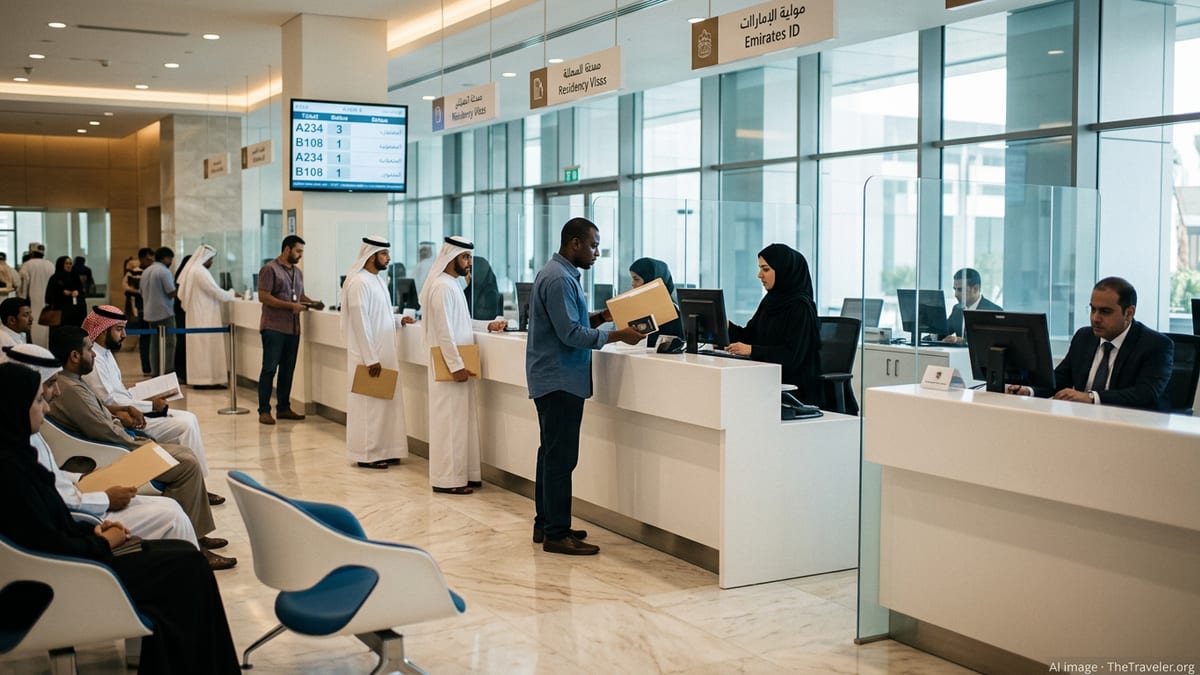
Overview of UAE Residency Screening and Decision-Making
Residency applications in the UAE are processed either by the federal identity and citizenship authority or by emirate-level residency and foreigners’ affairs departments. In all cases, decisions are based on a combination of documentary review, automated database checks and, where required, human security vetting. Authorities have broad discretion, and many rejections are issued under generic labels such as “administrative reasons” without detailed justification.
From a relocation risk perspective, applicants should expect a multi-step process. For most residency types, approval depends first on the eligibility of the sponsor or investment, then on the applicant’s own profile, and finally on technical compliance with submission standards. Failure at any of these layers can trigger an outright refusal or repeated returns for clarification that effectively delay or derail relocation.
Recent practice indicates that the most frequent rejection drivers are incomplete or inconsistent documentation, failure to meet category-specific financial or professional criteria, adverse immigration or security history, medical fitness issues, and problems on the sponsor side such as expired trade licenses or system violations. Long-term residency streams, including the Golden Visa, add a further layer of scrutiny on income, assets and track record, increasing the rejection exposure for higher-net-worth or senior professional movers.
Prospective residents therefore need to evaluate not only whether they appear to qualify on paper, but also how robustly their documentation, personal history and sponsor compliance can withstand increasingly data-driven checks before committing to a UAE relocation plan.
Documentation Accuracy and System Mismatches
Documentation quality is one of the most common and underestimated reasons for UAE residency refusal. Authorities frequently reject applications for seemingly minor issues such as unclear passport scans, missing passport cover pages, inconsistent name spellings, or incomplete form fields. Recent guidance for Dubai long-term visa applications, for example, highlights that low-resolution uploads or partially visible documents can trigger automatic rejection rather than a request for resubmission.
Data mismatches between documents are a recurring cause of refusal. Differences in the order of names, use of middle names, spelling variations between passports and educational certificates, or discrepancies between employment contracts and salary certificates often lead to database conflicts. Automated systems treating these as potential identity risks may flag the file, and case officers may opt for rejection rather than entering into prolonged clarification.
Expired or un-attested documents are another high-risk category. Residency frameworks in the UAE typically require that education certificates, marriage and birth certificates, and some professional licenses be properly legalized and, in many cases, attested locally. If degree certificates are not attested in line with current requirements or if critical documents are beyond accepted validity periods, applications for both standard and long-term residency can be declined outright.
Technical submission errors also contribute to refusals. Selecting an incorrect visa category, uploading the wrong type of document in a mandatory field, or failing to adhere to new digital requirements can result in automatic rejection codes. For relocation planning, this creates additional timing risk: even fully eligible applicants may experience multi-week delays or denial if administrative execution is weak.
Eligibility Gaps: Salary, Occupation and Investment Thresholds
A significant proportion of UAE residency applications fail because applicants or their sponsors do not meet the financial, professional or investment thresholds for the specific category. For employment and family sponsorship, each emirate publishes minimum income levels. For example, recent practice indicates that sponsoring immediate family members generally requires at least a low four-figure monthly salary in UAE dirhams, with higher thresholds for larger families or certain emirates. If salary certificates, labor contracts or bank records do not clearly demonstrate the required income, authorities frequently refuse the residency application.
For long-term residency pathways such as the Golden Visa, the criteria are higher and more complex. In the salary-based professional category, authorities have, in recent years, tightened basic salary requirements into the high five-figure range in dirhams per month, excluding allowances. Where applicants rely on property investment, the minimum real estate value is typically in the multimillion dirham range, sometimes accepting a smaller cash down-payment ratio but still expecting robust asset proof. Applications are often rejected when bank statements do not support the declared income, valuations are not accepted, or tax and asset documentation is considered insufficient.
Occupation and experience requirements also drive rejections. Professional categories are usually limited to specific job families such as managers, engineers, doctors or other skilled roles, and authorities expect job titles to match approved classifications. If an applicant’s employment contract or labor card reflects a title that falls outside the recognized list, or if they cannot demonstrate at least around two years of relevant experience in that role, authorities may consider the residency request non-compliant and issue a refusal.
Investor and entrepreneur residency applications are subject to additional viability and sustainability checks. Files can be rejected where business plans appear high risk, revenue projections are not credible, or the applicant’s financial history includes bankruptcies, unresolved debt disputes or similar red flags. For individuals evaluating a move tied to new business formation, these factors substantially increase the unpredictability of residency outcomes.
Immigration History, Security Screening and Blacklist Issues
Beyond formal eligibility, the UAE conducts extensive immigration and security screening that can override otherwise compliant applications. One major rejection driver is the presence of an active or unresolved immigration file. If a previous UAE residence, employment or student visa was not properly cancelled, new residency applications may be automatically blocked until the record is closed. This is particularly common for applicants who left the UAE years earlier without formally cancelling their prior visas.
Past visa violations also carry significant weight. Histories of overstay, working without authorization, or breaching sponsorship conditions can result in the applicant being placed on internal watchlists. When such records are detected during application processing, authorities may refuse new residency requests, sometimes without specifying detailed reasons beyond internal codes. Applicants with unpaid fines, unresolved exit issues or prior deportation orders face a high likelihood of refusal even if current documentation is otherwise in order.
Security and criminal background screening operates at multiple levels and is largely opaque. Applications may be refused where records indicate serious criminal convictions, outstanding law enforcement alerts or broader security concerns. In such cases, authorities rarely provide explicit justification, citing internal procedures. Once an applicant is associated with such a flag, repeated reapplications generally do not succeed unless the underlying issue is resolved through judicial or administrative channels.
For relocation planners, the key implication is that a clean record in the applicant’s home country is necessary but not sufficient. Any prior UAE stay, even short-term, should be carefully reviewed for compliance, and individuals should anticipate that historical issues will resurface in today’s more integrated immigration databases.
Medical Fitness, Health Coverage and Biometric Compliance
Most UAE residency categories require applicants to pass a medical fitness examination at an approved government or authorized medical center. The standard screening typically focuses on communicable diseases such as tuberculosis and HIV, along with chest imaging and blood tests. Failure to meet these health benchmarks usually results in automatic rejection of the residency application, and in some cases, applicants may be required to leave the country.
Medical rejections can occur even when conditions are treatable if they fall within categories that UAE public health regulations consider incompatible with residency. Additionally, incomplete or inconsistent medical records, or undergoing tests at non-recognized facilities, can result in authorities treating the applicant as unfit due to non-compliance rather than the underlying health status. For dependants and long-term visa categories, lack of valid UAE-based medical insurance is increasingly cited as a reason for refusal or for not issuing the final residency permit.
Biometric enrollment is another mandatory element in the residency process. Applicants must complete fingerprinting and biometric capture aligned with their Emirates ID issuance. Missed biometric appointments, poor-quality fingerprints, or data mismatches between biometric records and passport data can stall or derail applications. In some cases, repeated biometric failures can lead authorities to terminate the file rather than continue manual intervention.
From a relocation standpoint, this means that applicants with known health issues or prior inconclusive medical tests should factor additional time and risk into their planning. They should also anticipate the need for compliant health insurance solutions where required by specific visa categories or emirate-level regulations.
Sponsor, Employer and Corporate Compliance Risks
In the UAE, almost all residency pathways depend on a sponsor, whether an employer, free zone authority, local partner, or family member. Even when the applicant is fully compliant, weaknesses on the sponsor side are a frequent cause of rejection. Authorities routinely refuse applications if the sponsoring company’s trade license has expired, if establishment or immigration cards are not renewed, or if the entity has outstanding fines or labor violations recorded in government systems.
Employment-based residency applications are particularly sensitive to employer compliance history. If a company has labor bans, a pattern of contract violations, or is under investigation, new residence applications tied to that entity may be frozen or rejected. For foreign professionals, this translates into an additional due diligence requirement on prospective employers, as their compliance posture directly affects the likelihood of securing and maintaining residency.
Investor and partner residency streams can be declined when shareholder structures or corporate documents are considered inconsistent or high-risk. Rejections have been reported where share capital is not properly recorded, where there are recent abrupt changes in shareholders, or where the business activity does not align with the visa category being requested. Authorities can also refuse applications when the relationship between individual and sponsor appears artificial or created primarily for the purpose of obtaining residency, for example through questionable employment contracts without genuine job duties.
Family sponsorship is similarly affected by sponsor status. If the sponsoring relative loses their own residency status, falls below required income thresholds, or accumulates immigration or legal violations, dependants’ applications may be rejected or not renewed. For families assessing relocation to the UAE, the sustainability of the main sponsor’s employment or business position is therefore a central risk factor.
Long-Term Residency and Golden Visa Specific Pitfalls
Long-term residency schemes in the UAE, including the Golden Visa, have become important tools for attracting investors, senior professionals and high-achieving individuals. However, rejection rates for these programs tend to be higher than for standard work or family visas due to stricter criteria and more granular verification. Authorities scrutinize not just whether the headline criteria appear met, but also whether supporting evidence is robust and consistent over time.
Common reasons for long-term visa rejection include inadequate proof of assets or investments, insufficient or unstable income histories, and incomplete tax or financial documentation where applicable. For investors, authorities may assess whether the declared investment is truly at risk and whether the business or property is genuinely controlled by the applicant. Files that rely on highly leveraged structures, unverified valuations, or complex arrangements that obscure ownership can be assessed as non-compliant.
Professional and talent-based categories face their own rejection patterns. Applications may be refused when academic degrees are not in a relevant field, are not properly attested, or come from institutions that are not recognized at the required level. Authorities may also conclude that professional achievements or rankings do not meet the threshold for “exceptional” or “top talent” designations, particularly where the applicant cannot produce credible third-party verification or government nominations.
Procedural and technical issues are also common in long-term residency refusals. These include submitting salary certificates that reference total compensation instead of basic salary where basic salary is the qualifying metric, failing to clear outstanding traffic or administrative fines before applying, or omitting newly required documents like passport cover page scans. Because long-term visas often require higher fees and more extensive documentation, errors carry a greater financial and timing impact for relocating individuals and their families.
The Takeaway
Across all categories, UAE residency applications are rejected most often for preventable reasons: incomplete or inconsistent documentation, failure to meet clearly defined income or investment thresholds, unresolved immigration or legal history, and weaknesses on the sponsor or employer side. Additional layers of risk arise from medical fitness requirements, health insurance obligations, and increasingly detailed verification for long-term residency schemes.
For individuals and organizations evaluating relocation to the UAE, the key is to treat residency not as a simple formality but as a structured risk process. Decision-grade preparation involves validating eligibility against current category rules, ensuring documentation is precise and fully attested, auditing any prior UAE immigration history, and carefully assessing the compliance standing of the intended sponsor or employer.
While ultimate decisions remain at the discretion of UAE authorities and some refusals occur for opaque internal reasons, many negative outcomes can be anticipated and mitigated. Those who approach residency applications with the same level of diligence applied to major financial or career decisions are more likely to achieve predictable, positive results and to determine realistically whether a UAE move is operationally viable for themselves and their dependants.
FAQ
Q1. What is the most common reason UAE residency applications are rejected?
The most frequent triggers are documentation problems such as unclear passport scans, missing or expired documents, inconsistent name spellings, and incorrect data entries, followed closely by failure to meet income or category-specific eligibility thresholds.
Q2. Can a clean criminal record still result in a UAE residency refusal?
Yes. Even with no criminal history, applications can be rejected due to immigration violations such as previous overstays, unresolved fines, uncancelled old visas, sponsor non-compliance, or purely technical submission errors.
Q3. How much does salary matter for residency approval in the UAE?
Salary is central for employment and family sponsorship categories. Authorities look at basic monthly income recorded in official systems and supporting bank statements, and if it falls below the threshold for the specific category, residency is often refused.
Q4. Are Golden Visa and other long-term residency applications more likely to be rejected?
They are generally subject to stricter scrutiny. Authorities verify income stability, asset ownership, business viability and professional status in more depth, which increases the likelihood of refusal where evidence is incomplete or marginal.
Q5. Can medical issues lead to automatic denial of a UAE residence permit?
Certain communicable diseases and failure to pass the mandated medical fitness exam at approved centers typically result in automatic rejection, regardless of other eligibility factors, and may require the applicant to leave the country.
Q6. What sponsor-related issues can cause a residency application to fail?
Applications are commonly refused if the sponsoring company has an expired trade license, unpaid fines, labor violations, or inactive establishment cards, or if the sponsor’s own residency and income no longer meet requirements.
Q7. Is it possible to reapply after a UAE residency rejection?
In many cases reapplication is possible, especially where the refusal was due to documentation or technical issues. However, if the rejection is linked to security concerns, serious immigration violations or blacklist entries, reapplying without resolving the underlying issue is unlikely to succeed.
Q8. How do name or date-of-birth discrepancies affect residency decisions?
Even small discrepancies between passports, certificates and application forms can create system mismatches that result in rejections. Authorities may treat unexplained differences as potential identity or fraud risks.
Q9. Do unpaid traffic or administrative fines affect residency approval?
Yes. In recent practice, outstanding fines, including traffic penalties, can delay or block residency issuance, particularly for long-term visa categories, until all amounts are settled and cleared in government systems.
Q10. What should an employer or applicant do before starting a UAE residency process?
They should confirm that all eligibility thresholds are met, ensure company and sponsor records are fully compliant, gather properly attested and current documents, check for any historical immigration issues, and follow the latest technical submission requirements to reduce the risk of rejection.