

More news on this day
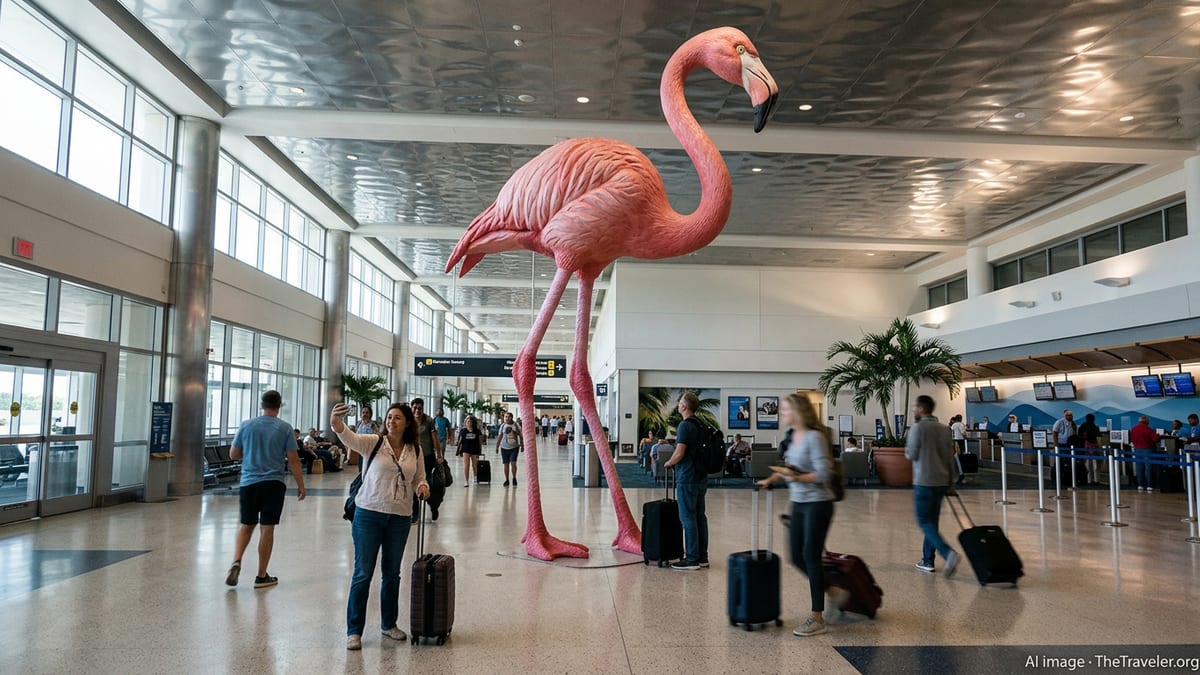
At Tampa International Airport, one of the busiest crossroads in Florida tourism, a 21-foot-tall flamingo named Phoebe has quietly become the airport’s unlikeliest celebrity, turning a once-ordinary terminal into a must-stop attraction for travelers from around the world.
Get the latest news straight to your inbox!
From Public Art Experiment to Viral Airport Star
Installed in the main terminal in 2022, the towering pink flamingo sculpture is officially titled “HOME” by artist Matthew Mazzotta, but it is better known by its nickname, Phoebe. The immersive work appears to show a life-sized flamingo bending down to dip its head beneath the surface of an imagined pool, with reflective ceiling panels and clever lighting completing the illusion of shimmering water overhead.
The piece was selected from hundreds of proposals submitted to Tampa International Airport’s public art program, part of a broader push to make the terminal feel more like a civic living room than a waystation. Airport officials invested heavily in the project, betting that a single, bold artwork could redefine the feel of the central hub and create a strong sense of place for visitors arriving in Florida.
Early reactions confirmed that the gamble paid off. Even before the installation was fully complete, photos of the giant bird’s legs and neck emerging from the floor began circulating widely on social media. Within months of the sculpture’s unveiling, it had become one of the most recognizable images associated with Tampa International Airport and a frequent backdrop in travelers’ vacation photo albums.
Today, airport staff say it is rare to walk through the terminal without seeing people clustering around the flamingo for selfies, family photos or quick videos. For many travelers, meeting Phoebe is now as much a part of flying through Tampa as picking up baggage or grabbing a Cuban sandwich before boarding.
How a Naming Contest Helped Create a Mascot
Phoebe’s rise from intriguing artwork to full-blown mascot began in earnest with an international naming contest announced in late 2022. The airport invited the public to submit their ideas for what to call the sculpture, and more than 65,000 suggestions poured in from across the globe. After weeks of voting and spirited debate, the name Phoebe emerged as the winner in early 2023.
The contest did more than settle on a moniker. It sparked a wave of engagement that made travelers feel personally invested in the flamingo’s story. Social media channels filled with jokes, campaign-style pleas for favorite names and snapshots of fans posing with the artwork while holding homemade signs. Even critics of the shortlisted options often admitted they had grown unexpectedly attached to the bird in the process.
Once the name was announced, the airport’s marketing and public affairs teams leaned into Phoebe’s newfound fame. The flamingo began appearing in playful campaigns highlighting Tampa International’s nonstop destinations and amenities, often presented as if Phoebe were an enthusiastic traveler herself. The character now turns up in seasonal promotions, children’s activities and race swag for the airport’s charity 5K, where flamingo-themed prizes are a regular draw.
The result is that Phoebe functions much like a sports mascot or theme-park character, even though the original artwork was conceived as a piece of fine art. By embracing the public’s affection for the sculpture, Tampa International has turned it into a flexible symbol that can carry messages about tourism, community and the airport’s evolving identity.
A Stress Reliever in the Middle of the Terminal
While the sculpture’s size and novelty make it an obvious photo opportunity, many passengers say the real appeal of Phoebe is emotional. Airports are often associated with delays, crowds and tension. In that environment, a whimsical flamingo bending into an imaginary pool offers an unexpected moment of calm and humor.
Airport officials and art curators note that people frequently describe the sculpture as soothing and even meditative. Travelers pause under the reflective “water” to look up at the dappled light, or lean against the low railing to watch other people interact with the piece. Families with young children use it as a distraction during long layovers, while solo travelers are often seen quietly taking it in from a distance before heading to security.
The artwork’s hyperrealistic textures and gentle lighting contribute to that effect. Rather than a flashy, high-tech installation, Phoebe feels tactile and almost familiar, echoing the flamingo motifs that appear across Florida souvenirs and signage. That sense of recognition helps ease anxiety for visitors who may be arriving in the state for the first time, turning a potentially stressful space into something playful and welcoming.
For Tampa International, those softer benefits align neatly with broader industry research showing that thoughtful design and public art can improve wayfinding, reduce traveler stress and even influence how passengers rate their overall airport experience. Phoebe has become a case study in how a single, well-placed piece can shift the mood of an entire terminal.
International Recognition and Copycat Attention
Phoebe’s impact has not been limited to Tampa. In 2023, the sculpture earned a major international public art prize, winning in the transportation category of a prominent global competition and securing a People’s Choice honor after thousands of online votes. Judges praised the way the work combines visual whimsy with a site-specific concept tied to Florida’s ecology and the experience of flight.
The award amplified attention from other airports and cultural institutions looking to modernize their public spaces. In the time since, artist Matthew Mazzotta has been commissioned to create new large-scale works for other transportation hubs, including a vast jellyfish-themed piece at San Diego International Airport. Design observers frequently reference Phoebe when discussing the growing trend of using signature artworks as landmarks and orientation points within sprawling terminals.
The sculpture’s success has also dovetailed with a wider resurgence of interest in Florida’s native wildlife, particularly as scientists revisit long-held assumptions about the state’s wild flamingo populations. For many visitors, the connection is informal: they simply associate the bird with the sunshine, beaches and tropical imagery that dominate Florida tourism marketing. Yet the artwork’s title, “HOME,” invites a deeper reading about where flamingos truly belong and how people share space with animals along migration routes.
By bridging those layers of meaning, Phoebe manages to satisfy both casual observers who just want a fun backdrop and art enthusiasts who come looking for more. That balance of accessibility and concept has helped solidify the flamingo’s standing in the crowded field of airport art, where pieces often struggle to hold the attention of distracted travelers.
Shaping the Future of the Passenger Experience
Three years after Phoebe first stretched her bright pink legs across the floor of Tampa International’s main terminal, the sculpture is now woven into the daily rhythm of the airport. Staff use it as a meeting point, airlines reference it in social posts, and local tourism groups routinely tell visitors to build in extra time just to see the giant flamingo before their flights.
The airport has responded by integrating Phoebe into more of its programming, from behind-the-scenes tours to the revived TPA All Access passes that let non-ticketed guests visit the airside areas on select days. For many locals, a visit to the airport to see the flamingo has become a casual weekend outing, particularly for families with children who are fascinated by the scale of the artwork.
Industry analysts say this kind of destination-in-its-own-right thinking points to where airport design is heading. As competition for passengers intensifies, airports are leaning on architecture, art and hospitality to stand out. Signature pieces like Phoebe serve not only as visual anchors but also as social-media-ready symbols that can travel far beyond the terminal, shaping how an airport is perceived around the world.
For now, Tampa International shows no sign of retiring its unexpected star. As new gates and facilities come online over the next few years, officials point to Phoebe as proof that thoughtfully chosen public art can resonate with both hurried business travelers and vacationers in flip-flops. In a space defined by arriving and departing, the giant flamingo has given Tampa’s airport something rare in modern air travel: a shared, joyful moment that most people are happy to linger in, even when their boarding group has already been called.