

More news on this day
For many travelers, a delay notification feels the same whether it is caused by a summer thunderstorm or a missing crew member. In practice, the reason behind your disruption can shape everything from your legal rights to how you plan your next trip, and governments and airlines are putting new emphasis on spelling that out in plain language.
Get the latest news straight to your inbox!
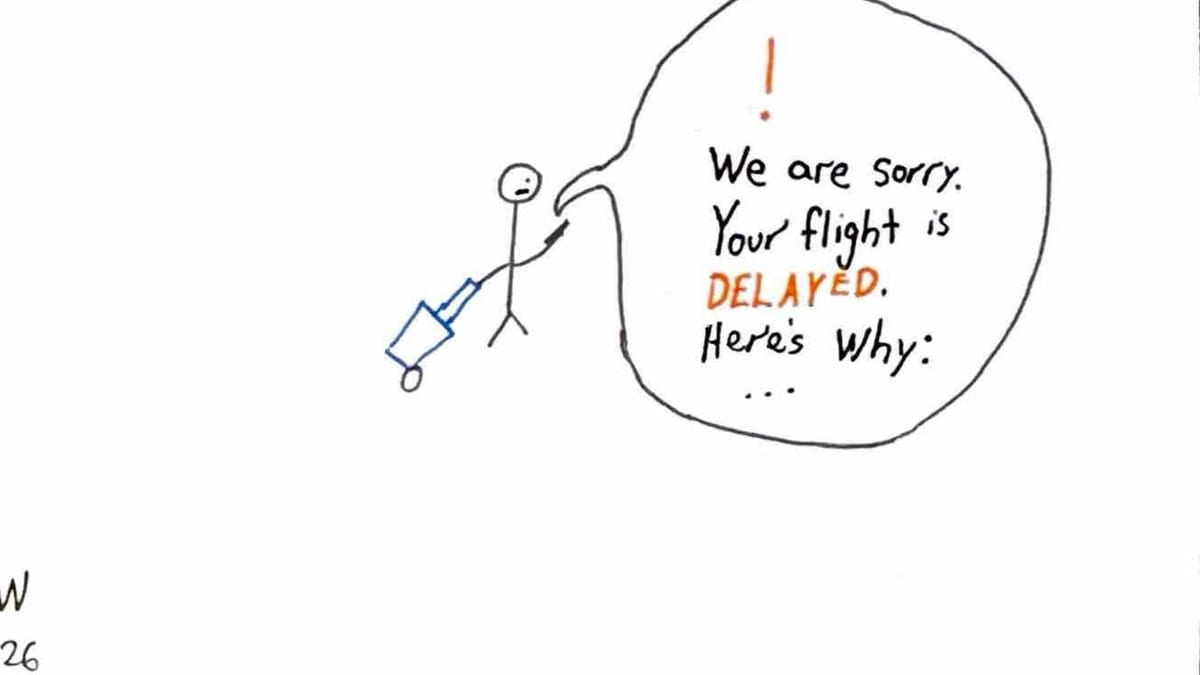
Image by USA Today
Not All Delays Are Treated Equally
Publicly available data from the United States Department of Transportation groups delays into specific buckets, including airline-controlled issues such as crew or maintenance, national aviation system constraints like congestion or air traffic control, extreme weather, security, and late-arriving aircraft. Similar breakdowns appear in European and UK statistics, where regulators distinguish between ordinary operational problems and "extraordinary" events outside an airline’s control.
This categorization has real consequences. Under rules modeled on Europe’s air passenger rights framework, long delays caused by factors within an airline’s control can trigger compensation, meal and hotel vouchers or free rebooking, while the same length of delay caused by severe weather may only entitle passengers to a later seat. Reports on EU261 enforcement, for example, note that compensation typically applies when delays exceed three hours on arrival and are not linked to extraordinary circumstances.
In the United States, the federal Airline Cancellation and Delay Dashboard highlights what each carrier voluntarily promises to provide during controllable disruptions. Travel industry summaries of the dashboard emphasize that amenities such as meal vouchers, hotel accommodation or ground transportation are usually only guaranteed when the cause is squarely the airline’s responsibility, such as staffing shortages or mechanical problems, making the reason for the delay central to what support passengers receive.
For travelers, understanding these categories can be the difference between accepting a generic apology and confidently requesting specific assistance. Without clarity on the cause, it becomes much more difficult to know whether it is worth pursuing refunds, asserting compensation rights under foreign rules, or rebooking independently.
Transparency Shapes Trust and Satisfaction
Academic research into service delays consistently finds that uncertainty and lack of explanation can amplify frustration. Studies of airline passengers’ emotional reactions to delays conclude that when travelers are left guessing about what is happening, they tend to rate the overall experience more harshly and are less likely to book the same airline again, even when the length of the delay is moderate.
Recent work examining online reviews and passenger feedback has reinforced this pattern, highlighting the importance of clear communication during disruptions. One study published in 2025 used large datasets of airline reviews to show that passengers often focus less on the delay itself and more on how the problem was handled, including whether information was shared proactively and whether the stated reasons felt credible.
Air travel performance reports from both sides of the Atlantic suggest that delays remain a persistent feature of modern aviation, particularly during peak travel seasons and at congested hubs. Against that backdrop, communication has become a key differentiator. Airlines that regularly provide specific, timely explanations and updates are more likely to retain customer goodwill than those that issue only vague announcements.
For travelers, pressing for a clear reason is not just about curiosity. It can reduce anxiety, allow better decisions about missed connections, and influence whether a disruption is remembered as a tolerable inconvenience or an avoidable failure. In an era when passenger expectations are rising, the narrative around a delay can matter almost as much as the timetable.
Data That Informs Future Travel Decisions
Knowing why a flight was delayed also feeds into a growing universe of public performance statistics. Monthly air travel consumer reports in the United States, for instance, break down how many minutes of delay each carrier racks up in each category, while European air traffic management reviews analyze how capacity constraints and staffing affect en route delays at different control centers.
Independent analyses that draw on these datasets have become increasingly common. Recent data projects using tens of millions of domestic flight records show how the share of delay minutes attributable to carrier-controlled factors has evolved, and which airports or airlines are more frequently affected by particular causes. Travel industry reports have begun to translate these technical numbers into consumer-friendly rankings and forecasts.
For individual travelers, this information can shape route planning in very practical ways. Understanding that certain hubs are especially vulnerable to weather-related disruptions in specific months, or that a preferred carrier has a higher proportion of carrier-caused delays on particular routes, can guide choices about connection times, departure times of day, or whether to build in an overnight stop.
Crucially, these data-driven insights rely on accurate reporting of delay causes. When reasons are recorded generically or inconsistently, the value of historical statistics for predicting future reliability diminishes. Clear, standardized categories benefit not only regulators and analysts but also anyone trying to choose the most dependable option for a tight connection or an important meeting.
Rights, Refunds and the Language of Responsibility
The growing emphasis on clearly defined delay causes is closely tied to passenger rights frameworks. In Europe and the UK, case law interpreting air passenger regulations has repeatedly turned on whether an airline’s explanation qualifies as an extraordinary circumstance. Disputes have arisen over what counts as a technical defect outside an airline’s control versus a routine maintenance problem that should have been anticipated.
In the United States, recent policy debates and rulemaking efforts have focused on making it easier for passengers to claim refunds when airlines cancel or significantly change flights. Consumer advocates point out that when disruptions are blamed on weather or air traffic control without detailed evidence, travelers may be discouraged from seeking refunds or filing complaints, even in situations where internal issues played a role.
Following several high profile disruption events, including large scale schedule collapses linked to technology failures and crew shortages, public coverage has highlighted the tension between how airlines initially describe the cause and how regulators later classify it. These episodes illustrate why the specific wording of delay reasons matters, and how it can affect whether events are treated as within an airline’s control.
For passengers, carefully noting the stated reason and how it may change over time can strengthen any later claim with an airline, credit card provider or regulator. Screenshots of airline apps, notifications and airport display boards, combined with a basic understanding of the main delay categories, can turn a frustrating experience into a well documented case.
What Travelers Can Do With Better Explanations
As governments push for more transparent reporting and airlines refine their disruption playbooks, travelers are gaining more tools to act on the reasons behind delays. Knowing that a problem is rooted in widespread airspace restrictions may prompt a traveler to stay put and rely on automatic rebooking, while a carrier controlled mechanical issue might justify asking for meal vouchers, exploring alternative routings on partner airlines or invoking protections under foreign regulations.
Real time awareness of why a delay is occurring also allows passengers to make smarter decisions outside the airport. Understanding that a late arriving aircraft is likely to trigger a missed connection could influence whether to hold on to nonrefundable hotel reservations, adjust ground transport plans or notify employers and family members earlier.
In the longer term, the accumulation of clearly labeled disruption experiences helps travelers calibrate their own risk tolerance. Some may accept a higher chance of weather related delays in exchange for a scenic seasonal route, while others prioritize carriers and itineraries that have historically demonstrated strong performance on carrier controlled factors. In each case, the specific reason attached to a delay transforms a generic inconvenience into actionable information.
Flight delays are unlikely to disappear from modern air travel, but the way they are explained is changing. As regulators, airlines and data analysts converge on clearer categories and more candid communication, travelers who pay attention to the real reasons behind disruptions will be better positioned to protect their rights, manage their time and choose how they fly.