

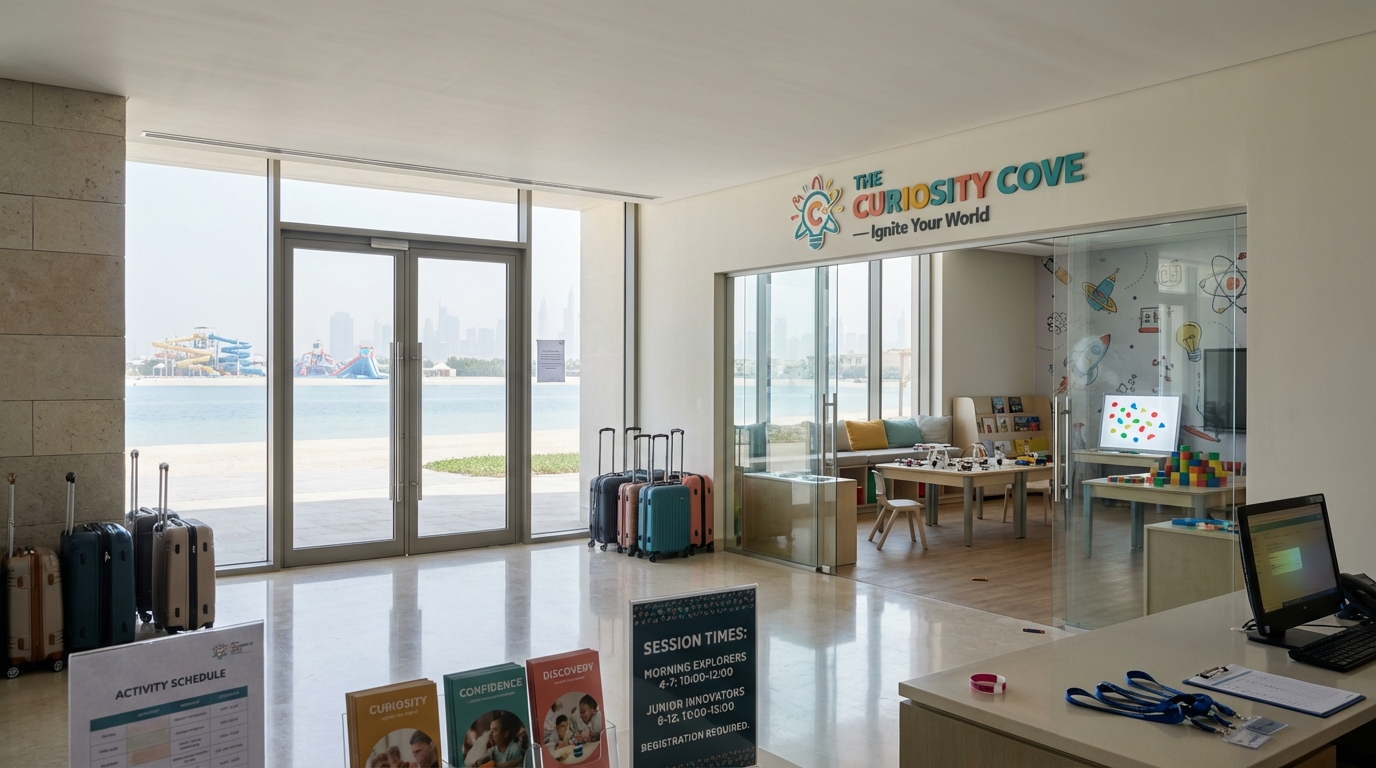
The scene feels familiar at first. A family steps into a bright, sea-facing lobby, bags trailing, eyes already drifting toward the curve of the beach outside. Children clock the promise of a kids’ club before anyone has even found the room key.
For many, this has become the real marker of arrival in Dubai: not the view, not the skyline, but the question of what the hotel has planned for their children.
Yet something about this ritual has begun to feel less predictable. Parents arrive with a loose idea of what a kids’ club is supposed to be, only to discover a space that looks less like casual childcare and more like a compact, curated museum for young guests.
The promise of “play” has expanded into a full vocabulary of tinkering, building, experimenting and sensory exploration, shaped by designers who usually work in dedicated children’s museums rather than hotel basements.
In waterfront districts across the city, family resorts are quietly competing over who can turn childhood curiosity into the most elaborate in-house experience.
What used to be a small room with soft mats and a television has, in many properties, evolved into a carefully staged environment where children build contraptions with motors, experiment with light and color, and move through zones that feel themed around science, art and motion. The kids’ club has shifted from side attraction to central storyline of the stay.
This change can catch travelers off guard. Many adults arrive expecting the old model: a safe space with some toys and maybe face painting. Instead, they find a program that expects children to navigate workshops, rotating activities and semi-structured sessions.
The result is a new kind of pressure that parents quietly describe: the sense that if their child does not engage fully, they are somehow missing the “point” of the hotel.
Family-focused properties in Dubai have leaned into a narrative of enrichment. The language that surrounds these clubs now emphasizes curiosity, confidence, imagination and hands-on discovery.
The kids’ spaces are framed less as a convenience and more as an educational journey set against a backdrop of sun, sea and skyline. It is a way of reassuring parents that time spent away from them is still time well spent.
On the ground, the experience can be more mixed. Some children thrive in richly designed spaces, turning every visit into a burst of independent exploration. Others simply want unstructured play or quiet water time, and can feel overwhelmed by rooms that seem to demand engagement.
The more sophisticated the design, the easier it becomes for a simple request to “go play for a bit” to transform into a full block of the day that needs to be negotiated and understood.
In parts of the beachfront strip, there is also a growing blur between the kids’ club and the rest of the resort. Museum-style installations, themed corners and interactive objects spill out toward family pools and shaded terraces.
Children drift between building something indoors and racing out to the water slides next door, while staff try to keep track of who is checked into which program and when. For parents used to a clear boundary between supervised club time and general pool time, the new layouts can feel disorienting.
Many properties frame these developments as a response to what families ask for: more meaningful play, more variety, more reasons for children to remember a particular stay. In practice, though, some travelers describe a quieter reality in which parents and children are trying to decode the rules of engagement.
Which activities are drop-off and which require an adult nearby. Which sessions are included in the stay and which carry an extra cost. Which age brackets apply to which zone, especially when siblings fall on opposite sides of a cut-off.
There is also an emerging social layer. Children who are used to interactive museums and structured after-school programs often slip seamlessly into these new kids’ clubs, treating them as extensions of home routines.
Others, visiting from places where such spaces are rare, can feel like they have stepped into a carefully choreographed world without a script. Staff move constantly between calming shy newcomers and managing seasoned “regulars” who know exactly where everything is and how it works.
A subtle tension appears around time. Resort messaging frequently paints the kids’ club as a place where children will want to spend long stretches of the day, leaving adults with rare hours of quiet by the pool or in nearby lounges.
On busy days, however, some families encounter capacity limits, rotating time slots or partial closures as teams reset activity areas. The promise of endless access can shrink into shorter, carefully managed windows that require families to adjust their rhythms.
These patterns create a particular form of uncertainty. Parents no longer wonder whether there will be anything for children to do. Instead, they try to understand how central the kids’ space will become to their entire stay.
Children absorb that same uncertainty, quickly learning that the story of their trip hinges less on the room or the beach, and more on what happens inside a brightly colored room bearing a whimsical name.
In this environment, the meaning of a “child-friendly” hotel in Dubai is shifting. It is less about tolerating the presence of young guests and more about building a full narrative for them, often in partnership with creative studios that specialize in learning through play.
The kids’ club becomes both stage and script, shaping how families remember their time by the water and what they expect from future stays elsewhere.
The result is a city where traveling with children feels more curated, but also more complex. Every new renovation or concept space raises the bar for what a family resort experience is supposed to look like, even as some guests quietly miss the simplicity of a playground and a pool.
For now, the story remains unfinished: parents arrive with familiar hopes, children step through another set of colorful doors, and each stay becomes one more attempt to navigate a version of family travel that keeps reinventing itself in the background.