

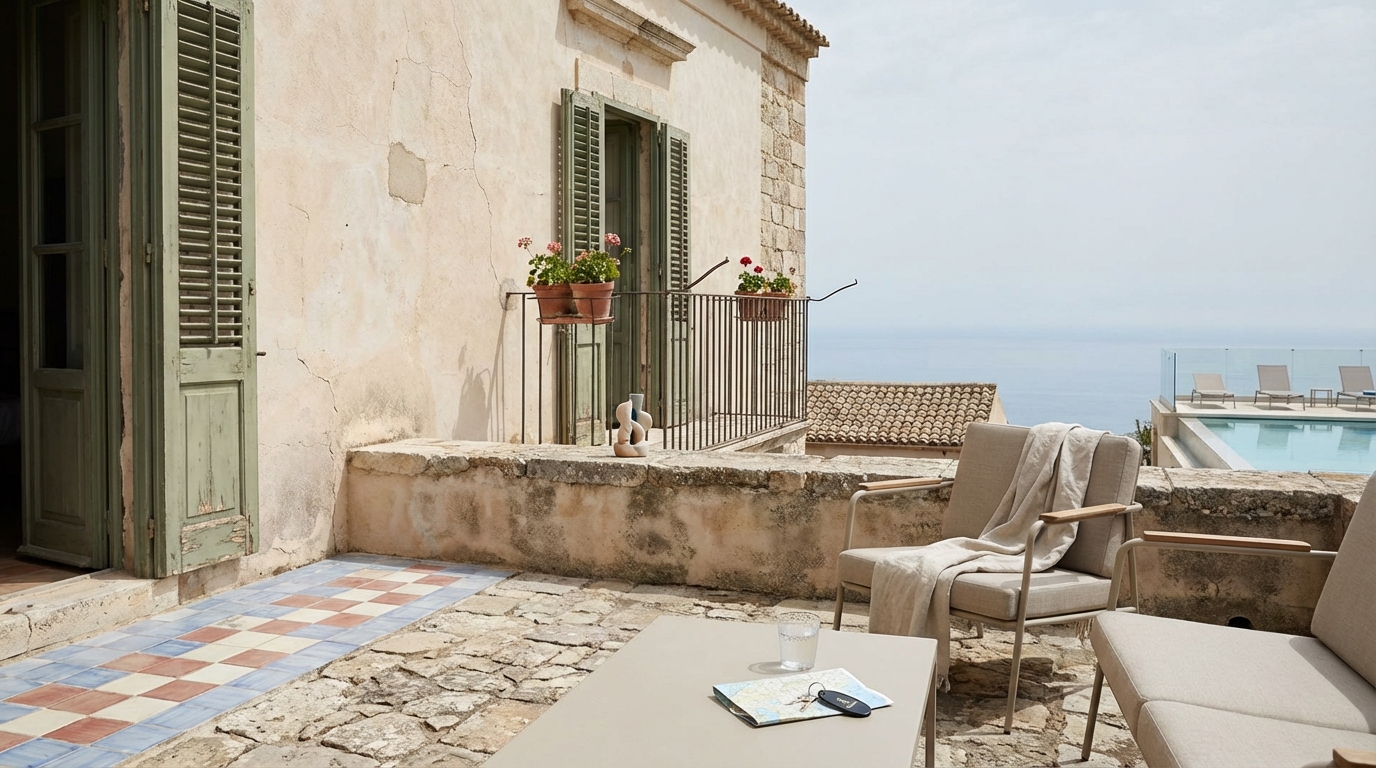
There is a particular kind of arrival that many travelers still picture in their minds when they think of Sicily. A stone villa, a view that runs all the way from tiled rooftops to a strip of sea, a sense that the place has been there forever and will outlast whatever is happening elsewhere.
Yet those same travelers now increasingly discover that this old-world image comes wrapped in a careful layer of design language and brand storytelling that did not use to be there.
Check into certain hilltop residences today and the welcome feels different. The bones are familiar, with frescoed ceilings, heavy doors and fragments of aristocratic life, but the rooms tell a softer, curated story.
Local ceramics are arranged like gallery pieces, fabrics are described in the language of collaborations, and a house that once might have been introduced as a family palazzo is now framed as a “noble home” interpreted through a contemporary lens.
This shift is especially visible in corners of Sicily that have long been associated with mythology, literature and a very specific idea of Mediterranean glamour. In parts of the island, travelers stepping into a villa or small annex near a grand hotel notice that heritage is no longer presented as a static backdrop.
It has become an aesthetic material in its own right, something designers and brands rework to produce a feeling of slowness, privacy and intimacy, even when the property is closely linked to a larger resort machine.
Many visitors are caught off guard by how deliberate this feels. They arrive expecting a “classic” hotel or a rustic guesthouse, and instead encounter a hybrid space. Hand-painted tiles sit beside mid-century silhouettes, antiques are placed alongside conspicuously new pieces, and every object seems to carry a story about craft or provenance.
The experience can feel carefully staged, an edited version of Sicilian life that promises authenticity while also smoothing away anything that might read as rough or unpredictable.
Part of the surprise comes from the way these places are now talked about long before anyone sets foot inside. Heritage is framed less as a simple matter of age and more as a narrative to be “reimagined” or “reenchanted.”
Travelers see phrases that evoke slowness, sanctuary and noble domesticity, and they build expectations around that language. When they arrive, the contrast between the marketing vocabulary and the lived texture of the house creates a low, persistent tension.
In this pattern, operators tend to present themselves as guardians of memory who also understand contemporary comfort. They emphasize that historical stones and views remain untouched, that local artisans are central, and that design decisions were taken to honor the island’s layered past.
At the same time, they lean heavily on signals of international luxury: named designers, collectible furniture, spa partnerships just steps away, and the suggestion that every corner has been calibrated for a certain type of photograph or gathering.
On paper, the arrangement seems tidy. A once-private villa becomes an intimate extension of a larger hotel, offering both seclusion and complete access. Rooms can be taken individually or all at once, the pool is described as private yet visually continuous with dramatic coastal scenery, and the bar is framed as a lounge that could host a quiet aperitivo as easily as a curated event.
The messaging reassures travelers that they are stepping into a secluded world that still connects, invisibly, to a powerful hospitality infrastructure.
In practice, the experience is more ambiguous. Some guests feel they are entering a home carefully edited for them, where even the imperfections look intentional. Others sense the weight of orchestration. The presence of a neighboring main hotel, with its terraces, restaurants and branded wellness spaces, can blur the line between private retreat and annex.
A traveler may wake to birdsong and old stone, then notice that every textile, lamp and tile aligns with a global design narrative that could reappear in another destination with similar ambitions.
There is also a subtler form of instability at play. As more historic Sicilian properties are filtered through contemporary design, it becomes harder for visitors to tell where local life ends and curated image begins.
When a bar ceiling references distant influences and a suite is named after a historical figure or family member, travelers encounter a layered fiction that sits somewhere between biography, homage and set design. The villa feels deeply rooted in place, yet its atmosphere has been tuned to meet the expectations of an audience accustomed to collectible interiors and branded experiences.
For many, this is not a disappointment so much as a quiet puzzle. The amphitheatre view is real. The cool touch of stone floors, the pattern of maiolica tiles, the light over the bay at certain hours all belong unmistakably to Sicily.
At the same time, every part of the environment has been thought through by a designer working at a global level, someone who may carry references from other cities, other mansions, other collaborations. Travelers sense that they are moving through a carefully framed version of Sicilian heritage rather than something entirely organic.
As this model spreads, staying in a villa beside a famous hotel begins to mean something different than it once did. The annex is no longer simply overflow accommodation or a quieter wing; it becomes a standalone story, often described as the purest expression of a place’s soul.
Its limited key count, its layered design and its connection to a grand neighbor turn it into a stage where ideas about slow luxury, domestic intimacy and cultural homage are tested in real time on paying guests.
None of this makes the experience less alluring. For many travelers, the chance to inhabit a reimagined noble house, surrounded by terraces and sea, is precisely the point of coming.
Yet there is a growing sense that these spaces are also mirrors, reflecting back what the global luxury world wants Sicily to be at this moment. The result is an atmosphere in which heritage feels both cherished and edited, lovingly preserved yet consciously arranged.
For travelers moving through these houses of stone and light, the uncertainty lies not in whether the stay will be comfortable, but in what exactly is being encountered. Is it an old Sicilian home quietly adjusting to new demands, or a contemporary concept wrapped in historic walls.
That unresolved question lingers long after checkout, shaping how people remember the place and what they expect from the next villa that promises to honor the island’s past through a soft, contemporary lens.