

More news on this day
Turkish Airlines has been recognized as Europe’s Best in Entertainment at the 2026 APEX Official Airline Ratings, solidifying the carrier’s push to pair its vast route network with a modern, digitally focused onboard experience that now shapes how many travelers fly between Istanbul and major European capitals such as Berlin, Paris and London.
APEX 2026: What “Best in Entertainment” Really Means
The Airline Passenger Experience Association’s 2026 APEX Best in Entertainment awards, announced this month at the APEX Content Market event in Dubai, distilled more than one million verified passenger ratings into a snapshot of which airlines are winning the onboard content race. In Europe, the headline went to Turkish Airlines, which secured the Best in Entertainment title for the region in the latest APEX Official Airline Ratings.
The ratings are based entirely on passenger feedback, collected in partnership with travel management platforms that gather scores on flights operated by more than 600 airlines worldwide. Travelers rate their experience across a five-point interface, scoring factors such as seat comfort, cabin service, food and beverage, Wi-Fi and in-flight entertainment. In this framework, Turkish Airlines’ win is not a marketing claim but a reflection of consistent passenger satisfaction with the breadth and quality of content available at 35,000 feet.
For Turkish Airlines, the 2026 entertainment award comes on top of its long-running recognition within APEX’s World Class program, in which the carrier has been repeatedly cited both for overall passenger experience and for specific strengths such as sustainability and food and beverage execution. Taken together, the latest ratings underline that the entertainment screen in front of every seat is now a central pillar of the airline’s brand, rather than a secondary amenity.
The award also carries competitive weight in a European market where full-service rivals are investing heavily in refreshed cabins and streaming partnerships. By topping the entertainment category in 2026, Turkish Airlines has positioned itself as a benchmark for what travelers can expect from a European carrier on medium- and long-haul flights linking the continent to its Istanbul hub.
A Four-Year Streak in the Spotlight
While the 2026 APEX distinction is headline news, it is not an isolated success. Industry data and company statements show that Turkish Airlines has now retained a best-in-Europe entertainment title for four consecutive APEX ratings cycles, indicating that its content strategy is less a short-term push and more a sustained, iterative program.
In recent years, the airline’s entertainment and connectivity upgrades have coincided with broader recognition. It has repeatedly earned the APEX World Class rating, reserved for a small group of carriers that meet stringent standards in safety and wellbeing, service and guest experience, sustainability and food and beverage. In the 2026 cycle, Turkish Airlines stood out further with best-in-class honors in sustainability and onboard dining, underscoring how entertainment excellence has been built alongside, not instead of, other parts of the product.
The APEX results also arrive as Turkish Airlines continues to feature prominently in other independent rankings. It has been named Best Airline in Europe by Skytrax for multiple years running and has been cited in safety reports as Europe’s safest carrier, all while operating one of the world’s largest international networks. The pattern suggests that the same long-term investment mindset that has grown its fleet and global reach is now being applied to the passenger-facing digital layer inside the cabin.
For travelers, this continuity matters. A single upgraded aircraft type or a short-lived content deal is unlikely to sway booking decisions. A multi-year record, backed by consistent third-party ratings, gives passengers more confidence that when they select Turkish Airlines for a route between Istanbul and a European capital, they can expect a reliable entertainment experience rather than a hit-or-miss proposition.
Inside the Screen: How Turkish Airlines Curates Its Content
At the heart of Turkish Airlines’ APEX win is the sheer scope and curation of its in-flight entertainment library. While exact catalog numbers vary by aircraft type and route, the system is built around an on-demand platform that mixes Hollywood and European cinema, Turkish films and series, international television, music channels, podcasts, games and children’s programming. The emphasis is on depth in multiple languages, reflecting the airline’s position as a carrier that connects more countries than any other in the world.
For passengers flying between Istanbul and European capitals such as Berlin, Paris and London, this translates into a selection that caters both to local tastes and to the global mix of travelers in each cabin. Popular American and European releases sit alongside Turkish productions, offering visitors a cultural primer before landing in Türkiye while giving local passengers familiar titles. Subtitles and dubbed options are increasingly standard, lowering language barriers for families and business travelers alike.
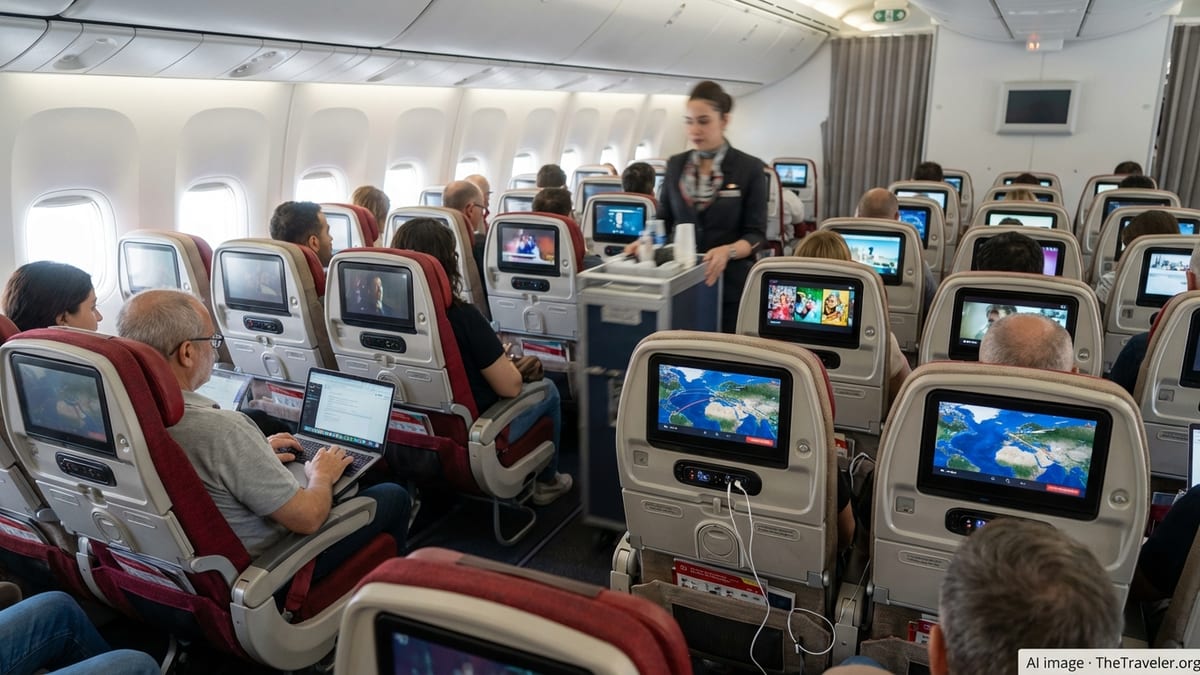
The interface itself has been progressively modernized. Newer widebody and single-aisle aircraft feature high-definition seatback screens with improved touch response and more intuitive menus, making it easier to browse categories, resume partially watched content and discover recommendations. The focus on usability reflects how passenger expectations have shifted in the streaming era, where clunky legacy systems quickly become a source of frustration.
Another component in the airline’s entertainment strategy is its approach to children and families. Dedicated kids’ zones, parental controls and age-appropriate collections allow parents to hand over the screen with more confidence, particularly on overnight or early-morning departures. For routes around three hours in length, which are common on flights between Istanbul and major European cities, a well-designed children’s catalog can be the difference between a stressful and a manageable journey for families.
Connectivity, Cabins and the Digital Passenger Journey
Entertainment alone does not secure top scores in APEX’s ratings; the association also measures Wi-Fi and broader aspects of the passenger journey. Turkish Airlines has invested in connectivity across its fleet, offering Wi-Fi on a growing number of aircraft and routes, with packages that cater to messaging, browsing and heavier use such as VPN connections or streaming on personal devices, depending on the cabin and fare.
Industry announcements over the past year point to a gradual rollout of enhanced connectivity and digital services, including plans to offer complimentary basic Wi-Fi tiers for more passengers and to integrate in-flight connectivity with the airline’s mobile app ecosystem. For business travelers commuting between Istanbul and hubs like London Heathrow or Paris Charles de Gaulle, this can turn a three- to four-hour sector into an extension of the workday, while leisure passengers gain the ability to share trip moments or manage onward bookings in real time.
Cabin hardware underpins the entertainment and connectivity offer. Turkish Airlines has been modernizing both its widebody and narrowbody interiors, debuting business-class suites with direct aisle access, larger 4K-capable screens and personal device charging, alongside refreshed economy cabins with improved ergonomics and upgraded seatback displays. These changes are gradually filtering across key European routes, meaning that travelers on flagship Istanbul to London or Istanbul to Paris services are increasingly likely to experience the airline’s latest products.
The digital journey also extends beyond the aircraft door. Mobile check-in, digital boarding passes and lounge access information are woven into the airline’s app, allowing passengers to manage their trip, adjust seats and, in some cases, preview entertainment options before boarding. As APEX increasingly evaluates carriers on end-to-end experience, these small digital touchpoints contribute to the overall perception that Turkish Airlines is closing the gap between on-the-ground and in-the-air service quality.
Istanbul as a Seamless Hub for Europe-Bound Travelers
Turkish Airlines’ entertainment leadership is closely tied to the role of its home hub, Istanbul Airport, which has become one of the largest and most modern aviation gateways in Europe. For many travelers, the journey between European capitals and destinations across Asia, Africa and the Middle East now flows through Istanbul, making the quality of onboard time a key factor in how smooth that connection feels.
At Istanbul Airport, extensive lounge facilities, particularly the airline’s flagship business-class lounge, bridge the gap between flights with quiet workspaces, Turkish and international dining, shower suites and relaxation zones. For passengers continuing on to or from cities like Berlin, Paris or London, this can transform a long layover into a manageable pause between legs, especially when combined with reliable in-flight entertainment on both sectors.
The airport’s design, with spacious halls and an emphasis on natural light, supports high transfer volumes, and the carrier’s schedule is tightly banked to connect waves of arrivals and departures. Many Istanbul to Europe flights are timed to feed into these banks, meaning passengers may spend only a few hours on the ground before boarding again. In that context, the variety of entertainment and connectivity on board becomes an important tool for combating fatigue and jet lag over the full journey.
For travelers originating in Istanbul and flying to European capitals, the combination of a modern departure experience and high-quality in-flight entertainment positions Turkish Airlines as a compelling alternative to point-to-point European carriers. This is particularly true for passengers booking premium cabins, where access to lounges, priority services and upgraded screens can tilt the balance when comparing fares and schedules.
On the Routes: Istanbul to Berlin, Paris and London
On core European routes, Turkish Airlines operates a mix of narrowbody and widebody aircraft, tailored to demand and slot availability at each destination airport. While equipment can vary by season and time of day, the airline has increasingly scheduled aircraft with newer-generation cabins on flagship frequencies to and from Berlin, Paris and London, aligning product consistency with the expectations of business and connecting traffic.
The Istanbul to London corridor, served to multiple airports in the metropolitan area, showcases much of the airline’s latest hard and soft product. Passengers in business class may find lie-flat or deep-recline seats, large-format seatback screens, multi-course dining and robust connectivity, while economy-class travelers benefit from refreshed seating, individual entertainment screens and content lineups comparable to those on long-haul flights. As APEX’s entertainment award suggests, even shorter segments receive a full-featured media offering rather than a cut-down version.
Between Istanbul and Paris or Berlin, the pattern is similar, with schedules designed to appeal to both point-to-point passengers and those connecting onward to destinations as diverse as Tokyo, Nairobi or São Paulo. On morning and evening departures, the availability of reliable in-flight entertainment is especially significant, helping passengers bridge mealtimes or unwind at the end of a workday. For travelers seated in economy cabins on fully booked flights, the ability to immerse themselves in a film or television series is a tangible relief.
Operational reliability, punctuality and safety records complement the onboard product on these routes. Reports released over the past year have placed Turkish Airlines among Europe’s safest carriers, an important reassurance for passengers who may be trying the airline for the first time based on its entertainment and service reputation. The combined message is that travelers do not have to trade safety or operational performance for a richer digital experience in the cabin.
How Turkish Airlines Compares With European Rivals
Turkish Airlines’ 2026 APEX entertainment award arrives in a competitive landscape where European legacy carriers are upgrading their own systems and content partnerships. Many airlines now offer seatback screens or streaming portals on personal devices, and several have invested in high-bandwidth satellite Wi-Fi and exclusive content arrangements with major studios. The difference, analysts note, lies in execution and consistency.
Where some carriers still offer a limited catalog on shorter intra-European routes, Turkish Airlines has aimed to deliver a broadly similar experience regardless of sector length, particularly on high-traffic links with major capitals. This all-in approach gives passengers fewer unpleasant surprises when they step on board. Travelers accustomed to transatlantic-level entertainment on long-haul flights increasingly expect a comparable, if slightly scaled-down, experience on three- to four-hour journeys, and Turkish Airlines’ product strategy appears to recognize that shift.
Price sensitivity in the European market also plays a role. Turkish Airlines competes not only with other full-service carriers but also with low-cost operators that strip back frills in favor of lower base fares. By emphasizing a high-quality entertainment and connectivity offering even in economy cabins, the airline is betting that a differentiated onboard experience can justify modest fare premiums, especially for travelers weighing up the full cost of their journey, including baggage and ancillary fees on low-cost carriers.
At the same time, the airline’s APEX World Class recognition for sustainability and food and beverage underscores that its focus is not limited to screens and bandwidth. In an era when environmental impact and onboard dining are rising alongside digital expectations in passengers’ decision-making, Turkish Airlines is positioning itself as a carrier where multiple elements of the journey are being elevated in parallel.