

More news on this day
For thousands of Nigerian air travelers, a “routine” delay on United Nigeria Airlines now often hides a more complicated story, as the young carrier juggles bird strikes, intensive maintenance checks and an ambitious fleet expansion that is reshaping its flight schedule in real time.
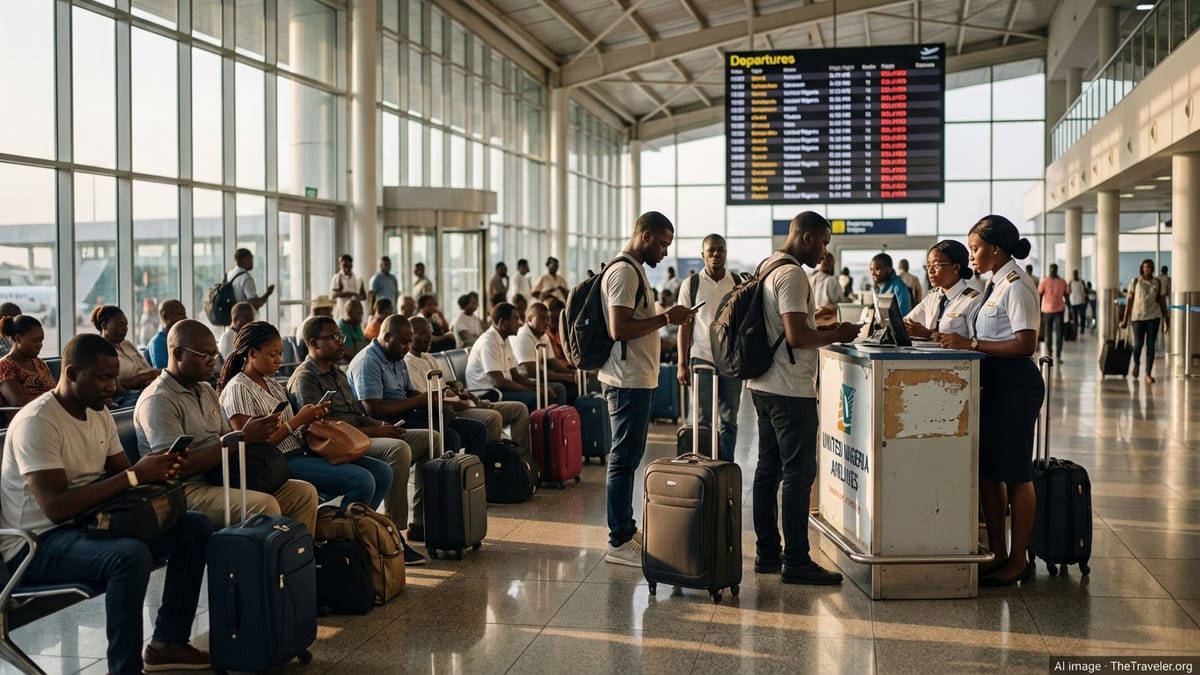
Fresh Disruptions Put United Nigeria in the Spotlight
United Nigeria Airlines is back under scrutiny after a fresh sequence of operational disruptions in early 2026. A series of bird strikes on its Airbus A320 fleet, the latest recorded on 15 February on flight UN0519 between Abuja and Lagos, forced the withdrawal of at least one aircraft from service and triggered a ripple of knock-on delays across the domestic network. The incident, the second bird strike within 24 hours and the fourth since January according to airline statements, has underscored just how tight the carrier’s current fleet and scheduling margins remain.
Passengers caught in the latest disruptions reported extended waits, rolling departure time changes and short-notice rebookings as the airline sought to consolidate flights and reposition aircraft. United Nigeria maintained that safety protocols required immediate grounding and comprehensive technical inspections after any strike affecting an engine, framing the delays as the unavoidable price of caution. For travelers already weary of unpredictable domestic schedules, that explanation offers reassurance on safety but little comfort when missing meetings, weddings or onward connections.
The timing is particularly sensitive. United Nigeria has just marked its fifth anniversary with public commitments to consolidation, service quality and sustainable growth. The carrier now operates a mixed fleet of Airbus A320s, CRJ900s, Embraer jets and regional E145s, with more aircraft due to arrive this year. As it seeks to position itself as a dependable alternative in a challenging market, every high-profile operational hiccup carries outsized reputational risk.
From Bird Strikes to Maintenance: What Is Driving the Delays?
Behind the headlines, the causes of recent disruptions are varied, but they converge on one reality for passengers: more frequent and sometimes longer delays. Bird strikes have become the most visible trigger. In December 2025, United Nigeria alerted customers to network-wide disruptions after a bird strike sidelined one of its aircraft, pulling it from service for full engineering checks. Just two months later, similar incidents have repeated in quick succession, prompting further schedule reshuffles.
These bird strikes are occurring against a backdrop of routine and unscheduled aircraft maintenance that can also upend operations. In March 2025, the airline publicly acknowledged disruptions tied to unscheduled maintenance on some aircraft, emphasizing that safety took precedence over on-time performance. Maintenance-related groundings are a standard part of any airline’s life, but for a carrier with a still-limited fleet, each aircraft out of rotation has a sharper impact on the timetable.
System reliability has been another stress point. In April 2025, United Nigeria temporarily suspended bookings and check-in functions following a wider technology outage, before announcing a full restoration of its systems. That episode highlighted how quickly an IT failure can cascade into delayed departures, missed turnarounds and overburdened airport counters. For passengers, it all registers as the same frustrating outcome: waiting at the gate and wondering if the flight will depart at all.
Compounding these factors are external constraints, from weather to runway conditions and congested airspace at hubs such as Lagos and Abuja. While airline executives frequently stress that many delays are beyond their control, Nigerian travelers now see a pattern in which operational shocks, whether internal or external, tend to hit a handful of carriers hardest. In recent civil aviation performance data, United Nigeria appears among the domestic airlines with notable shares of delays and cancellations, reinforcing the perception that disruptions are becoming part of the travel calculus.
How United Nigeria Is Adjusting Its Schedule and Fleet
Faced with repeated shocks to its day-to-day operations, United Nigeria Airlines is quietly reshaping its schedule and fleet strategy in ways that passengers should understand. The immediate response to bird strikes and unscheduled maintenance has typically involved consolidating flights, re-routing aircraft and, in some cases, cancelling less popular services to protect core trunk routes such as Lagos–Abuja and Lagos–Port Harcourt. The airline has framed these as “operational adjustments” designed to maintain safety and reliability on its busiest corridors.
At the same time, management is betting that a larger and more capable fleet will give the airline more resilience. United Nigeria has signed agreements to acquire a batch of Boeing 737-800 Next Generation aircraft, including ex-Southwest Airlines jets, with deliveries scheduled to begin in the first quarter of 2026. Alongside additional narrow-body aircraft expected by mid-2026, the airline’s active fleet could roughly double to around 21 aircraft, expanding both capacity and scheduling flexibility.
Executives describe this fleet build-up as part of a medium- to long-term strategy that extends beyond Nigeria’s domestic market. The carrier has flagged plans for regional West African routes and longer-term ambitions to reach destinations in Europe, North America and the Middle East. Yet to support that growth, the airline must first demonstrate that it can stabilize operations at home and reduce the frequency of last-minute timetable changes that currently frustrate regular flyers.
In internal and public messaging, United Nigeria has sought to reassure passengers that its adjustments are calibrated, not chaotic. Officials stress that aircraft withdrawals for technical inspection are precautionary and that schedule changes are communicated via SMS, email, call centers and airport agents. Nonetheless, uneven execution at the airport level, coupled with limited spare capacity, means that passengers can still face lengthy queues at customer service desks and delayed information when irregular operations strike.
Regulators, Safety and the Legacy of Earlier Sanctions
United Nigeria’s current adjustments cannot be separated from the regulatory environment it operates in, or from the legacy of earlier enforcement action. In late 2023, Nigeria’s civil aviation regulator suspended the airline’s wet-leased Airbus A320 aircraft following a controversial diversion incident, citing concerns over the explanations provided by the carrier. That decision temporarily cut into available capacity and served as a sharp reminder that operational missteps can rapidly become regulatory flashpoints.
Since then, the airline has emphasized a renewed focus on compliance, pilot training and route planning. The message to both regulators and customers has been that lessons were learned and that internal oversight has been strengthened. Bird-strike responses, for example, are now being framed in communications as strictly aligned with local and international safety requirements, with no shortcuts taken to restore aircraft to service before exhaustive inspections are complete.
For travelers, this heightened regulatory scrutiny is a double-edged sword. On one hand, robust oversight and swift action when procedures are questioned should strengthen confidence that safety is non-negotiable. On the other, sanctions, inspections and mandatory groundings often translate directly into cancelled flights and reduced frequencies, particularly for smaller airlines that lack spare aircraft to cushion the blow.
Industry analysts note that Nigerian regulators are under pressure to demonstrate firm control over a sector that has experienced periodic safety scares and financial turbulence. With United Nigeria positioning itself as a rising national player, its operational record will likely remain under close watch. The result is an operating environment where conservative choices on safety and compliance may intensify in the months ahead, adding another layer of unpredictability for passengers already bracing for delays.
What the Numbers Reveal About Delays and Cancellations
Beyond individual incidents, official performance data helps explain why United Nigeria’s schedule adjustments matter to anyone booking a ticket. Quarterly reports compiled by the country’s civil aviation authority and reviewed in late 2025 show that domestic airlines collectively operated more than 17,000 flights between July and September 2025, with roughly one in four experiencing delays or cancellations. United Nigeria appeared among the carriers contributing significantly to those disruption figures.
In that quarter, the airline recorded a notable share of both delayed and cancelled flights relative to its total operations, placing it alongside higher-profile carriers in terms of reliability challenges. While some rival airlines have managed to trim their delay ratios year-on-year, United Nigeria’s performance still reflects the strain of operating a growing network with a relatively small but diverse fleet, subject to maintenance cycles, operational hiccups and congested airport infrastructure.
These numbers matter because they shape expectations. For a business traveler in Lagos weighing options to Abuja, or a family planning to connect through Port Harcourt or Enugu, statistical performance is increasingly part of the decision. Frequent flyers are learning to anticipate that peak periods, weather systems or runway works could tip a delicate schedule into disruption, especially for airlines with less redundancy built into their operations.
Yet it is also worth noting that United Nigeria’s record is not uniquely troubled in a domestic market where no carrier is immune to delays. The broader trend across Nigeria’s aviation sector points to structural issues, from limited airport capacity to air traffic control constraints and challenging weather patterns. In that context, United Nigeria’s adjustments look less like isolated failings and more like a case study in how fast-growing airlines navigate a system already operating close to its limits.
Passenger Rights and Practical Steps When Your Flight Changes
For travelers caught in the middle of these adjustments, knowing what to do at the first hint of a delay is essential. Nigerian regulations and airline policies set out basic entitlements when flights are significantly delayed or cancelled for reasons within a carrier’s control, such as technical faults or crew availability. These can include meals, refreshments, hotel accommodation for overnight disruptions and rebooking on the next available service, though the exact provisions vary by ticket type and circumstance.
United Nigeria typically offers free rebooking on the next flight with available seats when disruptions stem from operational or technical issues. In public statements after recent bird strikes and maintenance-related groundings, the airline has apologized for inconvenience and pledged to assist with alternative arrangements. Passengers are usually encouraged to contact customer service by phone, email or at airport counters to confirm new itineraries, and to keep travel documents and contact details up to date for notification purposes.
Where factors are clearly outside the airline’s control, such as severe weather or unforeseen airspace restrictions, compensation may be more limited, but travelers can still expect timely information, basic care and clear options. In practice, many of the frustrations Nigerian passengers describe stem not only from the delay itself but from poor communication: unclear announcements, conflicting messages between call centers and airport staff, and uncertainty over whether to wait or abandon the trip.
Seasoned flyers recommend a proactive approach when booking with any carrier operating in a tight, disruption-prone environment. That can mean allowing longer connection times, traveling earlier in the day when schedules are less congested, and monitoring flight status closely via airline channels before leaving for the airport. For those whose plans are particularly time-sensitive, understanding the carrier’s historical on-time performance and its policies for reaccommodation can make the difference between a manageable setback and a travel crisis.
Expansion Ambitions Collide With Reliability Demands
United Nigeria’s story is ultimately one of ambition colliding with operational reality. In just five years, the airline has grown from a start-up flying a handful of domestic routes to a multi-type operator serving more than a dozen Nigerian states and a regional destination in Ghana. Fresh aircraft are due within months, and management has talked openly about long-haul aspirations to major global markets, including Europe and North America.
That trajectory mirrors Nigeria’s broader push to position aviation as a pillar of economic growth. As trade, investment and tourism flows intensify, domestic connectivity becomes more important, and airlines like United Nigeria are expected to shoulder a greater share of the load. Yet passengers are becoming less forgiving of “growing pains” when those ambitions translate into missed appointments, stranded nights and additional costs on already expensive trips.
In this context, the airline’s current schedule adjustments, while disruptive, may also be a necessary recalibration. Temporarily trimming frequencies, building in more slack for maintenance, investing in better communications systems and training frontline staff to manage irregular operations could help rebuild confidence. The arrival of additional 737-800s and other aircraft, if paired with disciplined scheduling, should gradually provide more buffer against the next unexpected bird strike or system outage.
For now, travelers choosing United Nigeria must navigate a mixed picture: a carrier with visible growth momentum and clear investment in hardware, but still working to translate that into consistent, delay-resistant service. The coming months, as new aircraft arrive and the airline refines its timetable, will be decisive in determining whether United Nigeria can deliver on the promise of its expansion without leaving too many passengers stranded in the departure lounge.
Why These Adjustments Should Shape Your Next Booking Decision
If you are weighing whether to book a ticket on United Nigeria Airlines in the next few months, understanding the forces behind its flight delays is more than an academic exercise. The pattern of bird strikes, maintenance groundings, regulatory scrutiny and rapid fleet changes is directly reshaping which routes the airline operates, how frequently it flies them and how quickly it can recover from unexpected disruptions.
For regular travelers on core domestic corridors, United Nigeria’s adjustments may ultimately deliver a more robust schedule, especially once additional aircraft are in service. Short-term, however, you may notice more consolidation of flights, tighter availability on peak days and a greater likelihood that departure times could change between booking and travel. Building flexibility into your plans and monitoring airline communications will be key.
For occasional flyers, the headline to remember is that United Nigeria is a work in progress. It is investing in new jets, talking up service improvements and pledging to put safety first, even when that means grounding aircraft and inconveniencing passengers. But until the airline demonstrates a sustained improvement in punctuality and a smoother handling of irregular operations, every traveler should approach their booking with open eyes, a backup plan and a clear understanding of their rights if things go wrong.
As Nigeria’s aviation sector continues to mature, carriers that match ambition with reliability will win the loyalty of a rising generation of air travelers. United Nigeria’s current wave of adjustments, and how it manages the delays that come with them, will be a crucial test of whether it can become one of them.