

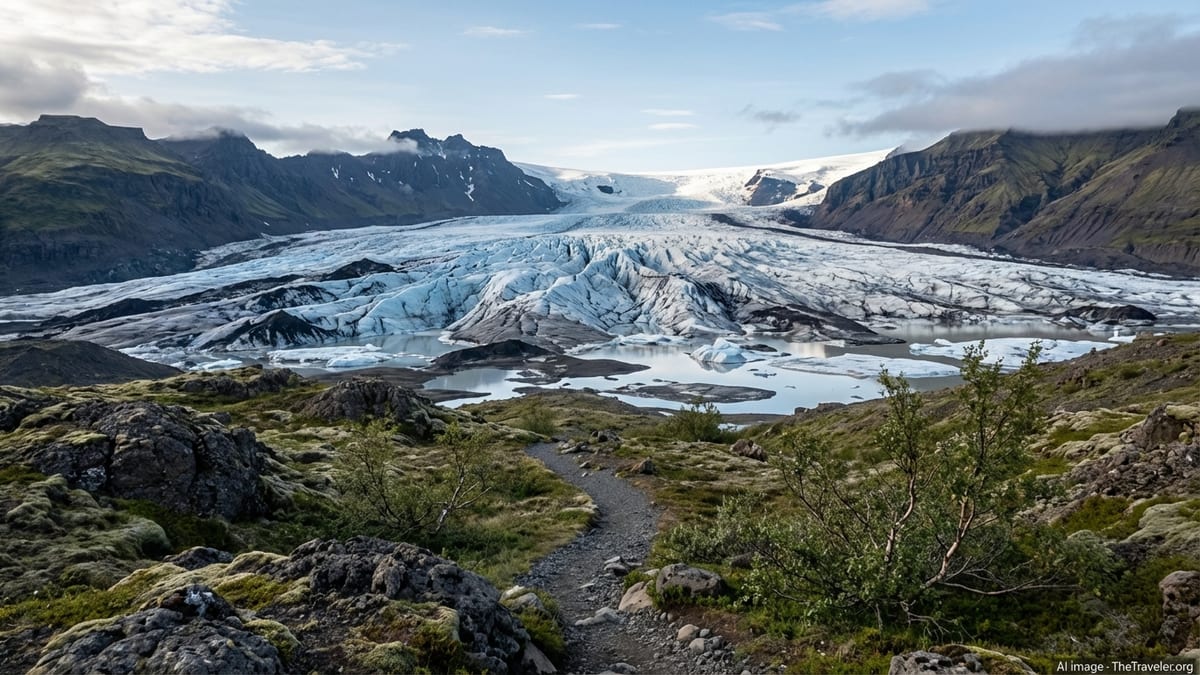
Vatnajökull National Park covers much of southeast and central Iceland, protecting a landscape where ice caps bury active volcanoes, black sands meet bright blue icebergs, and delicate moss fields cling to lava carved by enormous glacial floods. For travelers drawn to raw, immersive nature, it is one of Europe’s most remarkable protected areas and a place that rewards both quick stops along the Ring Road and longer, slower explorations on foot.
A National Park on a Truly Epic Scale
Vatnajökull National Park is extraordinary in its sheer size. It encompasses all of Vatnajökull, the largest glacier in Europe by volume, and a vast surrounding area of mountains, volcanic systems and outwash plains. The park covers roughly 14 percent of Iceland’s land area, which gives a sense of just how dominant this wild landscape is in the country’s southeast and interior. Traveling along the Ring Road, you can drive for hours with the ice cap or its outlet glaciers in view, constantly reminded of the park’s scale.
Within its boundaries lie multiple distinct regions, each with its own character. Skaftafell, on the southern edge of the ice cap, is a green oasis of birch scrub and waterfalls below looming glaciers. Farther east, the Jökulsárlón glacier lagoon is a stark, luminous world of drifting icebergs and black sand beaches. Inland, highland plateaus and volcanic calderas remain remote and largely inaccessible outside the short summer window. This diversity makes the park feel more like a small country than a single destination.
In 2019, Vatnajökull National Park was inscribed as a UNESCO World Heritage Site, recognized for both its natural beauty and its outstanding geological value. The listing highlights how the park’s glaciers, volcanoes and river plains vividly illustrate the geological processes that shape Iceland. For visitors, that status underscores that this is not simply another scenic stop along the south coast, but a protected landscape of global significance worth taking time to experience properly.
Because the park stretches across such a wide area, travelers can approach it in different ways. Some experience it as a series of strategic stops on a multi-day south coast road trip, combining waterfalls, black sand beaches and glacier views. Others treat Vatnajökull as a primary destination in its own right, basing themselves in Skaftafell or near Jökulsárlón and exploring the surrounding trails and outlets for several days. Either approach reveals that this is a place of layers, where the more you look, the more details emerge in the ice and rock.
Dramatic Glaciers and Ice Lagoons
The accessible glaciers are a major reason Vatnajökull National Park is worth visiting. Around 30 outlet glaciers flow from the ice cap, many of them reaching down close to the Ring Road. Skaftafellsjökull and Svínafellsjökull, near Skaftafell’s visitor center, are among the most approachable. Short, relatively easy trails lead to viewpoints where you can safely observe the crevassed ice and the changing landscape around the glacier tongues without stepping onto the ice itself.
For a more immersive experience, certified local operators based in Skaftafell and nearby areas lead guided glacier walks on several outlet glaciers. These tours typically involve a short approach hike followed by one to two hours on the ice, using crampons and safety equipment provided by the guides. Participants learn how glaciers are moving and thinning, how crevasses and moulins form, and how volcanic ash layers get preserved inside the ice. For many travelers, walking on a living glacier is a lifelong memory and a powerful way to understand what climate change means on the ground.
Jökulsárlón glacier lagoon is another of the park’s defining sights. Here, the retreating tongue of Breiðamerkurjökull calves icebergs into a large, deep lagoon, where they drift slowly toward the sea. The icebergs range from small, sculpted chunks to towering blue slabs, often streaked with volcanic ash from past eruptions. Seals frequently patrol the water’s surface or haul out on ice, and birdlife shifts with the seasons. On the nearby shoreline, often referred to as Diamond Beach, waves roll in over polished black volcanic sand, studded with fragments of crystal-clear ice that gleam in the low Icelandic light.
Boat tours, zodiac excursions and even kayak trips operate on the lagoon in season, offering closer perspectives on the icebergs and glacier front when conditions allow. Yet Jökulsárlón is also compelling from the shore. Even a brief roadside stop can deliver views of ice calving, seals surfacing and clouds reflecting on still water. For many visitors driving the south coast, the first glimpse of the lagoon feels like entering another world, and it is often the moment when Vatnajökull National Park shifts from a faint line of white on the horizon to a living, changing landscape.
Accessible Hiking and Iconic Waterfalls
Vatnajökull National Park is also worth visiting for its network of hiking trails that bring the scenery into sharper focus. Skaftafell is the main hub for walking routes, offering everything from one-hour paths to full-day highland excursions. The trail to Svartifoss, one of Iceland’s most photographed waterfalls, is a particular highlight. The route climbs gradually from the Skaftafell visitor center through low birch and open slopes before arriving at a narrow cascade framed by dark, hexagonal basalt columns. The contrast between the white water and the geometric lava formations makes Svartifoss feel almost architectural.
Another popular path in Skaftafell leads toward the tongue of Skaftafellsjökull. This mostly easy route, partly paved and partly gravel, allows visitors to observe how the terrain changes as the glacier has retreated. Interpretive markers in places explain landforms such as moraines and polished rock surfaces, helping to decode the story of past ice extent and recent melt. On clear days, viewpoints along the trail open to wide glacier vistas backed by the main ice cap, offering a sense of scale that is hard to glean from a parking lot stop.
For more experienced hikers, longer routes in the Skaftafell area venture deeper into valleys and up to panoramic ridges. Trails toward Morsárdalur valley, Kristínartindar mountain and high viewpoints above the outlet glaciers reveal a wilder side of the park, where braided rivers thread through broad glacial plains and distant waterfalls trace white lines across black cliffs. These routes typically require several hours and good weather, but they reward with solitude and a powerful sense of being surrounded by ice, rock and sky.
Beyond Skaftafell, hiking options continue along the southeastern edge of the park. Trails near Jökulsárlón and Fjallsárlón explore less visited glacial lagoons and moraine ridges, while paths in areas such as Hjallanes provide views toward Skálafellsjökull and other outlet glaciers with fewer crowds. The variety means that whether you have one afternoon or several days, there is likely to be a route that matches your fitness level and appetite for adventure.
Living Geology: Volcanoes, Floods and Climate Change
One of the most compelling reasons to visit Vatnajökull National Park is how clearly it tells the story of Iceland’s geology. Unlike many glacier regions elsewhere in Europe, this is a landscape where active volcanoes lie hidden beneath the ice, and where the interaction between fire and ice has left dramatic marks. Several volcanic systems, including Grímsvötn and Bárðarbunga, sit under the ice cap. Their eruptions can melt enormous volumes of ice, triggering glacial outburst floods that rush down to the lowlands and reshape the land in a matter of hours.
The broad outwash plains flanking the southern park boundary are evidence of those past floods. Crossing them, travelers encounter vast, flat gravel fields cut by braided rivers and dotted with stranded boulders. Bridges on the Ring Road stand as engineering responses to earlier eruptions, reminders that this scenery is not static. Visitor centers and ranger-led walks often explain these processes in accessible language, helping visitors visualize how volcanic activity beneath the glacier can suddenly alter river courses and landscapes far downstream.
At the same time, Vatnajökull is one of Europe’s clearest natural laboratories for observing climate change. The retreat of outlet glaciers, visible in historic images and in interpretive material on-site, shows how quickly ice margins have shifted in recent decades. Trails that once ended at the glacier’s edge now sometimes require a longer walk to reach ice, and new lagoons have formed where meltwater collects in depressions left by shrinking tongues. On ranger-guided walks at sites such as Skaftafell and Jökulsárlón, staff frequently discuss how temperature trends, precipitation and changing snow accumulation are affecting the park’s glaciers.
For visitors, encountering these changes firsthand can be sobering, but it also adds meaning to the experience of being in Vatnajökull. Watching icebergs drift past or tracing the curve of a retreating glacier tongue is no longer only a scenic moment, but a glimpse into ongoing planetary shifts. The park’s educational programs aim to balance awe with understanding, giving travelers tools to interpret what they are seeing and to appreciate the fragility as well as the grandeur of this environment.
Wildlife, Seasons and the Atmosphere of the Arctic Edge
While Vatnajökull National Park is not primarily a wildlife destination, its ecosystems support a range of birds and mammals that add life to the austere scenery. Seals are commonly seen in and around Jökulsárlón, where they hunt fish near the glacier front or rest on icebergs. Along rivers and coastal margins, migratory seabirds and waders arrive in spring and summer, filling the air with calls that contrast with the soft creaks and booms of the moving ice. In more vegetated areas such as Skaftafell, Arctic birch scrub provides habitat for songbirds and small mammals adapted to the subarctic climate.
The park’s atmosphere changes distinctly with the seasons, giving travelers different reasons to visit at different times of year. In summer, long daylight hours and relatively stable weather make it the prime season for hiking and glacier activities. Trails are generally snow-free at lower elevations, ranger-led walks operate in key areas, and visitor centers run extended opening hours. Summer remains the busiest season, but the park’s scale means it is still possible to find quieter corners, especially away from the main viewpoints.
In autumn, shorter days bring richer colors to the low vegetation, with birch leaves turning shades of gold against dark lava and ice. Weather becomes more changeable, but the crowds thin, and the softer, lower-angle light can make glacier faces and icebergs look particularly sculptural. Winter transforms Vatnajökull again, covering much of the surrounding land in snow and ice, while the glaciers themselves take on a deeper, more monochrome palette. When skies are clear and conditions are safe, winter offers opportunities to explore certain ice caves with qualified guides and to view the northern lights reflecting on snowfields, lagoons and frozen rivers.
Spring is often a transitional season, when lingering snow patches and rising meltwater reshape trails, but it can offer its own rewards. Birdlife returns, some of the first flowers emerge in sheltered spots, and the contrast between white peaks and greening lowlands is at its sharpest. For travelers flexible about conditions and open to a mix of weather, visiting in the shoulder seasons can provide a more contemplative experience of Vatnajökull’s moods and the sense of being close to the Arctic edge.
Visitor Services, Safety and Sustainable Travel
Another reason Vatnajökull National Park is worth visiting is the balance it offers between wild scenery and practical accessibility. Skaftafell and Jökulsárlón are both directly off the Ring Road, making them straightforward to incorporate into a south coast itinerary. Skaftafell’s main visitor center is open year-round and provides information on current trail conditions, weather and safety, as well as exhibitions about the area’s nature and human history. Staff can advise on which hikes are suitable for the day’s forecast and for your fitness level.
Around Skaftafell, there are campgrounds and accommodation options, along with a small range of services such as simple food outlets in season and facilities at the visitor center. Near Jökulsárlón, parking areas on both sides of the road provide access to the lagoon and shoreline, and ranger presence helps manage safety and protect sensitive areas. Throughout the park, signage and marked paths guide visitors to viewpoints while encouraging them to avoid unstable riverbanks, glacial edges and moss-covered lava that can be easily damaged.
Safety is particularly important in a landscape dominated by glaciers, rivers and changeable weather. Park authorities and local guides consistently emphasize that travelers should not walk on glaciers, approach steep ice cliffs or enter ice caves without professional guidance and proper equipment. Conditions on the ice can change rapidly, and hazards such as crevasses, falling ice and sudden waves in lagoons are not always obvious from a distance. Likewise, rivers that appear shallow can become difficult or dangerous to cross after heavy rain or during rapid melt. Checking the daily weather and heeding local advice are essential parts of a responsible visit.
In recent years, Vatnajökull National Park has also focused on sustainable visitor management. Ranger-led interpretive walks, educational signage and clearly marked paths are all designed to concentrate foot traffic in resilient areas and reduce impacts on fragile vegetation and geological features. By staying on trails, respecting closures and following guidelines on waste and driving, visitors help ensure that the park’s unique glacial and volcanic landscapes remain intact for future generations. For many travelers, being part of this shared responsibility adds depth to the experience, turning a scenic stop into a more thoughtful connection with Iceland’s natural heritage.
The Takeaway
Vatnajökull National Park is worth visiting not just because it is large or famous, but because it offers a rare combination of accessibility and true wilderness. Few places in Europe allow you to stand within sight of an ice cap, active volcanic centers, glacier-carved valleys and storm-battered black sand beaches in the space of a single day, yet still find spaces of quiet where only the sound of wind and distant ice carries across the landscape.
Whether you come for a brief glimpse of icebergs drifting through Jökulsárlón, a family-friendly hike to Svartifoss, or a multi-day exploration of Skaftafell’s trails and nearby lagoons, the park rewards curiosity and patience. It is a place where geology feels immediate, where climate change is visible at the edge of every glacier, and where light and weather continually reinvent the views. For travelers willing to plan carefully, respect safety advice and travel lightly on the land, Vatnajökull offers an unforgettable encounter with Iceland at its most elemental.
FAQ
Q1. Where is Vatnajökull National Park located in Iceland?
Vatnajökull National Park stretches across much of southeast and central Iceland, with its most visited areas, such as Skaftafell and Jökulsárlón, directly accessible from the south coast Ring Road.
Q2. How many days should I spend in Vatnajökull National Park?
If you are on a tight schedule, one full day allows for a taste of Skaftafell or Jökulsárlón, but two to three days give time for several hikes, a glacier activity and more relaxed exploration.
Q3. Do I need a guide to hike in Vatnajökull National Park?
You do not need a guide for marked walking trails such as Svartifoss or the Skaftafellsjökull viewpoint, but any activity on the glacier ice itself, including glacier walks or ice caves, should always be done with a certified guide.
Q4. What is the best time of year to visit Vatnajökull National Park?
Summer from roughly June to August offers the most reliable conditions for hiking and road travel, while late spring and autumn can be quieter and more atmospheric. Winter visits focus more on northern lights, limited ice cave tours and scenic roadside viewpoints when conditions permit.
Q5. Can I see the northern lights in Vatnajökull National Park?
Yes, in the dark months from roughly September to April, it is possible to see the northern lights if skies are clear, with reflections on snow, ice and lagoons adding to the spectacle on suitable nights.
Q6. Is Vatnajökull National Park suitable for families with children?
Many areas are family-friendly, including short trails to Svartifoss and Skaftafellsjökull, easy walks along Jökulsárlón’s shores and ranger-led programs in season. Parents should closely supervise children near water, cliffs and any glacial terrain.
Q7. How do I get to Skaftafell and Jökulsárlón from Reykjavík?
Both Skaftafell and Jökulsárlón lie along the Ring Road southeast of Reykjavík. The drive to Skaftafell takes roughly four to five hours in normal conditions, with Jökulsárlón around an hour farther east, so many travelers plan an overnight stay in the region.
Q8. What should I pack for a visit to Vatnajökull National Park?
Plan for quickly changing weather by bringing warm layers, a waterproof jacket and trousers, sturdy hiking shoes or boots, hat and gloves, along with snacks, water and a fully charged phone. In shoulder seasons and winter, traction aids and extra insulation may be useful.
Q9. Are there accommodation and food options inside the park?
There is a campground and some basic services near Skaftafell, and a range of guesthouses and hotels scattered along the nearby Ring Road. Around Jökulsárlón, accommodation is in the surrounding area rather than directly at the lagoon, so advance booking is recommended in busy periods.
Q10. How can I visit Vatnajökull National Park responsibly?
Stay on marked trails, follow safety and closure signs, avoid driving off-road, pack out all waste, and choose locally owned guides and services when possible. Respecting these guidelines helps protect fragile glacial and volcanic landscapes while supporting the communities that depend on the park.