

More news on this day
Western governments including the United States, Canada, the United Kingdom, Australia, Sweden, Ireland and Spain are quietly but firmly telling their citizens to think twice before booking a Cuban beach escape, as the island’s deepening fuel and economic crisis spills into every aspect of daily life and raises serious questions about the safety and practicality of travel.
A Wave of Stark Travel Warnings for a Former Winter-Sun Favorite
Over the past year, a string of governments across North America and Europe have toughened their travel advice for Cuba, a destination long marketed as an easy, affordable tropical getaway. What began as incremental alerts about shortages and service disruptions has rapidly escalated into some of the strongest official wording seen since the pandemic, with several countries now advising against all but essential travel.
Canada, traditionally Cuba’s largest single source of tourists, has upgraded its advisory to highlight what it calls chronic and severe shortages of fuel, food, water, medicines and cash, alongside increasingly frequent blackouts and unreliable transport. Officials warn that even visitors staying in resort enclaves may find services significantly curtailed and could struggle to move around the island or reach airports in an emergency.
In London, the United Kingdom’s Foreign, Commonwealth and Development Office has taken the unusually serious step of advising against all but essential travel, citing severe nationwide disruption to essential infrastructure, persistent power outages and fuel rationing. That move carries real weight in the travel and insurance industries, signalling that normal holidays are no longer considered low risk. Australia, Sweden and Ireland have echoed many of the same concerns in their own advisories, while Spain, which has close historical and commercial ties to Cuba, is urging travellers to monitor the situation closely.
The United States, which already heavily restricts tourist travel to Cuba, continues to maintain a Level 2 advisory, telling citizens to exercise increased caution due to crime and other risks. For Americans, the practical barriers to visiting remain high, but the broader message from Western capitals is converging: Cuba’s crisis is no longer a distant political story, but a concrete threat to the safety, health and mobility of foreign visitors.
Fuel Shortages, Blackouts and a Tourism System Under Strain
At the heart of the current warnings lies a severe and worsening fuel shortage that has rippled through every critical system on the island. Long reliant on subsidised oil from allies, Cuba has seen imports collapse amid shifting geopolitics and stepped-up US pressure on suppliers. The result is an energy crunch that Cuban officials themselves now describe as one of the worst in the country’s post-revolution history.
Electricity cuts, once an intermittent nuisance, have become routine in many provinces. Foreign ministries report scheduled daily blackouts designed to ration power, punctuated by longer unplanned outages that can leave entire districts without electricity for more than 24 hours at a time. For travellers, that means air conditioning switching off in the tropical heat, unreliable lighting and lifts in high-rise hotels, and sporadic access to phone and internet services.
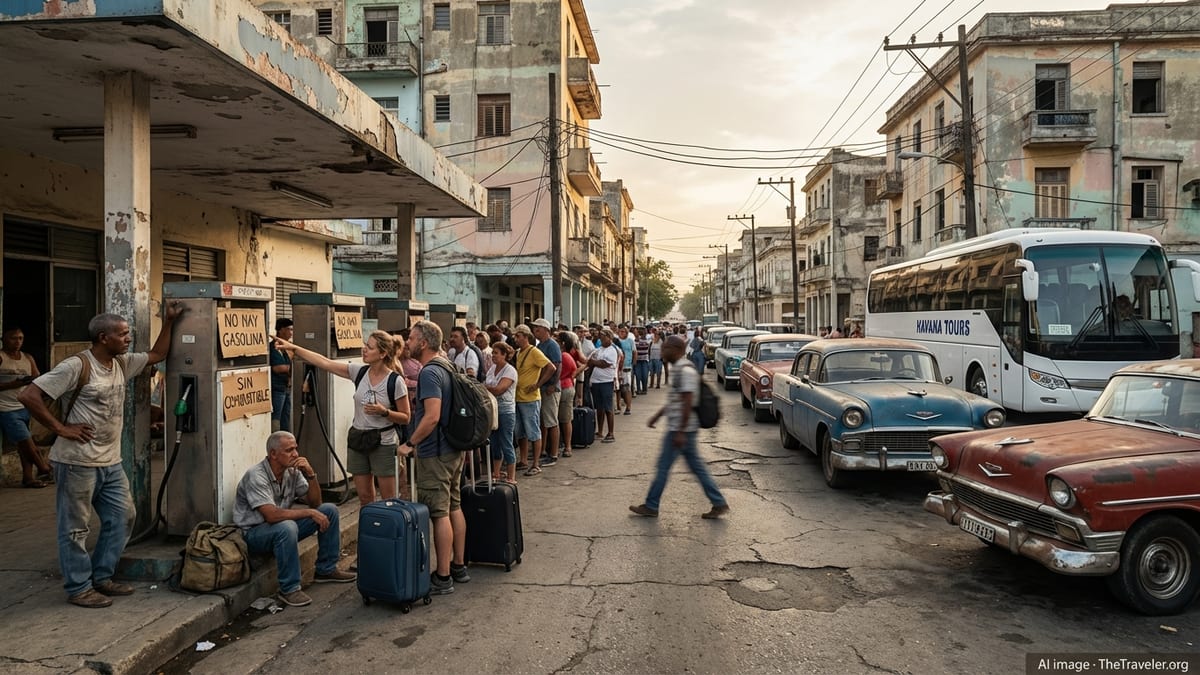
Fuel scarcity has simultaneously crippled transport. Public buses have been drastically reduced, taxis are harder to find, and long lines snake from the few petrol stations that still receive regular deliveries, occasionally flaring into heated confrontations. Several governments warn that tourists have been temporarily stranded after being unable to refuel rental cars, and that even pre-booked transfers may fail to materialise if operators cannot secure fuel on the day.
Crucially for the tourism industry, the energy crisis has moved airside. Aviation authorities have acknowledged that supplies of jet fuel are dangerously tight, forcing airlines to rethink their schedules. In recent weeks, multiple Canadian carriers have suspended or reshaped their Cuba programmes, while other foreign airlines have had to add technical stops or reduce frequencies. The UK and Canada both caution that flight cancellations or sudden schedule changes could leave visitors struggling to leave the country as planned.
From Shortages to Humanitarian Concerns
Beyond the immediate discomfort of blackouts and transport disruption lies a deeper humanitarian problem that foreign ministries say is now impossible for travellers to ignore. Years of economic decline, compounded by the pandemic’s shock to tourism revenues and tightening sanctions, have drained shelves, pharmacy stocks and household budgets. The latest fuel crisis has exacerbated shortages by making it harder to produce, transport and refrigerate essential goods.
Government advisories now routinely reference long-running scarcities of basic items such as cooking oil, flour, bottled water and baby supplies, along with critical medicines ranging from antibiotics to chronic disease treatments. Visitors who once packed light are being told to bring their own basic pharmaceuticals and any prescription drugs in more-than-adequate quantities, on the assumption that local supplies may be unavailable or prohibitively expensive.
International agencies and independent observers warn that the strain on food and water systems is intensifying as fuel shortages disrupt agriculture, processing and distribution. Hospitals and clinics, already stretched by years of underinvestment, are struggling to run essential equipment during prolonged blackouts. While Cuba continues to present itself as a safe and orderly society, foreign governments are increasingly blunt that they cannot guarantee rapid medical evacuation or basic standards of care for visitors outside the main tourist hubs.
This deterioration is pushing some governments to frame Cuba’s predicament in humanitarian terms rather than purely political ones. Briefings reference the risk that infrastructure failures could escalate quickly, overwhelming local capacity and leaving tourists caught in the middle. That assessment is driving the shift from routine caution to open questioning of whether leisure travel to the island is appropriate while residents themselves face mounting hardship.
Political Tension, Protests and the Risk to Foreigners
Cuba’s economic crisis is unfolding against a backdrop of heightened political tension. The single-party state maintains tight control over public life, with restrictions on freedom of expression, assembly and association. When discontent has spilled into the streets in recent years, authorities have responded with a heavy security presence, internet blackouts and swift detentions.
Canada and several European governments explicitly warn that public demonstrations critical of the government are considered illegal, and that foreign nationals can be detained simply for being in the vicinity of protests. Travellers are advised to avoid large gatherings, refrain from filming or photographing security forces and steer clear of any politically charged conversation in public spaces.
While large-scale unrest remains relatively rare and is typically short-lived, Western diplomats privately acknowledge that prolonged shortages of fuel, food and electricity increase the risk of spontaneous local protests. In that context, tourists wandering into an angry queue outside a petrol station or supermarket could find themselves uncomfortably close to a confrontation with police.
Heightened political sensitivity is also reflected in cautions about online behaviour. Some governments note that Cuban authorities have previously restricted social media access during moments of tension and remind travellers that critical posts about the government, even from foreign citizens, may attract unwanted attention. The overarching message is clear: this is a country where political lines are tightly drawn, and visitors are expected to stay far away from them.
Crime, Cash and Everyday Risks in a Strained Economy
Compared with many destinations in the region, Cuba still records relatively low levels of violent crime. However, foreign ministries are now stressing that the island’s deepening economic woes are fuelling a rise in opportunistic theft and scams, particularly in areas frequented by visitors. The United States rates Cuba as a place where travellers should exercise increased caution due in part to crime, a formulation mirrored in several European advisories.
Reports of bag-snatching, pickpocketing and theft from accommodation have become more common in urban hotspots such as Old Havana and resort towns where the gap between tourist spending and local incomes is stark. Travellers are urged to limit displays of wealth, keep valuables locked in hotel safes where possible and remain especially alert at night or in crowded transport hubs.
Money itself has become an unusual hazard. Cuba’s complex, evolving currency regime and shortages of cash mean that travellers can no longer assume that cards or ATMs will function as expected. Some governments warn that cash machines are frequently empty or inaccessible during power cuts, and that state-run establishments increasingly favour electronic payments, while many private operators still insist on cash. The result is a confusing two-tiered system where visitors need both card capacity and hard currency to navigate daily transactions.
Western embassies advise travellers to bring sufficient euros or US dollars to cover their stay, divided into small denominations and stored securely. Exchanging money outside authorised outlets remains illegal, and those tempted by black-market rates risk fines, confiscation or worse. The message is that in today’s Cuba, financial logistics are not a minor detail but a central travel risk to be managed carefully.
Flight Cancellations and the Real Risk of Being Stranded
If there is a single scenario officials now emphasise to would-be visitors, it is the possibility of being stranded. Cuba’s shrinking fuel supplies have had a direct impact on aviation, and disruptions are no longer limited to occasional delays during hurricane season. Recent weeks have seen carriers, particularly from Canada, suspend or significantly reduce their flights after Cuban authorities warned that jet fuel stocks were running critically low.
Some airlines have organised repatriation flights for tourists already on the island, but have simultaneously halted new bookings until at least late spring. Others have opted to maintain a skeleton service by adding refuelling stops in third countries, increasing journey times and the risk of missed connections. Foreign ministries caution that further last-minute changes are likely as Cuba juggles scarce fuel between domestic needs and the tourism sector.
The potential knock-on effects for individual travellers are considerable. A cancelled outbound flight may be rebooked days later, if at all, while accommodation options are constrained by power and water shortages and dwindling supplies. Travel insurance policies may not fully cover extended stays if a government has already advised against non-essential travel. Embassies, for their part, warn that their capacity to intervene is limited when airline decisions and local infrastructure failures converge.
In practical terms, governments now recommend that anyone who does choose to travel to Cuba maintains flexible plans, monitors airline communications obsessively, and has both extra funds and time buffer in case departure proves more complicated than expected. The romantic image of an all-inclusive, fixed-price week in the sun no longer squares with the realities on the ground.
Why Governments Say This Crisis Matters for Travellers Now
For years, many visitors have been willing to look past Cuba’s shortages and queues, viewing them as part of the island’s unique character or as the cost of experiencing its culture and beaches at relatively low prices. What is changing, according to diplomats and travel industry insiders, is not just the depth of the crisis but its unpredictability and systemic nature.
The current wave of advisories from the United States, Canada, the United Kingdom, Australia, Sweden, Ireland and Spain reflects a shared judgment that the situation has crossed a threshold where normal tourism assumptions no longer apply. It is no longer simply a matter of tolerating occasional inconvenience, but of calculating how travellers will cope if basic utilities fail for extended periods, if fuel shortages shut down internal transport, or if political tensions flare unexpectedly while visitors are far from consular help.
Behind the cautious language of official guidance lies a blunt reality: Western governments see limited scope to rescue or rapidly evacuate large numbers of their citizens should conditions deteriorate further. Airlines are trimming capacity, embassies are under-resourced, and Cuba’s own infrastructure is buckling. In that context, strongly worded advisories are one of the few tools left to reduce the number of people at risk without severing relations entirely.
For travellers, the message is not universally to stay away, but to recognise that the Cuba of 2026 is fundamentally different from the destination many remember. Those still determined to go are being urged to prepare as if visiting a country in the throes of a serious economic and energy crisis, not a carefree Caribbean playground. The gap between postcard imagery and lived reality has rarely been wider, and governments are making clear they do not want that shock to come as a surprise at the arrivals hall.