

More news on this day
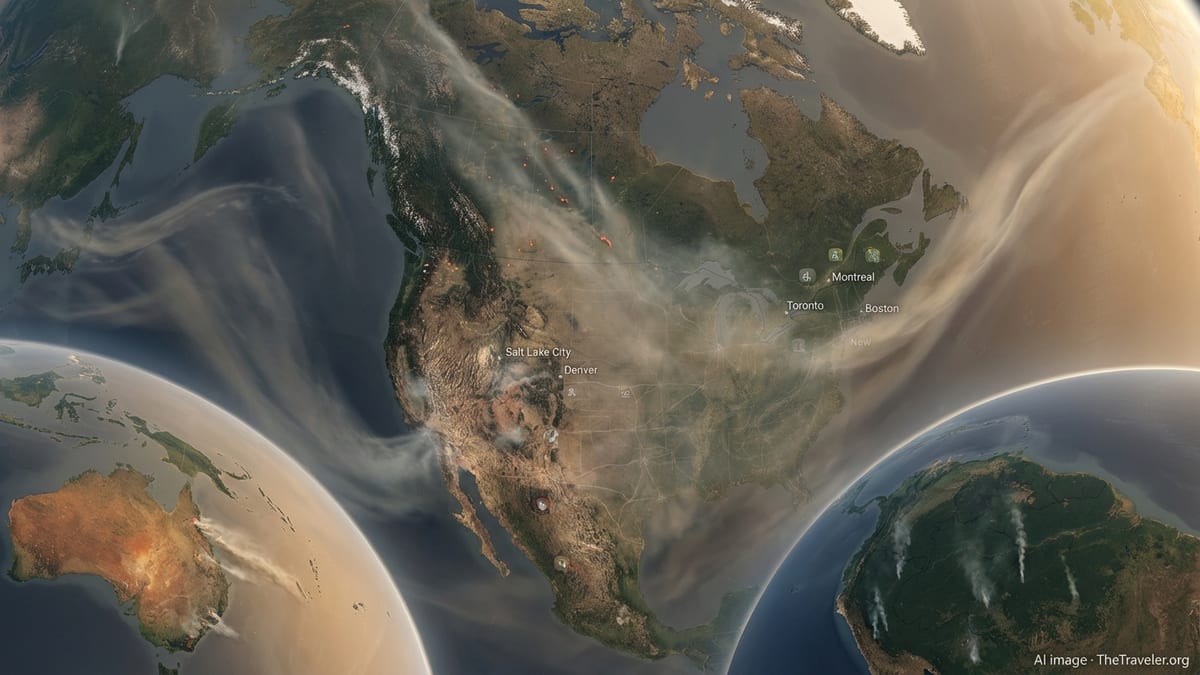
Wall-to-wall wildfire smoke over Canada, the western United States, parts of Brazil’s Amazon and fire-scorched landscapes in Australia and Russia are reshaping how and where people travel.
New scientific and industry reports released in late 2025, combined with a 2026 outlook from fire and climate agencies, draw a stark picture: the world’s biggest tourism markets are entering an era of chronic fire risk, hazardous air quality and sudden travel shutdowns directly linked to a warming climate.
More News
- TSA Rolls Out $45 ConfirmID Fee for Travelers Without REAL ID at Security
- Flying Blue Launches February 25% Promo Rewards on Transatlantic and Regional Routes
- United Fast-Tracks Starlink Wi‑Fi Across Fleet, Free for MileagePlus Members
Canada’s Out-of-Control Fires Push North America Into a New Hazard Zone
Canada’s 2025 wildfire season is emerging as one of the most consequential in modern history, trailing only the record-breaking infernos of 2023 in burned area and carbon emissions. By mid-year, authorities reported hundreds of simultaneous blazes across multiple provinces, forcing mass evacuations, mobilizing the military and drawing in international firefighting crews. Entire communities in Manitoba and Saskatchewan have been emptied at short notice as fast-moving flames cut across highways, rail lines and key power corridors.
The human toll has been felt well beyond the fire lines. Hazardous smoke from northern Manitoba and Saskatchewan has repeatedly spilled into heavily populated corridors in Ontario and Quebec, pushing cities such as Toronto and Montreal into the ranks of the world’s most polluted on multiple days. Environment and health agencies have urged residents and visitors to remain indoors, cancel outdoor events and limit strenuous activity when air quality index values spike into dangerous territory.
South of the border, the same Canadian plumes have smothered huge swaths of the United States. Recent analyses highlight that roughly a third of the continental US has, at times, been affected by smoke from Canadian fires, with tens of millions of Americans placed under air quality alerts. Travel hubs from Minneapolis to Boston have faced flight delays and, in Boston’s case, a temporary ground stop due to low visibility. For travelers, that has meant missed connections, abrupt route changes and lingering health concerns around breathing fine particulate matter in already congested airports.
For tourism operators in Canada, the new fire reality is existential. Lakeside lodges, fishing camps and adventure outfitters in affected provinces are grappling with repeat seasons of closures, evacuations and weeks lost to smoke. Insurance premiums are climbing. Some operators are quietly questioning whether their business models are viable if fires and smoke intrusions continue at this scale in the late spring and summer high season.
United States: From Scenic Getaways to Smoke Zones
In the United States, the 2025 wildfire year has further entrenched a pattern that western states have been confronting for more than a decade: peak tourism months now overlap with peak fire danger. Colorado’s South Rim Fire in Black Canyon of the Gunnison National Park and Utah’s sprawling Monroe Canyon Fire are just two examples of blazes that have forced the closure of prized national parks, the evacuation of campgrounds and the shutdown of scenic byways that are cornerstone draws for domestic and international visitors.
New reporting from travel and tourism analysts shows that wildfire smoke is emerging as a critical driver of itinerary changes, often even when flames are far from major cities. Health advisories in Los Angeles, San Francisco, Denver and Salt Lake City have led visitors to cancel hikes, postpone road trips and rethink long-planned national park tours. In California’s Sierra Nevada region, for instance, counties that depend on summer visitation reported double-digit percentage drops in tourist numbers during 2025, translating into tens of millions of dollars in lost revenue and a sharp fall in seasonal employment.
Airlines, meanwhile, are contending with a changing risk map. Low-visibility conditions linked to smoke have forced reroutings and delays at western and Midwestern airports, and planners are factoring more frequent summer disruptions into their schedule models. Airports and local tourism boards are increasingly under pressure to communicate real-time air quality and fire threat information to passengers who are far more climate risk aware than they were even five years ago.
Economists warn that the cumulative effect on the US travel sector could be profound. As fire seasons grow longer and more intense, businesses in gateway communities from California’s Mono and Plumas counties to Colorado’s Gunnison region face a future where every summer may bring days or weeks of closures, cancellations and refund battles. Those patterns are already reshaping insurance markets, investment decisions and even where tourism workers choose to live.
Australia Braces for a “Highly Flammable” Tourism Summer
On the other side of the world, Australia is entering what officials describe as a “highly flammable” period, with its 2025–26 summer outlook dominated by elevated bushfire risk. Federal and state agencies have warned that long-term rainfall deficits and hotter than average temperatures are priming forests and grasslands to ignite rapidly. Fire chiefs are urging residents and visitors alike to prepare for dangerous bushfires, even in regions that appear relatively green at the start of summer.
Recent weeks have underscored those concerns. New South Wales and Tasmania have already endured destructive fires, with more than 70 blazes burning at one point and dozens of homes lost in coastal and rural communities. Disaster declarations have unlocked emergency funds and housing support, but for local tourism operators, the damage extends beyond physical assets to reputational risk. Iconic coastal drives, wine regions and wilderness retreats risk being recast, in the eyes of would-be visitors, as zones of chronic summer disruption.
Australia’s tourism boards are balancing a complicated message: they want to reassure international travelers that the country remains open and that vast regions are unaffected at any given time, while also being transparent about localized fire danger and evacuation protocols. The experience of the catastrophic 2019–20 Black Summer still looms large, when viral images of smoke-choked Sydney Harbour and red skies over coastal towns prompted mass cancellations and long-term perception damage in key source markets.
Fire and climate scientists in Australia are blunt in their assessment. The combination of a warming atmosphere, accumulated dry fuel and more frequent heatwaves means that bushfires are likely to ignite earlier in the season, spread more quickly and be harder to control. For the travel sector, that means a strategic pivot toward shoulder-season promotion, more flexible booking policies and a greater emphasis on real-time risk communication will not be optional; they will be essential to surviving the next decade.
Brazil’s Amazon: Deforestation Slows as Fire Counts Surge
In Brazil, the latest government data tells a paradoxical story. Between August 2024 and July 2025, deforestation in the Amazon fell by about 11 percent, reaching its lowest level in nearly a decade. Stronger enforcement, expanded satellite surveillance and coordinated environmental policing have been credited with curbing illegal clearing in key hotspots. Yet satellite fire detections in the same period climbed to their highest level since 2010, fueled by extreme drought, residual land-clearing burns and hotter conditions.
This surge in fire activity is visible on the ground in Amazonian gateway cities and ecotourism destinations, where operators offering river cruises, jungle lodges and wildlife excursions report more days disrupted by smoke and heat. While the core of Brazil’s international tourism economy is concentrated in coastal hubs such as Rio de Janeiro and São Paulo, the Amazon has become a flagship for the country’s sustainable travel ambitions. Growing fire risk threatens both the ecological integrity that underpins those trips and the health of visitors drawn to the region’s remote landscapes.
Travel planners are monitoring another dynamic: the political and diplomatic attention focused on Brazil ahead of its hosting of the COP30 UN climate summit in Belém in 2025. With global scrutiny on the Amazon’s fate, authorities are under pressure to not only curb deforestation but also tackle the underlying climate and land-use drivers of wildfires. New restrictions on burning, stricter enforcement along major highways and potential seasonal access limits in the driest months could all affect how, when and where visitors are allowed to move through parts of the rainforest.
For now, health agencies advise that travelers to fire-affected Amazon regions pay close attention to local air-quality updates, especially those with respiratory conditions. Tour operators are being urged to develop contingency plans that can shift activities away from smoky areas on short notice, or temporarily relocate guests to less affected regions when smoke plumes settle over study sites, reserves or popular river routes.
Russia’s Wildfire Frontier and the Northern Travel Shift
Russia’s sprawling boreal forests and Arctic frontier have seen a series of intense fire seasons over the past several years, turning previously obscure regions into recurring features on global wildfire maps. Hotter, drier summers in Siberia and the Russian Far East, combined with melting permafrost and lightning storms, have created conditions where fires burn deeper into peat soils and persist for longer, sometimes smoldering beneath the snow and re-emerging when temperatures rise.
Although visitor numbers to these remote regions are modest compared with Canada, the United States or Australia, they are strategically significant in the context of a warming Arctic. As northern sea routes open for longer periods, cruise operators have begun to market itineraries that skirt Russian and neighboring Arctic coastlines. Increasing fire activity, accompanied by smoke that can drift for thousands of kilometers, complicates those plans and adds yet another layer of risk to already complex polar operations.
Smoke from Russian boreal fires has, at times, contributed to hazy skies across northern Europe and parts of Asia, reminding travelers that these are not isolated local events. Climate scientists warn that the carbon released from recurring fires in peat-rich regions could further accelerate warming, reinforcing a feedback loop that bakes in longer-term fire risk across high latitudes. For Arctic-focused tour operators, the challenge will be integrating sophisticated climate and fire modeling into itinerary planning, vessel routing and guest education.
Diplomatically, data gaps and geopolitical tensions can make it harder for global agencies to track Russian wildfire dynamics in real time. That uncertainty filters down to cruise lines, adventure companies and expedition outfitters, which must rely on a patchwork of satellite feeds, regional reports and on-the-ground partners to assess whether conditions along remote coastlines or inland river systems are safe for travelers.
Climate Science Connects the Dots Between Fire and Travel Disruption
Across these five vast countries, the scientific storyline is remarkably consistent. Agencies from Natural Resources Canada to Australia’s Bureau of Meteorology and Brazil’s environmental monitors point to the same cluster of drivers: hotter than average temperatures, prolonged drought, reduced snowpack and low soil moisture. These factors, themselves amplified by human-driven climate change, are transforming landscapes that were once seasonally wet or cool into fuel beds primed for ignition.
New analyses emphasize that it is not only the flames that matter for travelers, but also the reach of smoke. Fine particles generated by wildfires can travel thousands of kilometers, cross borders and settle over major tourism centers far removed from any active fire. In mid-2025, that was illustrated by Canadian smoke triggering “hazardous” air quality in US cities and even drifting as far as Europe on high-altitude winds. As a result, travelers now must consider air quality in destinations that might never appear in headline wildfire maps.
Health experts bring another layer of concern. Short-term exposure to smoke, even for otherwise healthy visitors, can irritate lungs and eyes, aggravate asthma and cardiovascular conditions and raise hospital admissions. For travel insurers and tour operators, that translates into a more complex risk environment. Policies are being rewritten to clarify what constitutes a wildfire-related disruption, while frontline guides and hotel managers are receiving training on when to recommend masks, indoor activities or even early checkouts.
Meanwhile, climate attribution studies are increasingly able to put numbers on how much more likely certain fire weather extremes are in a warming world. That scientific clarity is beginning to filter into legal cases, corporate disclosure requirements and investor assessments of tourism infrastructure. Resorts built in forested or semi-arid regions, for example, may soon face tougher scrutiny from lenders unless they can demonstrate credible fire-risk mitigation strategies.
How the Travel Industry Is Adapting, From Smoke Maps to “Green Fees”
Faced with this volatile new normal, travel and tourism stakeholders are experimenting with a range of responses. Airlines and online booking platforms are investing in tools that overlay real-time fire and smoke data on route maps and destination landing pages, allowing travelers to see at a glance whether a planned trip coincides with major outbreaks. Some tour operators are marketing “climate-flexible” itineraries that promise alternative destinations or activities if fires or smoke make the original plan unsafe or unpleasant.
Destination managers are also using climate-linked taxes and fees to boost resilience. In the United States, for example, new environmental levies on accommodation in some states are explicitly framed as tools to fund wildfire prevention, forest restoration and disaster preparedness. While controversial among some travelers and industry groups, such measures signal a shift toward recognizing climate and fire risks as core infrastructure issues rather than unpredictable shocks.
At the local level, communities battered by repeat fire seasons are seeking to reframe their tourism offer. Rather than only selling peak-summer experiences, they are promoting shoulder seasons when fire danger is typically lower and air is cleaner. They are also investing in indoor cultural attractions, wellness retreats and food-focused tourism that can continue operating even when trails are closed or vistas obscured by haze.
Insurers and financial institutions, for their part, are becoming more selective. Properties in high-risk fire corridors face higher premiums, stricter building standards or, in some cases, limited coverage options. While painful in the short term, these shifts are pushing hotels, resorts and attractions to adopt more fire-resilient designs, from ember-resistant building materials to defensible landscaping and backup power systems that can operate when utilities are disrupted.
FAQ
Q1. Why are wildfires in Canada, the US, Australia, Brazil and Russia getting so much attention from the travel industry now?
They overlap with major tourism seasons, generate smoke that can spread across continents and increasingly force airport delays, park closures and mass trip cancellations, turning what were once localized emergencies into global travel disruptions.
Q2. How exactly does wildfire smoke affect my travel plans even if I am far from the flames?
Smoke can reduce visibility for aviation, trigger air-quality alerts that lead to outdoor activity bans, close popular trails and viewpoints and create health risks that prompt authorities or operators to scale back tours, excursions and events.
Q3. Are these recent wildfire outbreaks clearly linked to climate change?
Major climate and fire agencies report that warmer temperatures, prolonged drought, reduced snowpack and drier soils, all intensified by human-driven climate change, are making large, intense and long-lasting fires more likely in many of these regions.
Q4. Which popular destinations have seen the biggest wildfire-related tourism impacts recently?
Key examples include Canadian lake and forest regions in Manitoba and Saskatchewan, western US national parks and gateway towns, bushfire-prone areas of New South Wales and Tasmania, parts of Brazil’s Amazon ecotourism corridor and some Siberian and Arctic-adjacent regions in Russia.
Q5. How are airlines responding to the new wildfire risk landscape?
Airlines are incorporating smoke and fire forecasts into route planning, preparing for more frequent summer delays and diversions, and coordinating closely with aviation authorities when low visibility or degraded air quality threatens safe operations at major hubs.
Q6. Should travelers change when they visit wildfire-prone regions?
Many experts suggest considering shoulder seasons, when temperatures are lower and fire danger is reduced, as well as building flexibility into itineraries so trips can be shifted to safer periods or nearby alternative destinations if fire conditions worsen.
Q7. What can individual travelers do to stay safe during wildfire season?
Travelers can monitor official fire and air-quality updates, follow evacuation instructions, carry basic respiratory protection if they have underlying health issues, choose accommodations with good indoor air filtration and remain ready to adjust plans on short notice.
Q8. Are travel insurers covering wildfire-related cancellations and health issues?
Coverage varies by policy, but many insurers now explicitly address wildfires and smoke-related disruptions; travelers are advised to read terms carefully, look for policies that include natural hazard coverage and document any official advisories or closures affecting their trips.
Q9. How are governments using tourism-related revenues to address wildfire risk?
Some jurisdictions are introducing or increasing environmental or “green” fees on accommodations and visitor services, directing those funds toward forest management, firefighting capacity, community resilience projects and recovery efforts in heavily impacted regions.
Q10. Will wildfires permanently change where people choose to travel?
Experts anticipate a gradual shift in travel patterns, with some high-risk summer destinations losing share to regions with more stable climates or robust resilience measures, while others reposition their tourism offerings toward safer seasons and more climate-adapted experiences.