

More news on this day
Raging wildfires across Oklahoma, Kansas and Texas this week have turned key stretches of the Great Plains into active disaster zones, just as the United States struggles to convince the world that it remains a safe, open and welcoming destination after years of political shocks, tariff battles and tougher visa rules.
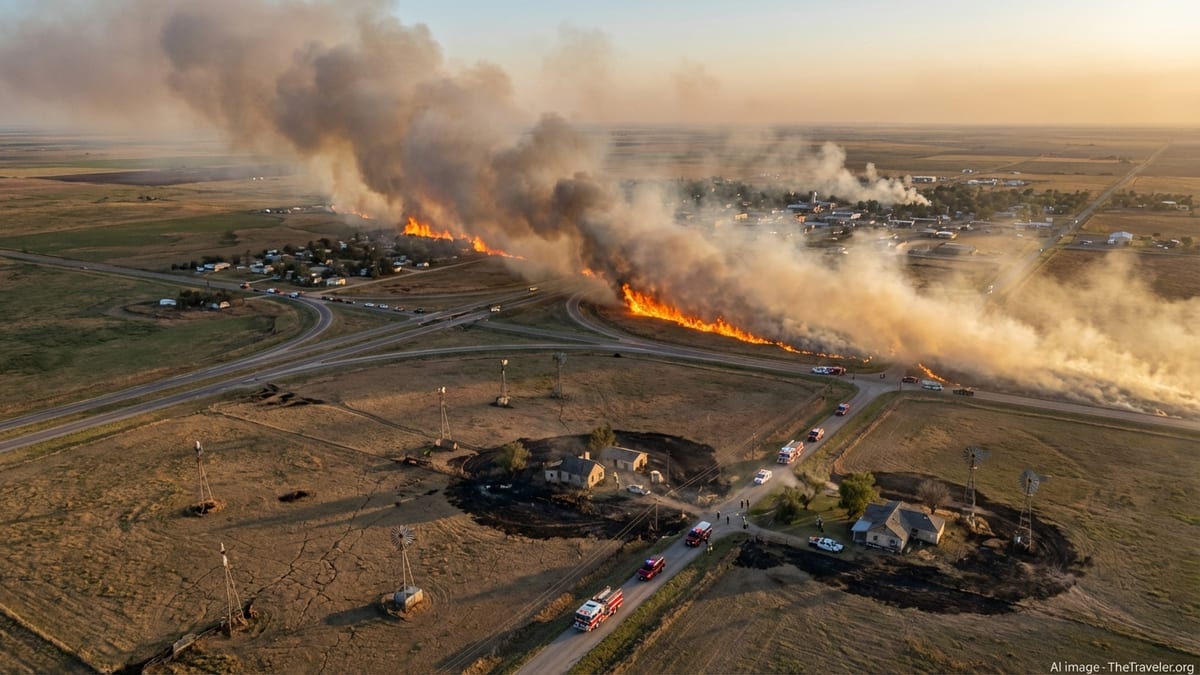
Ranger Road Megafire Puts the Southern Plains on Edge
A sprawling complex of fires led by the Ranger Road blaze along the Oklahoma Panhandle has become the defining emergency of this week’s wildfire outbreak in the central United States. Fed by winds that have topped 60 miles per hour and humidity levels in the teens, the fire has raced across grazing lands and croplands, leaping roads and state lines with alarming speed. By Thursday, officials estimated that the Ranger Road Fire alone had burned more than 280,000 acres, with containment still fragile despite a nonstop ground and air assault.
The fire’s explosive growth since it was first reported earlier in the week has forced incident commanders to prioritize life and property over perimeter control, leaving large stretches of rangeland to burn. Firefighters report flame lengths high enough to make direct attack too dangerous in many areas, particularly in the broken terrain southeast of Beaver, Oklahoma and north into Kansas. Dynamic, wind driven fire behavior has repeatedly grounded aircraft, while blowing dust has further complicated visibility for both pilots and evacuees trying to escape.
Local authorities across the region describe a patchwork of losses that is still being tallied: scattered homes and outbuildings destroyed, power infrastructure damaged, and fencing and water systems critical to ranching operations burned beyond use. Emergency managers caution that the true scope will only become clear when residents can safely return and insurers begin detailed assessments in the coming days and weeks.
The human toll is also mounting. At least four firefighters in northwest Oklahoma have been hospitalized with injuries linked to the firestorm conditions, and exhausted local crews have been reinforced by task forces from across the South Central states under interstate mutual aid compacts. Shelters in small towns from Beaver, Oklahoma to rural Kansas communities are hosting evacuees, many of whom left with little more than a change of clothes and important documents.
Oklahoma, Kansas and Texas Declare Fire Emergencies
As the flames spread, governors across the region moved quickly to formalize emergency measures. In Oklahoma, Governor Kevin Stitt signed an executive order declaring a state of emergency for multiple Panhandle counties after wildfires around Woodward and Beaver counties destroyed homes and forced the evacuation of the town of Tyrone. State officials say more counties could be added if forecasts for continued critical fire weather verify through the end of the week.
To the north, Kansas has been grappling with its own constellation of grass fires since Tuesday, driven by the same dry air mass and punishing winds sweeping the Plains. Governor Laura Kelly issued a state of disaster emergency as conditions deteriorated, and state agencies have activated wildfire awareness campaigns while coordinating closely with local fire districts and agriculture officials. Several small towns in southwest Kansas, including Ashland and Englewood, have seen repeated evacuation orders as the Ranger Road Fire and associated grass fires pushed north of the state line.
In Texas, Governor Greg Abbott recently renewed a sweeping disaster proclamation tied to long running “fire weather conditions” across much of the state and then escalated the readiness level of the State Emergency Operations Center as forecasters warned of a heightened outbreak. The Texas Panhandle in particular has been under a Red Flag Warning, with major incidents such as the Lavender and 8 Ball fires burning tens of thousands of acres west of Amarillo, alongside smaller but destructive fires near communities like Plainview.
These emergency declarations unlock additional personnel, equipment and financial resources, allowing fire agencies to mobilize air tankers, bulldozers, strike teams and logistical support from across the South Central region. They also reinforce burn bans and travel advisories that directly affect visitors who may be driving through or planning to stay in affected areas, from interstate travelers to road trippers exploring historic Route 66 and the High Plains.
Communities and Landscapes Transformed Overnight
On the ground, the images emerging from Oklahoma, Kansas and Texas are stark: fence posts charred into stumps, center pivot irrigation rigs collapsed from heat, and entire pastures blackened to the horizon. Livestock losses are already being reported in Kansas and the Oklahoma Panhandle, where ranchers say they had only minutes to open gates, cut fences and push cattle away from advancing fire lines. Many animals that survived initial flames are now being evaluated for burns and smoke damage.
State agriculture departments and local extension agents are rapidly standing up recovery hubs where farmers and ranchers can report damage, access emergency hay and feed supplies and seek guidance on rebuilding fencing and water infrastructure. Nonprofit groups familiar with disaster response in rural areas are likewise mobilizing to provide both financial aid and emotional support to families facing the prospect of rebuilding operations that have been in the same hands for generations.
In towns brushing up against the fire perimeter, the disruption is no less profound. Schools have shifted to remote or shortened schedules in some districts, while county authorities juggle power outages, road closures and the logistics of housing evacuees who may have lost homes or are unsure if they will have one to return to. The smoke plume has at times degraded air quality hundreds of miles away, triggering health advisories and pressuring officials to prepare clean air shelters for vulnerable residents.
At the same time, the fires are reshaping well known landscapes that form part of the United States’ tourism identity. Scenic ranchlands, wildlife habitat and prairie preserves that attract birders, hikers and photographers are now crosshatched with bulldozer lines and ash. Land managers caution that the ecological impacts will vary widely, with some grasslands capable of rebounding quickly but wooded draws and riparian corridors likely to see longer term damage.
Travel Disruption Across a Key Domestic Corridor
For travelers, these fires are hitting a region that serves both as a destination and a major overland corridor. Portions of highways in southwest Kansas and the Oklahoma Panhandle have faced closures or rolling escorts as visibility plunged due to a combination of smoke and blowing dust. Interstate routes that connect the Midwest with the Rocky Mountains, and link Texas to central and northern states, have seen periods of reduced speed limits and advisories discouraging nonessential travel.
State tourism offices and highway patrols have urged drivers to check real time conditions, avoid stopping on road shoulders near active fire zones and be prepared for abrupt detours. Travel businesses that serve motorists in small junction towns especially those dependent on fuel sales, diners and modest roadside motels report cancellations and dramatically lighter traffic over the last 48 hours. Some properties have temporarily shifted from hosting tourists to sheltering evacuees and relief workers, a role they know from previous wildfire and tornado emergencies.
Destinations within a day’s drive of the affected areas, including city breaks in Oklahoma City, Wichita and Amarillo, are watching closely for any spillover in visitor sentiment. So far, there is little sign of a wave of nationwide cancellations, but regional tour operators describe a spike in inquiries from guests who want reassurance that planned road trips and ranch stays in the High Plains remain viable and safe. Travel agents are advising clients to build more flexibility into itineraries, particularly for shoulder season trips that involve long stretches of rural driving.
Aviation infrastructure in the immediate fire zones remains largely intact, and major airports continue to operate normally. However, the thick smoke columns occasionally drift into air routes used by general aviation and firefighting aircraft, prompting pilots to divert around active sectors and, in a few cases, causing minor delays for sightseeing flights and private travel in the region.
Tourism Industry Faces Yet Another Confidence Test
The wildfire emergency arrives at an awkward moment for the wider U.S. tourism economy. After weathering the “Trump slump” in international arrivals linked by analysts to past travel bans, harsh political rhetoric and a perception of a less welcoming climate for foreigners, America’s visitor economy had been working to rebuild its reputation. Destination marketing organizations have spent the past few years emphasizing inclusivity, diverse cultural experiences and a return to normalcy after the pandemic and trade disputes of the previous decade.
Layered on top of these challenges, tighter visa screening and shifting consular workloads have stretched application timelines for travelers from key long haul markets, dampening demand during what otherwise might have been a robust recovery cycle. Hoteliers and travel executives have noted that, while headline arrival numbers have been improving, some high spending segments particularly business travel from Europe and Asia have remained sensitive to both policy signals and disruption risk.
Now, with images of massive flames and highway evacuations across the central United States in circulation, industry leaders worry about yet another hit to perceptions of safety and stability. Even though the fires are geographically concentrated, the visual shorthand in many international markets is simple: “America is burning.” For potential visitors unfamiliar with U.S. geography, it is easy to conflate scenes from the Great Plains with past infernos in California or the Pacific Northwest and assume that wildfire is a ubiquitous, year round threat.
Tourism boards in states unaffected by the current blazes are already monitoring social media sentiment and search trends for indications that travelers may delay or divert trips. Executives at major hotel groups say they are bracing for short term volatility in booking patterns, especially for self drive holidays and cross country itineraries that crisscross the interior West and Plains states.
Climate Risk, Policy Headwinds and the New Travel Calculus
Beyond immediate cancellations or itinerary tweaks, the Southern Plains fires sharpen a broader question facing both U.S. officials and global travelers: how do climate amplified disasters intersect with politics to influence destination choices. In recent years, wildfires, hurricanes and heat waves have joined immigration and trade policies on the list of variables that tour operators and travelers weigh when they decide where to spend their time and money.
In the United States, that calculus has been particularly complex. The same political cycle that produced contentious trade tariffs and high profile travel restrictions also delivered a patchwork of state level climate policies and resilience strategies. Some destinations have invested heavily in early warning systems, evacuation planning and disaster hardened infrastructure, while others remain more reactive, relying on emergency declarations once crises are underway.
For travel brands selling the American experience to foreign audiences, the messaging challenge is to acknowledge these risks without undermining confidence. Increasingly, brochures and digital campaigns highlight not just iconic scenery and cultural attractions but also safety protocols, real time information tools and traveler rights in the event of disruption. Industry analysts suggest that, over the long term, destinations that can demonstrate both environmental stewardship and predictable rules on visas, tariffs and traveler treatment will be best positioned to capture demand.
The current fires underscore another tension: many rural regions hit hardest by wildfire are precisely those hoping to diversify their economies through tourism, agritourism and outdoor recreation. When these areas suffer repeated climate related shocks, it can be harder to attract the investment needed for visitor infrastructure, from upgraded lodging to trail systems and interpretation centers that could, in turn, support resilience and restoration efforts.
Rebuilding Trust: Messaging, Transparency and Timing
For now, the priority in Oklahoma, Kansas and Texas is clear: protect lives, contain the fires and support affected communities. Yet tourism officials are already looking ahead to the communications task that will follow containment. Experience from prior wildfire crises suggests that timing and tone will matter. If destinations pivot too quickly to promotion, they risk appearing insensitive to residents still sifting through ashes. If they wait too long, they risk losing an entire shoulder season to lingering fear and outdated perceptions.
Industry experts advocate for transparent, fact based updates that distinguish between areas directly affected by fire and those operating normally. Clear, map based communication that avoids sensationalist language can help overseas agents and travelers understand that vast swaths of the United States remain untouched and fully open for business, even as specific communities recover. Local storytelling that highlights both the heroism of first responders and the resilience of residents can also play a role in reshaping narratives.
At the national level, tourism strategists argue that federal agencies responsible for travel promotion and border management should use moments like this to reinforce messages about predictability and fairness in visa and entry processes. Streamlined communication from consulates, coupled with a steady tone from political leaders about the value of international visitors, can temper any renewed anxieties triggered by images of disaster or talk of stricter enforcement.
For travelers considering future trips, the advice from experts is to stay informed rather than deterred. That means monitoring official fire information, purchasing flexible tickets and travel insurance, and choosing itineraries and seasons that align with evolving climate realities. It also means recognizing that, for many rural communities in America’s interior, responsible tourism dollars will be an essential part of the long road back once the smoke clears.